mbulelo smpofu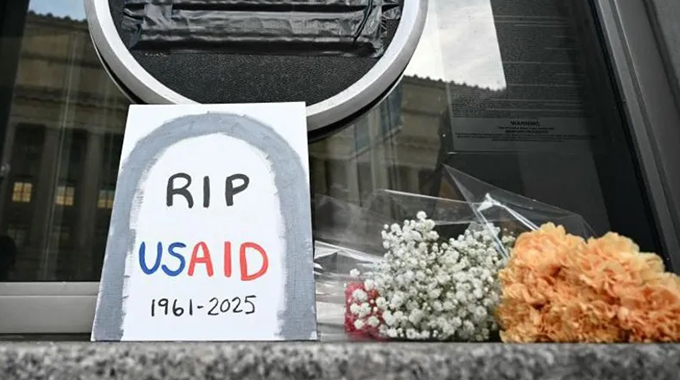
Gibson Nkiyadzino Correspondent
ONE sure thing is that the US under Donald Trump will have no time for Africa. The only interest in Africa that the US will probably have is to advise Africans to look inside, use their resources and find mechanisms that can make them competent and counted in all sectors.
The seismic developments in the aid industry following the January 20 executive order have triggered centrifugal movements with the hope that Africa rethinks on what it truly needs instead of financial aid.
It is unfathomable for foreign financial aid to continue coming through to Africa, with people thinking that it is the ultimate salvation to the current pressing challenges.
Those that are genuinely concerned about Africa should know that the continent does not need financial aid because there exists evidence to show that it does not work.
Consider this, over US$2,5 trillion has been invested in Africa as financial aid between 1960 and 2013 of which no tangible continental benefits have been accrued from it. If this money is adjusted based on inflation, it amounts to US$4,6 trillion within the same period of time.
Alternatively, did you know that as this aid trickles, over 75 percent of the world’s poor today live in Africa compared to only 10 percent in 1970? It means today Africans are in a worse condition than they were over 50 years ago. Sadly, it is projected that by 2030 poverty levels will be at 90 percent in Africa.
This tells a different story about what Africa needs. This continent Africa needs tractors, irrigation and mining equipment, technology, research, skills and scientific initiatives to develop and address its concerns. Unfortunately, that might not be how international politics pans out! It is a cruel game and as it is, Africans are on their own.
Without fear of contradiction, the financial aid industry in Africa is one big constituency that is deceitful! The deceit in that industry is like a honey-comb; so sweet that advocates of that establishment do not get enough of the lies.
These lies are also advanced by the political dynamics of language utilisation and the invention of new terminology aimed at fostering a dependency syndrome in Africa, which has become increasingly prominent within the non-government organisations (NGOs) sector.
Terms such as “sustainable development”, “technical assistance”, “capacity building”, “synergies,” and “experts” are many among the others, which are being misappropriated and misconstrued to align with the interests of the comprador bourgeoisie. These are some of the untruths and pre-truths that grant recipients want to pursue.
A fundamental truth that aid grant recipients know and admit is that international aid and other extended loans are a form of imperialism.
These financial extensions are not designed to lift nations out of poverty. Rather, they are subtly yet overtly designed to perpetuate an endless cycle of reliance on foreign powers. Burkinabe revolutionary, Thomas Sankara, once criticised foreign aid extensively.
“Imperialism is a system of exploration that occurs not only in the form of brutal guns that come to conquer territories. Imperialism often occurs in more subtle forms such as loan, aid and blackmail. We’re fighting this system that allows a handful of men to rule all of humanity,” he said.
When it comes to aid, what Africa is dealing with is a form of expression of soft power and a tool of foreign policy that has been sustained in various discourses for a long time such that many believed it, until a time the taps were closed.
Now that the US has paused on foreign assistance, particularly to developing nations, the outcry resulting from this reflects how over the past 60 years many have depended on foreign assistance to “move themselves from poverty”.
The decision by the Donald Trump administration serves as a wake-up call for Africans to stand on their own; to reflect their sovereignty by their ability to stand and fund critical sectors, improve the livelihoods of citizens and leverage mineral and natural resources to aid socio-economic transformation initiatives.
Neither the US nor any country in the world has an obligation to give aid to Africa and Africans at the expense of its citizens. Aid, historically and in contemporary times, has never and will not create any conducive environment that will turnaround any economy, grow any country’s gross domestic product (GDP) or improve its purchasing power parity (PPP).
Where aid is directed means there are some interests that are beyond humanitarian that will be at stake. For instance, the majority of the United Kingdom’s aid is directed towards nations that are either developing markets, like Nigeria, or nations that are deemed to have significant geopolitical worth, like Syria and Pakistan, both of which are crucial to the “war on terror”.
The same is true for the US, which provides the majority of its aid to Israel, Egypt and Jordan, with the main goal in each nation being to support US geopolitical objectives rather than to reduce poverty. Therefore, by pausing aid, the US seeks to re-assess geopolitical compass and determine whether in its “Make America Great Again” policy, Africa will be a useful partner.
There are also proponents of financial aid in Africa who have for a long time been used to entrench the dependence syndrome. It is not new that among Africans, there are some who act on behalf of the oppressor to secure their interests.


 Online Reporter