

 Online Reporter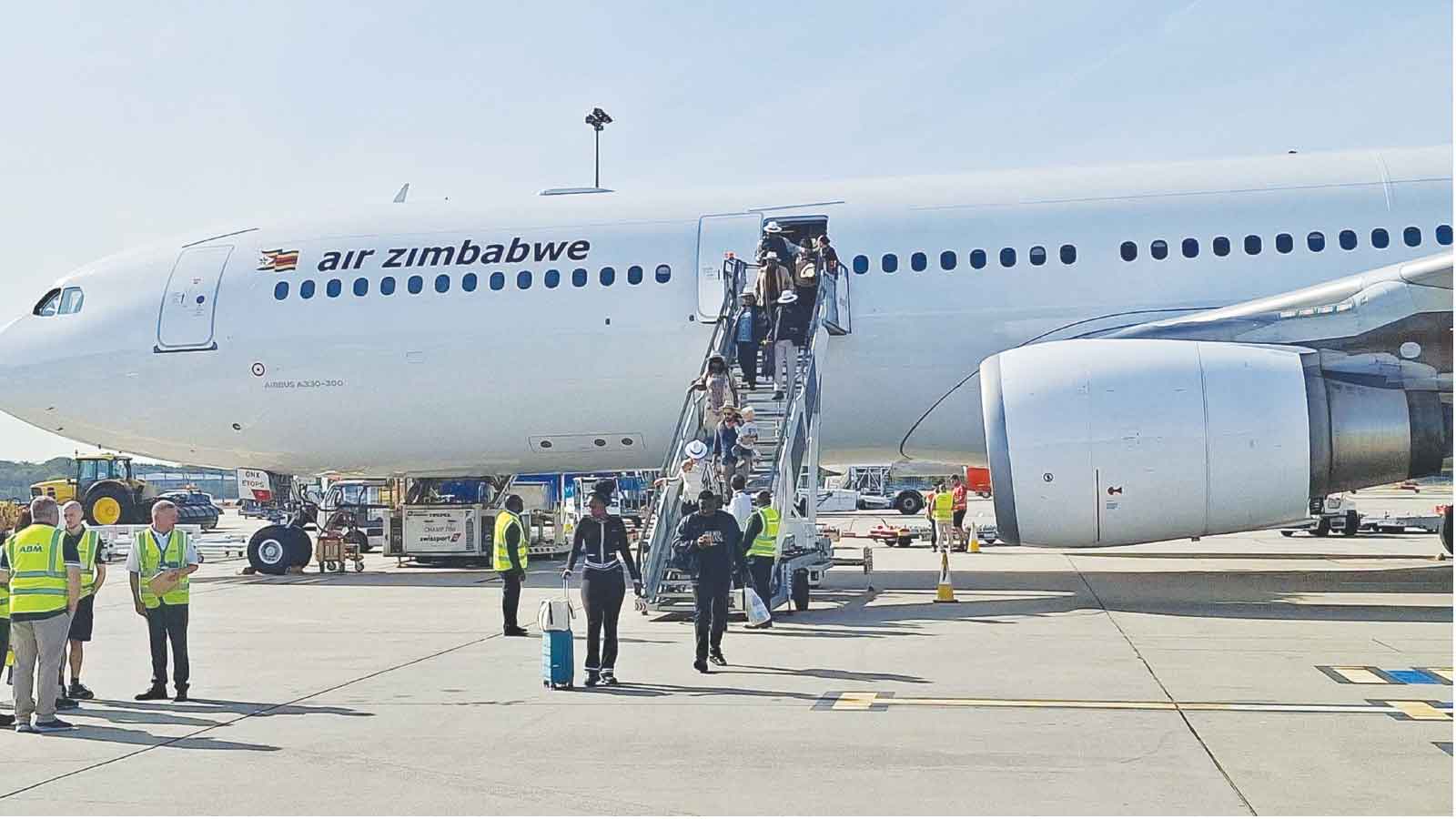
Hebert Zharare
Day Editor
Air Zimbabwe’s leased aeroplane landed at Gatwick International Airport in the United Kingdom on Thursday last week—successfully relaunching the famous direct Harare-London route.
While world businesses people, Zimbabweans included and some Diasporans view this as a huge relief given that they can now fly 10 hours straight into Harare from London and vis versa, prophets of doom viewed this development to the contrary.
There are some who on social media claimed the aeroplane was too small for the route, while others tried to brew some fictious stories, all meant to discredit the deal.
The route is being operated using an Airbus A330-300 aircraft under an Aircraft, Crew, Maintenance and Insurance (ACMI) wet lease agreement with Spanish carrier, Plus Ultra Líneas Aéreas.
Under the arrangement, Plus Ultra provides the ACMI, while Air Zimbabwe will oversee ticket sales, passenger services and commercial operation of the route.
Yes, for a company that has been away from the route for over a decade, also where huge players had consumed a huge chunk of the market, the national carrier’s arrangement is the perfect fit. And surely, the airline has a few challenges to battle with.
However, to prove that the resumption of the flights will be sustainable, a number of factors including the overwhelming bookings of about 1500 passengers just upon the announcement of the resumption of the route speaks huge volumes of the success.
The relaunch of this critical destination for Air Zimbabwe is central to Zimbabwe as one of the many steps to cement relations with Britain, strengthening His Excellence, President Mnangagwa’s mantra that Zimbabwe is a friend to all and an enemy to none.
Key benefits immediately accruing from the relaunch of the flight include improved route connectivity to other European destinations by businesspeople and tourists, trade and investment boom between Harare and London, a destination playing host to Zimbabwe’s Diaspora communities.
By virtue of Britain and Zimbabwe’s relations spanning over a century, the two countries have a lot in common including language, technologies and even infrastructure resemblance.
According to GOV.UK, trade between Zimbabwe and Britain reached $483 million for the four quarters last 2025.
Breaking the trade figures, the total UK exports to Zimbabwe stood at around US$250 million, while UK imports from Zimbabwe was about US$280 million.
Zimbabwe exports, according to GOV.UK during the period under review included edible fruits, nuts and vegetables, iron, steel, precious stones, metal ores and high-grade flue cured tobacco.
The UK exports included cars, road maintenance vehicles, general industrial machinery and medicinal or pharmaceutical products. Economic players are unanimous the reintroduction of the Air Zimbabwe flight with a cargo belly space of over 33 000 kg and possibly an additional plane depending on market’s reception is likely to see more freight of fresh produce and other key products landing in Britain cheaper and faster.
Last year, fresh horticulture products contributed 37 percent of Zimbabwe’s total exports to the United Kingdom, which has an overall value of US$21.26 million.
According to ZimTrade’s 2025 statistics, major shipments included blueberries, citrus fruits and fine vegetables like sugar snap peas and beans, products that are highly perishable and need cold value chains and fast movement.
There are also many other factors promoting the potential increase in volumes of passengers and cargo to and from the two major destinations.
So far research shows only two Southern African countries – South Africa and Zimbabwe have direct flights to Britain, opening vast opportunities for Air Zimbabwe to tap into Mozambique, Malawi, Zambia, Botswana, Namibia among others in both passengers and cargo.
Players such as Ethiopian Airlines move huge passenger volumes annually to the UK, but via long route through Addis Ababa.
But due to closeness of Air Zimbabwe to Southern Africa’s regional aviation hub, O R Thambo International Airport that for long hQas been connecting the region with Europe, the national carrier has huge potential to grab its fair share of travelers and cargo.
According to Travel News, just last year, Ethiopian Airlines was the largest indirect carrier for passengers between the UK and South Africa, serving about 39 000 passengers, just overtaking Emirates’ 38 000 passengers.
Its London Gatwick route saw about 14 000 from the Johannesburg market alone, and its London Heathrow route from Cape Town served over 14 200 travellers. The airline also transported a combined 15 800 passengers from South Africa to Manchester City.
There is no doubt some of these travellers are from the SADC region that had to endure long flights to South Africa to connect to UK and definitely these are now potential market for Air Zimbabwe.
South Africa is currently shaking, receiving unfavourable world publicity following recent xenophobia reports and Air Zimbabwe has to take advantage of that and present self as the best sustainable alternative.
Speaking to reporters on arrival at Gatwick International Airport, Transport and Infrastructure Development Minister, Felix Mhona said: “This is a proud moment for Zimbabwe and a significant step in reconnecting our country with the world. The return of Air Zimbabwe to the London route strengthens tourism, trade, investment and diaspora links.
“Any farmer would want the shelf life to be shortened when you are talking of perishables. We transport overnight and, in the morning, when shops open, they deliver.”
And while writing for our sister publication, The Sunday Mail, ZimTrade chief executive officer, Mr Allan Majuru, said horticulture was the sector best positioned to benefit immediately from the restored service.
“Horticulture is the first sector that should respond because time is part of the product for exporters of perishable products,” Mr Majuru said.
“Zimbabwe already exports blueberries, citrus, peas, vegetables and other fresh produce to the UK. The country’s climate allows growers to supply during periods when British and European production is lower, particularly in autumn and winter.”



