

 Online Reporter
Sukulwenkosi Dube-Matutu, [email protected]
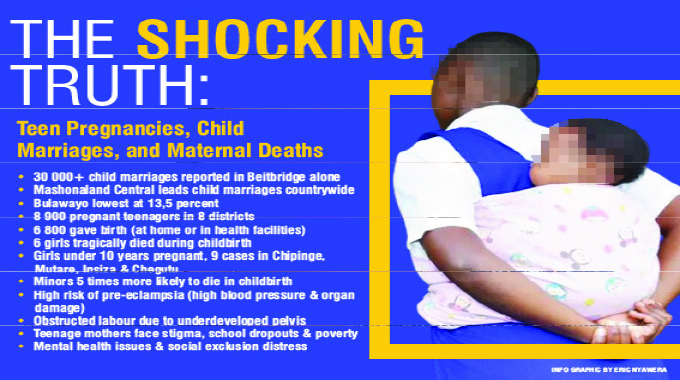
OVER 8 900 teenagers, including girls under the age of 10 fell pregnant in 2024 across eight districts in Zimbabwe with 6 800 giving birth either at home or at health facilities while six tragically died during delivery.
The alarming statistics were revealed during the “Not in My Village” campaign, which was piloted in Chipinge, Mutare, Goromonzi, Murehwa, Hurungwe, Chegutu, Beitbridge and Insiza districts.
Data from the Ministry of Health and Child Care highlights the severity of the issue where nine children under the age of 10 became pregnant in Chipinge, Mutare, Insiza and Chegutu. The districts also recorded significant numbers of antenatal visits and deliveries.
Chipinge recorded 1 665 antenatal visits, 1 755 deliveries, Mutare had 1 323 antenatal visits and 836 deliveries, Goromonzi recorded 1 160 antenatal visits and 361 deliveries while Murehwa recorded 723 antenatal visits and 653 deliveries.
In Hurungwe, 1 683 antenatal visits and 1 560 deliveries were recorded. In Chegutu 1 196 girls accessed antenatal visits while 836 delivered. In Beitbridge there were 659 antenatal visits and 542 deliveries, Insiza had 504 antenatal visits and 309 deliveries.
In a presentation made on her behalf during a “Not in My Village” chiefs’ orientation training workshop in Gweru by Masvingo provincial mental health officer, Ms Martina Nyazenga, Special Rapporteur for Children Without Parental Care in the Africa Union, Commissioner Anne Musiiwa, said many cases in districts were not being reported.
She said there is a need for stakeholders to assist in identifying these cases to fight teenage pregnancies and child marriages.
Comm Musiiwa said teenage pregnancies have severe physical, psychological and social effects on children.
“A child’s body is still growing and pregnancy adds additional physical, psychological and social stress. Their brains, bones and muscles are not fully developed, which can make labour and delivery more complicated,” she said.
“The pelvis, for example, may not be fully developed, increasing the risk of obstructed labour.
Comm Musiiwa further noted that girls under the age of 15 are five times more likely to die during childbirth than women in their 20s.
She said beyond health concerns, teenage mothers, particularly in rural areas, face stigma, social exclusion and reduced economic opportunities. Many drop out of school and struggle to reintegrate into society.
“Children who are pregnant are at an increased risk of developing pre-eclampsia (high blood pressure and organ damage. Young mothers, particularly those who are under the age of 18, often face judgment and stigma from their peers, families, and communities,” said Comm Musiiwa.

“They may be labelled as irresponsible or as a ‘bad influence,’ which can result in social exclusion. This isolation can also affect their mental health and self-esteem.”
Statistics have also shown that teenage pregnancies and child marriages are rampant, particularly in rural, resettlement, mining and border areas.
In Hurungwe and Chegutu, about 30 percent of adolescents were married before reaching 18 years. Murehwa District recorded 2 976 child marriages in the past year, while Goromonzi had 1 048 cases.
Beitbridge recorded over 30 000 child marriages, the highest in the country while Insiza recorded 20 872 cases. Chipinge has 12 863 cases of teenage pregnancies and child marriages combined.
According to the 2019 Zimbabwe Multiple Indicator Cluster Survey (MICS) Mashonaland Central has the highest child marriage prevalence rate at 50 percent, followed by Mashonaland West at 41,7 percent, and Mashonaland East at 37,8 percent and Manicaland at 36 percent. Masvingo is sitting at 35,5 percent followed by Matabeleland North at 32,9 percent, Midlands at 30,4 percent, Matabeleland South at 22,2 percent, Harare at 21,7 percent and Bulawayo with 13,5 percent.
Speaking at the same meeting Ministry of Women Affairs, Community, Small and Medium Enterprises Development deputy director, Ms Matildah Singende, said other challenges faced include low reporting of cases of child marriages and failure to locate the survivors so that they can access help.
She said some families do not cooperate in cases of child marriages while other cases are reported late after the marriage has failed.
These startling figures have prompted urgent action from community leaders and stakeholders.
The Government, in collaboration with the United Nations Population Fund (UNFPA), is spearheading the “Not in My Village” campaign. The initiative is youth-led, driven by the Young People’s Network on Health and Wellbeing (YPNHW), in partnership with NAC. The campaign which was was launched at Nzvimbo High School in Mazowe District, Mashonaland Central last year, is now expanding to Matabeleland South, Manicaland, Mashonaland East and Mashonaland West.
The fight against teenage pregnancies and child marriages aligns with National Development Strategy 1 (NDS1), which aims to create a prosperous and empowered upper-middle-income society by 2030.
However, experts warn that without stronger enforcement of laws, community education and improved access to reproductive health services, child pregnancies crisis may worsen. @DubeMatutu


