admin
admin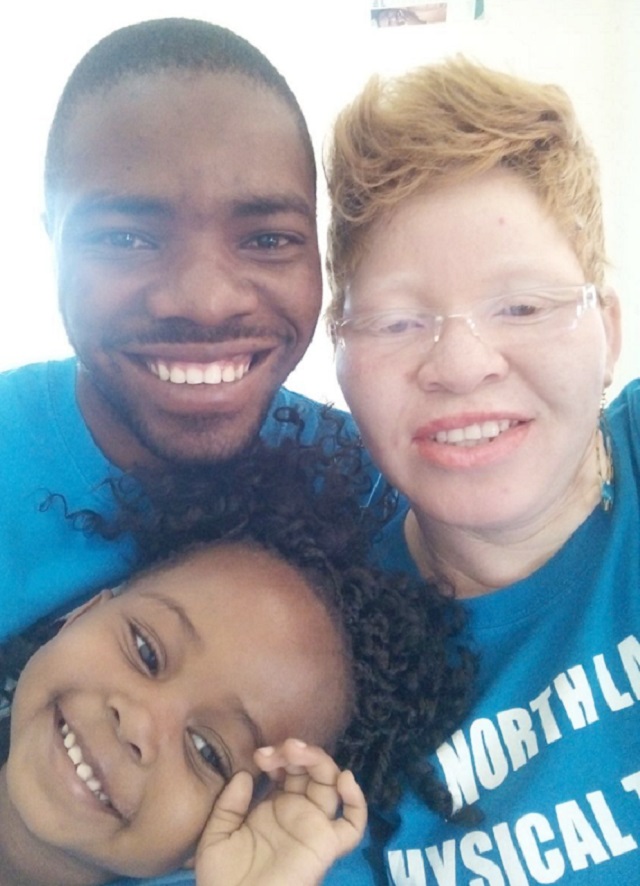

Robin Muchetu
ALBINISM is not by choice, no one gets to pick how they are born but people are born different in their own little ways and have to live with it. This is a philosophy that one Bulawayo couple has lived by over the years.
Dr Brian Takayidza (29) a Hospital Medical Officer at Mpilo Central Hospital defied the odds when he walked down the aisle with Tryagain, a 26- year-old woman who is living with albinism.
Albinism is a relatively common genetic condition in Zimbabwe. Those affected have little pigment in their hair, skin or eyes, in sharp contrast to the normal dark pigmentation.
“I met my wife in late 2012, we were final year students at UZ. I was studying Medicine and she was studying Political Science.
We met through a mutual friend and her confidence extremely attracted me to her. We got to know each other over time and although she initially wanted us to be just friends, we eventually became more and got engaged in 2013 with the assistance of our pastors at Dutch Reformed Church and in 2014 January we got married,” said Dr Takayidza.
Society has branded people with albinism as outcasts in some cases. They are regarded as vulnerable and not much of achievers but Mrs Takayidza is a force to reckon with and an inspiration to many.
Coming from a family of four, three who are living with albinism, Mrs Takayidza said she had a burning desire to excel as she was growing up. She is intellectually gifted too with a degree in Political Science. She sees nothing stopping her from achieving her goals as she strives to live a normal life like others and not let the albinism tag pull her down.
She said people make conclusions about albinos because they lacked knowledge about the condition but she had received support from her family and friends over the years.
“I have a good support system and it has led me to be where I am today. When we first started dating, I did not want to trust him because I had heard that men want to experiment with ladies who have albinism. I was scared and preferred friendship with him,” she said.
She, however, gave it a thought and persevered.
“I prayed about it, realised that he was serious about me when we got engaged, my friends did not believe that a doctor would want to marry a person with my condition and they thought only someone with some kind of disability would fully understand me,” said Mrs Takayidza.
The couple then started a love relationship which resulted in a marriage in 2014.
Mrs Takayidza said some people told her that men sleep with albinos so as to cure HIV or any other illnesses that they may have which she dismissed as untrue. There are a lot of misconceptions about albinism. Fortunately in Zimbabwe these are not as extreme as in other countries. In some cultures in Tanzania for example, albinos are killed and their limbs taken for traditional healing purposes as there is a belief that there is charm and luck in albino body parts.
People generally think that someone with albinism can easily be taken advantage of, or are incapable of rationale thought and are therefore unable to compete with other people in anything but recent reports have sought to debunk the misnotion and point to the competitiveness of people living with albinism — Mrs Takayidza being one such example.
“I remember in primary school, feeling like I was very different from other children and some teachers who were not trained in special needs education secluded the albino children from most class activities, especially in sport, without the full knowledge that if I got sunscreen or wore long sleeved clothes, I would be as active as the other children on the playground,” she said.
She said she was then limited to doing other indoor activities and as a result had low self-esteem.
Mrs Takayidza said society needed awareness campaigns, so that they understood that there’s no difference between people living with albinism and the rest of the population.
The biggest challenge that she noted for people with albinism is that sunscreen is expensive, which is why most people with the condition suffer from skin problems, leading to the society stereotyping them. Most people cannot afford the sunscreen lotions.
The doctors’ wife is a volunteer at Alive Albinism Initiative, a voluntary organisation that carries out awareness campaigns and seeks donations for people living with albinism, so that children with the condition get access to sunscreens and sunhats.
They work closely with ChildLine to assist children with sunscreen so that they prevent getting skin cancer since their skin is more sensitive than most people’s.
Another challenge for people with albinism is poor eyesight. From birth, someone with albinism suffers from poor eyesight, some are near sighted and end up needing spectacles with a tint to protect them from the sun’s rays. The Takayidzas’ are proud parents of one daughter Makatendekashe.
“Our daughter was born without albinism and that’s one thing that people were waiting to see when I was pregnant — whether my child would have the condition or not. That’s another thing that people do not understand, that someone with albinism can have a child without albinism, however, if both parents have albinism, there is 95 percent chance that the child will have it too but it is not always the case,” she said.
Mrs Takayidza has a twin brother who also has albinism. She said her key message to people with albinism, especially to women was to keep their self-esteem high and stay positive especially when it comes to marriage and education related matters.
Dr Takayidza said there was no difference between people with albinism and those without.
“It’s just a matter of difference in skin pigment but we think the same, we feel the same, and should therefore treat each other the same. Also taking advantage of anyone because of their disability or condition is plain cowardice. Be considerate. And when you do get involved with someone with the condition, it’s up to you to defend them among your family members and friends and prove your love,” he said.
Dr Takayidza said when he initially started a relationship with his wife he had no challenges with his peers as they were all from the medical field who understood fully what albinism was.
The legislator for Bulawayo Metropolitan Province, Jasmine Toffa, assisted the albino community recently with sunscreen during the International Day of Albinism.
In Bulawayo she said the community has been given a place to work in at Mpilo Central Hospital where they occasionally have talks and workshops concerning people living with albinism.
Hon Toffa said communities need to understand that albinism was not a curse but can happen to anyone. She said people also do not know that there were albinos in all races, it was not restricted to black people only. Zimbabwe has an estimated 17 000 albinos.



 Online Reporter