daniel chigunwe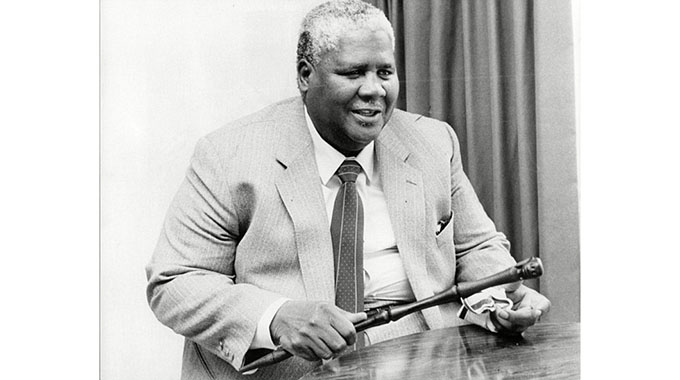
Pathisa Nyathi
IT is that time again when we remember with fondness and deeply cherish the good deeds of our liberation icon, Dr Joshua Nkomo, who was one of the founders of Zimbabwe’s protracted campaign for freedom, independence and economic empowerment.
Dr Nkomo was undoubtedly among the very few to volunteer and commit themselves to leading the struggle that culminated with the granting of independence in April 1980.
His numerous legacies today stand like some colossus on a lofty pedestal. Temporal events have, for ease of humanity’s comprehension been perceived as occurring in cyclic arrangements.
One could say the movement of time allows for the repetition of some worthwhile events whose tendency is to reiterate and enhance our commitment, rededication and renewed pledges to high values, principles to commitment to cherished values and principles.
The first of July every year marks that fateful day when Nkomo transitioned to the spiritual realm, leaving behind a proud and illustrious legacy and heritage of unparalleled sacrifices and iconic political struggles that were not only to current and future generations in Zimbabwe, but indeed to the continent of Africa and beyond.
He established himself as a selfless leader par excellence who chose to lead at a time when holding some political post in black struggles, did not promise monetary or material benefits. Rather, it was a selfless dedication to the cause for freedom of the oppressed African majority.
Several factors are attributable to the cultivation and development of Dr Nkomo’s character and the political giant that he would turn out to be.
Colonisation and its aftermath created conditions that were political, economic, social and educational that impacted on his life and conduct. Of course, his innate traits equally played a complementary role in moulding and preparing him for the roles that he later played in his life.
As a child, he, his siblings and his parents experienced massive and cruel land alienation. That inevitably shaped the sort of Dr Nkomo that we got to know and admire as a charming and never-say-die nationalist and freedom fighter. He and his parents lived at Tjimali towards the southern part of Matobo Hill. That had followed removals from nearer Bulawayo where they had lived under Umncwazi Village/Regiment under Mtotobi Mlilo.
There was no debate or consultation about their evictions. They were to go whether they liked it or not. Land dispossessions started closest to Bulawayo.
As far back as 1894, two reserves were set up for resettling defeated Africans. The two were Gwayi (Tsholotsho) and Shangani (Nkayi and Lupane). At the end of 1893, two farms had already been pegged. These were Reigate and Umvutshwa, a short distance to the north of Bulawayo. To the south, the same process took place. Land was being appropriated, especially after the end of World War II.
Whites returning from the war were eager to try their hands in agriculture that, by its very nature, required large swathes of land to work on. Mineral exploitation had proved not to be as successful and profitable as had been envisaged.
A new reserve was created to the south of Matobo Hills. It was named the Shashane Tribal Trust Land and encompassed areas such as Zamanyoni, Donkwe-Donkwe, Mbembeswana and Mloyi, inter alia.
By 1912, Africans were being evicted from areas to the north to create land for whites, especially for the Afrikaner stock that was discriminated against by the English who were giving themselves prime land.
In that year, Chief Mdilizelwa Fuyana, son of Maphisa, who had, during the heyday of the Ndebele State, been recruited into Imbizo Regiment, led his evicted subjects to settle in the new Shashane Tribal Trust Land. There, the Nyongolo family went to settle. The climate and soil quality were very different in comparison with Tjimali. Land alienation was to become one of the prominent rural grievances.
Education provision for Africans was not a priority to the colonial government. A social facility was not attended to until the mid-1940s when Mzilikazi Primary School was opened in 1945. In the towns, education provision was left to the whims of the numerous Christian denominations.
The Anglican and Roman Catholic churches pioneered the establishment of black schools in Bulawayo. These were St Columba’s and St Patrick’s, respectively.
It was worse in the Tribal Trust Lands (TTLs). Dr Nkomo would attend a primary school belonging to the London Missionary Society (LMS). Back then, there was no secondary school that he could attend. Before the outbreak of World War 1, an idea had been mooted to establish industrial schools for Africans.
For a while, the idea was abandoned until its revival by HS Keigwin after World War 1 resuscitated it after the cessation of the war. Domboshawa was the first to be established followed two years later by Tsholotsho. To Tsholotsho Dr Nkomo went.
South Africa was a favourite destination for blacks who sought higher academic qualifications. Dr Nkomo went to enrol at Adam’s College and Hofmeyr. There, he would realise that salary scales between whites and blacks for the same jobs were different. Despite possessing the requisite qualifications, he would face more racial discrimination in the job market.
He worked as a social worker for the Rhodesia Railways. He also worked for a white bakery where a young woman who was junior to him earned a higher salary because of her skin colour. It was exposure to the colour bar that saw Dr Nkomo joined the trade union movement.
Blacks were not considered as workers. Consequently, qualified black workers were discriminated against and not allowed to establish trade unions in the various trades. This was yet another influence that irked Dr Nkomo who realised the oppression and repression of blacks. Despite campaigning for improved conditions at workplaces, no progress was made.
It was disgruntled trade unionists such as Dr Nkomo that pushed their struggles a notch higher. Now they were demanding independence at a time when Africa was beginning to decolonize. In 1957, Ghana, under the leadership of Prime Minister Kwame Nkrumah got her independence. That served as an impetus for the rest of Africa to follow suit.
On the 12th of September, the first truly national political movement for blacks was established at the Mai Musodzi Hall in Harare Township (now Mbare). Several individuals were approached to lead the movement. Many declined, including Enock Dumbutshena and Ruredzo. Dr Nkomo stepped forward and accepted the onerous mantle. Nationalist parties, one after another were proscribed.
After the split the nationalists faced detention. Dr Nkomo and colleagues from ZAPU were detained at Gonakudzingwa for a lengthy period of 20 years. Nkomo will always stand as a towering figure on the political landscape of Zimbabwe. He is recognised as the everlasting torchbearer in the struggles for freedom and justice. For that, the future generations shall be indebted and remember him fondly on the 1st of July of each year.


 Online Reporter