admin
admin
Innocent Choga Fitness
An ideal exercise programme depends on one’s needs and level of fitness. The physical activity that one takes part in might not provide a balanced workout so at times there is need to balance out one’s programme by adding a few exercises to the core activity.
The selection of exercises and intensity of exercises depends on the facilities that are available for an individual to use. The crafting of a logically designed training routine, the combination of body parts, the selection and sequence of exercises makes a big difference in consideration of the benefits that one can enjoy in the gym.
This week I would like to go a bit technical. I have to answer two questions that were presented to me a few weeks ago. The first question is on what are the other exercises one can do at home to compliment their running schedule and have a complete body work out.
Running works out the thighs and calf muscles directly. After running one can do press ups; these work all the chest muscles, front shoulders and all triceps muscles. By clenching the fists tightly one will also involve the forearms. Doing the press ups in between chairs enables one to get a full stretch.
The next exercise one can do is pull ups, one can select a firm branch on a tree and pull up the branch, or if this is difficult, clasp hands around a tree trunk and pull yourself towards the tree trunk. Pull ups work all the back muscles (excluding the lower back) , rear shoulders and forearms.
To work the side shoulder simply raise the arms laterally to the side and bring them back to the body and raise them again for the required repetitions.
One can combine this with a squat as one raises the arms. To round up the shoulders one should just do shrugging movements for the trapezius muscle, this can be combined with calf raises on the spot.
The next exercise one can do is the leg raises for lower abdominals; these can be done on the ground. Then abdominal crunches for upper abdominals.
One can the round off the abdominal work with conventional sit ups for a total abdominal work. After that one can do the good morning exercise for lower back and hamstrings. Just stand legs apart, bend your trunk and try to touch the ground and raise your trunk, repeat for require repetitions.
The final exercise is the side raises or trunk twists for the waistline. These exercises can be done in a fast mode since one is exercising using body weight the slow mode can be boring.
The outdoor workouts are also great, because of the increase in the uptake of oxygen; the training can turn into aerobic sessions. This simple workout gives you a total body conditioning and can take twenty minutes at the most depending on one’s fitness levels and the intensity.
The second question is a gym training related question. It requires me to explain what is meant by push/pull, opposite and adjacent muscles training routines.
The push/pull system is meant to give adequate rest to the arm muscles and protect the elbow joint. The arm muscles are indirectly involved in all the upper body muscles exercises and we still have to work them directly as well.
For example when we train the chest muscles we push with the triceps, when we train the shoulders the triceps are involved in the basic shoulder pressing exercise and we still have to train the triceps directly.
So the triceps is involved in all pressing exercises .If one trains chest today, shoulders tomorrow and triceps the day after, the triceps will be involved for 3 consecutive days without rest.
This overuse of the triceps muscles can result in the injury of triceps or elbow joint. The over-training also means less growth of the muscle for the body-builder.
Back muscles and biceps are contracted by pulling exercises. If you work the back today and biceps tomorrow; the biceps will work for two consecutive days without rest.
The idea is to combine muscles that contract by the pushing action together, and train them one day. The next day you group muscles contracted by pulling and train them whilst the pushing triceps are resting.
This optimises the triceps’ strength for its next workout and rests the elbow joints. For the body-builder it also means the triceps has a chance to grow.
The same goes for the biceps. Biceps and triceps are small muscles and unlike the calves and forearms they cannot endure extensive daily workout.
The calves and forearms by nature are used extensively in all our daily chores and their muscle fibers are so dense they have the endurance to withstand daily workouts.
The opposite muscles system combines opposite muscles and brings extra blood to the two muscles situated in the same direction. An example is the chest and back relationship. A tie in exercise for the muscle group is the pull over exercise.
This exercise works both the chest and the back. It ties in the muscles between the chest and back, that is the serratus and the latissimus dorsi muscles. Since weight training is an anaerobic.
This means oxygen is not involved in energy production, but it comes in when we rest.
This means extra blood is required to flow into these two opposite muscles at the same time. In weight training blood should not flow haphazardly but in a logical manner to get the best from our workouts. As body-builders we grow when we rest because blood with nutrients and oxygen are pumped in when we rest taking out the lactic acid (which causes pain) as waste and thus taking away the pain caused by intense training.
This is exactly the logic behind the adjacent muscles technique .The muscles are neighbours, they join each other and therefore blood flows into the same direction and tie in exercises work best when neighbouring muscles are trained in the same workout.
For this I will give an example of the shoulder and back muscles. The trapezius is part shoulder and part back therefore the exercise upright rowing is a good tie in exercise that links the back and shoulder muscles and gives them a perfect aesthetic look.
The choice and sequence of exercises is a very important aspect in training. Personally I will select a basic exercise that combines all the parts of a muscle and then select one exercise for each muscle head.
For example for chest I will start with the basic exercise, the bench press. Because all the chest muscles are involved one is able to lift heavy weights.
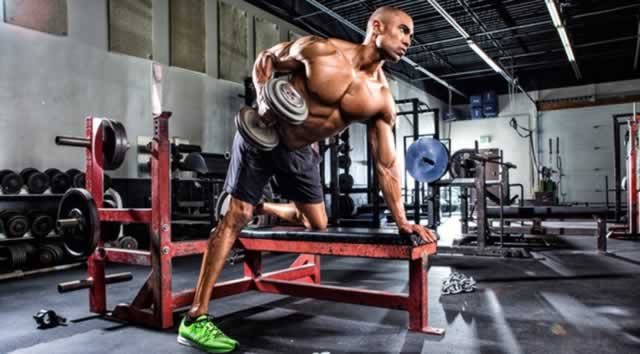
Next I will do the incline press that isolates the upper chest, followed by the decline press for lower chest then flyes for inner chest last is pullovers for outer chest and chest/back tie in.
If one has a weak part of a muscle it is wise to exercise that weak head first and then go to the basic exercise. This system is called the pre exhaust, because you exhaust the weak area and then because all the other muscles assist in the basic the exhausted area will benefit the most and catch up with the other parts of the muscle.
Exercising at a high level is all about identifying problems and solving them. This is what makes training exciting.
There is also need to avoid duplication and use that energy to work other areas. For example doing barbell bench press, then machine bench press and dumbbell bench press is duplication; three exercises doing the same thing.
One could vary their workouts by incorporating each of these exercises separately for the next three workouts.
As for the for the manner of doing exercises, I always recommend strict form and fairly slow movements, unless one is training with weights as a supplementary activity for another sporting discipline that requires forceful or explosive movements.
A full range of motion is necessary; remember half movement equals half benefits.
Half movement means some of the muscles are not being worked and the tendons and ligaments are also not being stretched and contracted; they are not involved. The most important thing to consider is that you must have a reason to train the way you do. There must be a reason why you combine certain body parts together in your training. You must have a good reason why you select the exercises you incorporate in your routine. So every time you are doing an exercise always ask yourself, “Why am I doing this exercise?”
Innocent Choga is a six time National Bodybuilding Champion with international experience. Currently he is studying for a science degree in Physical Education and Sport. Email;[email protected]


 Online Reporter