Samuel Kadungure
News Editor
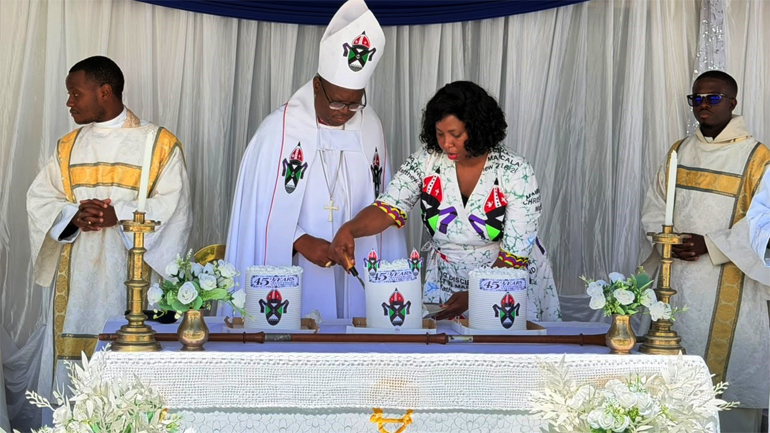
THE Anglican Diocese of Manicaland last Saturday marked 45 years of existence, using its milestone anniversary to rally behind Vision 2030 and challenge the church to deliver tangible answers to the nation’s social and economic troubles.
The Anniversary provided an opportunity for the diocese to reflect on its growth and contribution to communities across Manicaland, particularly in education, health care, and evangelism.
The diocese has established numerous schools and institutions that have contributed to education and health across the province.
Several of its schools continue to record strong performances in the Zimbabwe School Examinations Council (Zimsec) Ordinary and Advanced Level examinations.
Diocesan leader, Lord Bishop Reverend Eric Ruwona, said the church must move beyond pointing fingers and become an active force for practical solutions to the social and economic challenges confronting local communities.
Speaking at St Bartholomew Cathedral in Rusape during the Anniversary proceedings, Bishop Ruwona, urged the clergy and laity, not to stand on the sidelines while communities struggle with unemployment and drug and substance abuse.
Diocesan secretary, Dr Edmund Samutereko and Diocese Mothers union president, Mrs Eunice Ruwona also attended the event.
“My call to the church is simple – as a church we cannot blame anyone. We cannot just stand and blame others. The church’s calling is to transform our nation,” said Bishop Ruwona, noting that early missionaries did not complain about the absence of infrastructure, but actively constructed schools, clinics, and hospitals in rural areas.
“In a similar manner we cannot go around and say as a church there are no jobs, the youths are into drugs. No, we should prescribe solutions, not expect Government to go it alone,” he said.
Bishop Ruwona said the diocese fully supports Vision 2030, and the Village Business Units concept, outlining plans to establish SBUs and VBUs business units across schools and congregations, transforming churches into hubs for community development.
“Our vision cannot be separated from the vision of our nation, and our vision cannot be separated from the sustainable development goals. We cannot continue to tell people to expect to enjoy in heaven, yet the Lord’s prayer says thy will be done on earth as it is in heaven,” he said.
The diocese, which has established more than 100 schools, including several managed by rural district councils, seeks to turn congregations into centres of transformation, and expand its reach beyond traditional schooling and medical services.
Bishop Ruwona explained that given the current resource constraints and national shortfall of 3 000 schools, their immediate focus will be on increasing learners’ enrolment, while building new facilities.
“Every new community in Zimbabwe must have a school, a church and business unit so that we thrive as a nation,” he said.
Describing the diocese’s 45-year history as “nothing less than a miracle,” Bishop Ruwona said the church has weathered many storms to become a leading light within Zimbabwe.
He said the greatest test in its 45-year history occurred following independence, when international missionaries withdrew and donor funding ceased.
“An African bishop was in office, an African priest was in office, coming from a poor background, from a poor village, nothing to bring to the church. To mobilise and motivate members to fill in that gap has been the major challenge,” he said.
Moving into its next phase, the diocese intends to build on its foundation in education, health care, and evangelism.
“Our vision is to increase membership through evangelism, to ensure that our members are taught through our nurturing of new members. Our vision is to unite our members and the nation. An empowered church that gives life. Wherever we are, life should flourish. Of course, we should look at the environment, we should look at assisting those in need but, also assisting the nation to thrive and succeed,” said Bishop Ruwona, reaffirming that church objectives align with the Sustainable Development Goals.
Bishop Ruwona added that the Anniversary served both as celebrating history and renewing a commitment to community development.
“We now want to focus on our congregations to do much more so that the success we are recording in our schools, in our medical health institutions is also achieved in our communities so that we are a viable economy. Once our communities and the church thrive, the nation thrives. Forty-five years of the Diocese of Manicaland has been nothing less than a miracle. We have recorded several successes. We have the highest number of schools which have continued to produce the best results,” he said.
Anglican Diocese backs Vision 2030