Online Reporter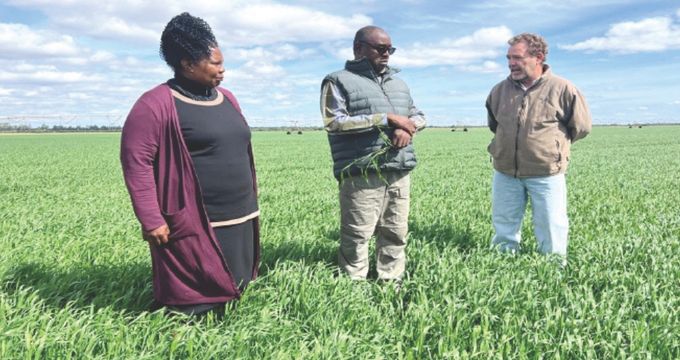
Sukulwenkosi Dube-Matutu, [email protected]
DEPUTY Minister of Agriculture, Mechanisation and Water Resources Development Davis Marapira has called for stronger partnerships between commercial and communal farmers as the Government accelerates its rural industrialisation agenda aimed at transforming agriculture into a catalyst for community development and economic growth.
Speaking during a tour of ARDA Antelope Estate in Maphisa on Thursday, Deputy Minister Marapira said strategic collaboration between established commercial farmers and surrounding communities was key to improving productivity, transferring skills and driving inclusive growth in the agricultural sector.
He said agriculture remains one of the major pillars in the attainment of Vision 2030 and stressed the importance of public-private partnerships in modernising farming and improving national food security.
ARDA Antelope Estate, a 1 000-hectare property owned by the Agricultural and Rural Development Authority (ARDA), is leased to a farmer Mr Deane Leroux under a public-private partnership arrangement established in 2013.
Over the years, the estate has emerged as one of the country’s flagship agricultural success stories, earning recognition for high productivity, innovation and contribution towards food security and nutrition.
Deputy Minister Marapira said successful farming models such as ARDA Antelope should become centres of excellence where communal farmers can learn modern farming techniques, innovation and climate-smart agricultural practices.
“We have farmers that are doing very well like here at ARDA Antelope where we established a public-private partnership in 2013. This farmer is conducting a lot of research and innovation backed by developed countries,” he said.
“We do not want to waste that kind of knowledge and expertise being brought into the country. We expect to see partnerships between such farmers and surrounding communities so there can be an exchange of knowledge, skills and resources.”
Deputy Minister Marapira said Zimbabwe’s agricultural sector could only grow sustainably through innovation, adoption of technology and modern farming trends that improve yields and strengthen resilience against climate change.
He urged agricultural extension officers and business advisers to tap into the innovations being implemented by successful commercial farmers and replicate them in communal areas.
“Projects that have become models of agricultural excellence should be replicated across the country. Every piece of land available for farming must contribute towards national food security,” said Deputy Minister Marapira.
Mr Leroux said soil health remained one of the most critical but often overlooked factors affecting crop productivity in Matabeleland South and other dry regions.
He said farmers needed to prioritise soil testing and nutrient management to improve yields and maximise returns.
“One of the major causes of low yields is nutrient deficiency in soils. In Matabeleland South, some of the key nutrients lacking are zinc, copper and boron,” said Mr Leroux.
“No matter how much fertiliser is applied, crops will not perform well if zinc is deficient because fertiliser cannot substitute zinc. These are issues farmers sometimes take for granted, yet they are very important.”
Mr Leroux said zinc application should become a standard farming practice because it is essential for healthy crop development and farmers can afford it.
He said before planting, soil samples are taken for laboratory testing to determine nutrient levels and deficiencies to enable farmers to apply the correct fertiliser combinations.
“As the crop grows, we also take leaf samples for testing so that we can determine what nutrients the crop may be lacking, whether it is zinc, nitrogen or any other element,” said Mr Leroux.
The ARDA Antelope Estate model is increasingly being viewed as a benchmark for productive agriculture and rural industrialisation, with the Government encouraging similar partnerships across the country to boost food production, create employment and strengthen rural economies.