Online Reporter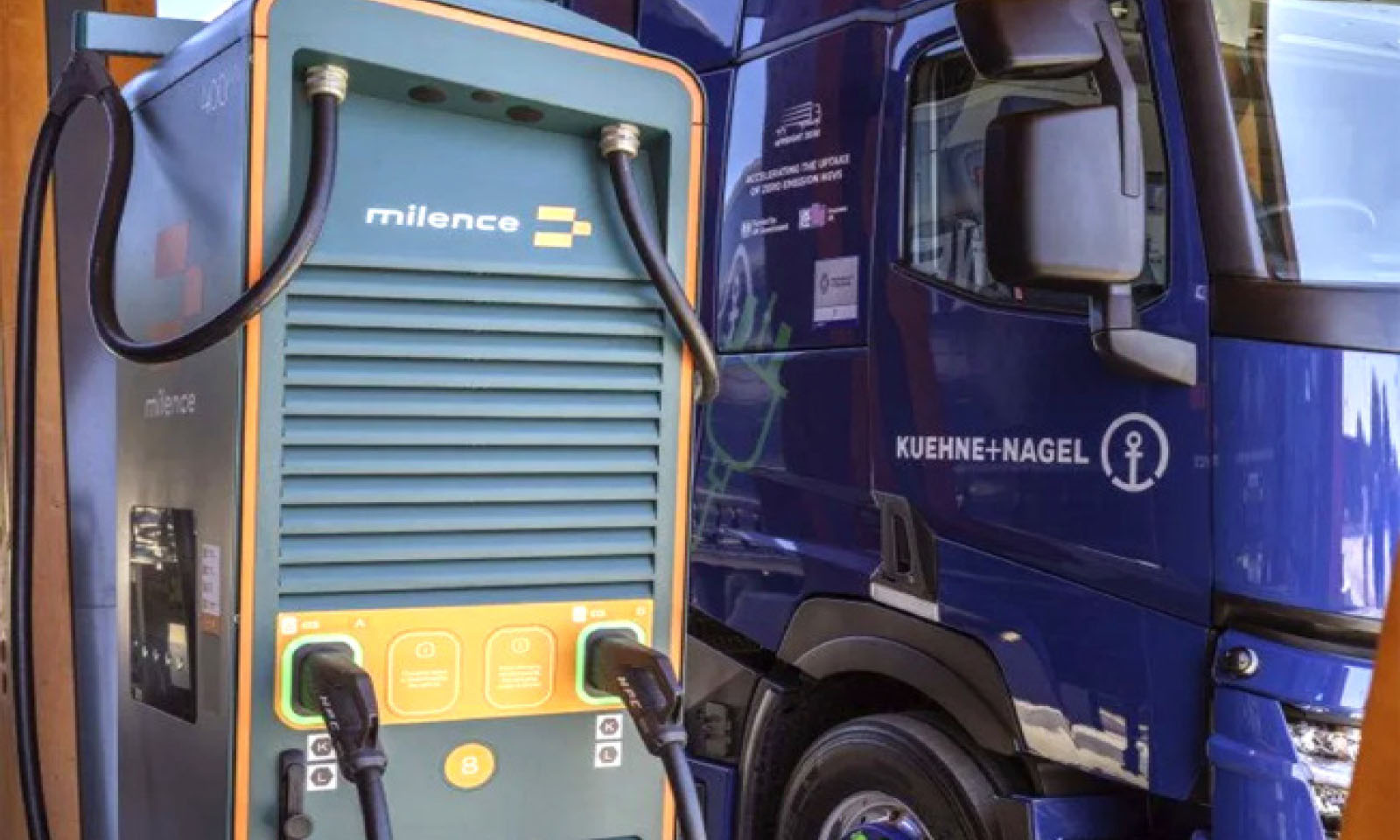
Libby Hargreaves
ELECTRIC trucks are moving from concept to action, and global logistics firm Kuehne+Nagel is making that move alongside Milence, the company behind Europe’s largest public electric truck charging network.
Together, they are putting electric heavy goods vehicles (HGVs) into real-world operations to show how cleaner freight can work at scale, despite known limitations around battery life, charging infrastructure and cost.
The spotlight is on supply chains as Kuehne+Nagel’s electric HGVs begin collecting cargo from the Able Humber Port. These trucks are now charging at Milence’s first United Kingdom hub, located in Immingham, Lincolnshire.
It is a step that moves electric trucks out of trials and into daily logistics.
Ms Kate Broome, sustainability and social impact director at Kuehne+Nagel UK, explains: “Alongside supportive measures to scale depot charging — such as faster access to grid connections and enabling policy measures — we also need high-performance, reliable and cost-effective public charging hubs.”
The Milence hub in Immingham is equipped with 400 kW CCS (combined charging system) chargers, delivering a full charge in one to 2,5 hours.
These chargers are compatible with most current electric HGVs.
Plans are also in motion to instal a megawatt charger, which would dramatically reduce charge times to 30-45 minutes, depending on battery size and truck specifications.
Kuehne+Nagel’s use of this first UK hub shows they are not just preparing for an electric future, but actively incorporating it into their current supply chain workflows.
“We are proud to be among the early adopters using Milence’s hub, proving that electric heavy trucks are not just the future — they are already here,” Ms Kate adds.
Building the infrastructure to scale
While truck electrification gains attention, it is the supporting infrastructure that will determine how quickly these vehicles become a standard feature of logistics.
Milence currently operates more than 20 public charging hubs across Europe, and the company sees its network forming the backbone of the continent’s “green corridors” — strategic freight routes designed with low-carbon travel in mind.
Mr Roel Vissers, chief commercial officer at Milence, sees this infrastructure as essential to scaling up electric freight.
“Electric road transport is no longer a future ambition, it’s happening now,” he says.
“With more than 20 operational hubs across Europe, our first green corridors are emerging and the shift to sustainable logistics is gaining momentum.”
Mr Roel is clear that adoption depends on usage, saying: “To scale this transformation, utilisation is key. At Milence, we collaborate closely with key stakeholders across the transport sector.”
Part of that collaboration includes data sharing and long-term planning.
Kuehne+Nagel feeds real-world usage data into eFREIGHT 2030, a UK government initiative within the “Zero Emission HGV and Infrastructure Demonstrator Programme”.
This input helps policy makers understand the challenges and opportunities involved in HGV electrification.
As Mr Roel puts it, “Partnerships with pioneers like Kuehne+Nagel are essential to shaping the infrastructure and services our industry needs. Our hubs are designed as safe, comfortable charging stops that support both drivers and fleets on their electric journeys. The transition will not happen overnight but by working together, we are moving closer to a road transport system that is not only sustainable but also economically viable.”
Challenges remain for electric freight
Despite the enthusiasm, electric HGVs still face multiple barriers to widespread adoption. One of the biggest issues is battery technology. Current lithium-ion batteries are less energy-dense than diesel, which means shorter driving ranges, heavier trucks and reduced payload capacity. Weight is also a concern.
Batteries add bulk, which reduces how much cargo a truck can legally and safely carry.
This can impact both profit margins and operational efficiency. Additionally, heavier vehicles may cause faster wear and tear on roads and bridges.
Charging infrastructure is improving, but it remains uneven. High-capacity charging stations for large trucks are rare and still too slow to suit fast-paced logistics.
Without enough charging options on main freight routes, electric HGVs remain limited in where they can go.
Cost is another barrier.
The high upfront price of electric HGVs and the ongoing expense of battery replacements discourage many operators.
And though electric trucks produce zero tailpipe emissions, the wider environmental impact depends on how the electricity is generated.
If power comes from fossil fuels, the emissions benefits fall apart.
Battery production itself raises environmental and ethical questions.
Mining materials like lithium and cobalt can lead to pollution and worker exploitation, and there are limited systems in place for safe battery disposal.
Still, both Kuehne+Nagel and Milence see these problems as manageable when tackled together.
By feeding real-time logistics data into government pilots, building infrastructure along major corridors and keeping the focus on operational needs, they aim to make electric freight a practical solution. — supplychaindigital