Chronicle Editor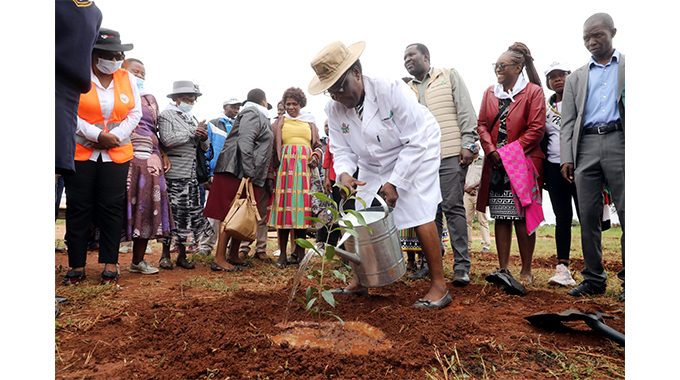
Nqobile Tshili, Chronicle Reporter
THE First Lady Dr Auxillia Mnangagwa has said it is every citizen’s responsibility to curb deforestation through planting of trees, thus mitigating climate change.
The First Lady said this on Tuesday at Emganwini High School in Bulawayo where hundreds of trees were planted within the school premises.
The tree planting programme is running under the theme; “Trees and Forests for Ecosystem Restoration and Improved Livelihoods.”
Dr Mnangagwa said tree planting is important as trees work as wind breakers during adverse weather conditions, mitigate against soil erosion and beautify environments.
Amai Mnangagwa was represented by Bulawayo Provincial Affairs and Devolution Minister Judith Ncube, in a programme that has been embraced by various environmental conscious organisations and communities.
The First Lady, who is the patron of Environment and Tourism, emphasised that the country benefits more from planting trees as opposed to cutting them.
She said planting trees prevents desertification which comes with adverse weather conditions.
“We are all in agreement that trees and forests are important through products and services that we get for our livelihoods. I would like to remind you of the importance of trees and forests in our day-to-day lives. Have you ever imagined what life would be like without trees and forests around us? We would probably be in the middle of a desert,” she said.
“We all know that life is unbearable in the desert. Desert life is characterised by extreme temperatures, dry conditions and soils being blown away by wind. Most of us would surely not like to live there if given an option,” she said.
Dr Mnangagwa said while the level of deforestation has decreased countrywide since 2010, more needs to be done to protect the environment.
“Around year 2010, the national average rate of deforestation was at approximately 330 000 hectares per annum whereas as from year 2017, it is estimated at 262 349 hectares per annum. Though this is an encouraging statistic, it does not give us reason to relax and think that all is well with our forests in Zimbabwe,” said Dr Mnangagwa.
She said as the country’s population increases, there is an increase in the demand for land for settlement and other developments, resulting in the need to clear more land, removing trees and forests in the process.
Dr Mnangagwa said afforestation becomes a necessity to address some of the human demands that result in the cutting down of trees.
She warned the public against illegally cutting trees and selling firewood.
“I wish to remind you all that tree cutting for firewood selling or making charcoal is against the law. It is not allowed. If there is a need to open up land on your farms, the law requires you to declare your intention to the Forestry Commission first before embarking on tree removal. The Forestry Commission together with other development partners will carry out inspection and offer appropriate advice,” said the First Lady.
She said planting of trees at schools is part of Government’s effort to address the deforestation problems.
“We need to intensify Beautification of our premises as is the case with today’s tree planting at Emganwini High School to increase tree population. If all 9 600 schools in Zimbabwe were to plant just 500 trees annually as Emganwini has done today, this would have the effect of adding 4,8 million trees to the national vegetation cover,” she said.
Dr Mnangagwa said rural schools can even plant more as they have vast pieces of land compared to urban schools.
She said while cities like Bulawayo might plant fewer trees, their survival rate is higher considering that they might not be damaged by animals.
The First Lady said planting of indigenous trees is important considering their nutritional value.
She said traditional fruits have become part of communities’ livelihoods especially during years of drought.
“Our indigenous forests are full of resources like indigenous fruits; umviyo, xakuxaku, umnyii, umtshwankela and various others. As a result of a variety of species offered by nature, we are able to get all body building vitamins and elements especially for those still growing. I implore you to think about orchards where indigenous fruit trees are planted,” said Dr Mnangagwa.
She said with the level of deforestation taking place in rural communities, it will not be surprising in the future to witness urbanites planting traditional fruit trees and produce to sell in rural areas.
The First Lady said planting of trees is part of homegrown solutions to national challenges.
Dr Mnangagwa said community leaders should take a leading role in the conservation of trees.
“I want to exhort the Emganwini community and the leadership, Members of Parliament and Senators as well as civil servants to actively play a part in the conservation of trees and forests in order to ensure that the next generations also enjoy the benefits of our natural resources,” said Dr Mnangagwa.
“Let us teach and train our fellow citizens and the young ones to plant and care for trees and to have respect for the environment so that it in turn takes care of our needs in posterity. Most importantly let us lead by example, let us be role models in tree resource conservation efforts.”
The First Lady said considering that both rural and urban communities use energy, it is important for every citizen to also plant a tree.
“Firewood in the rural areas is collected from forests. This is only possible if people take good care of the forests around them. As our economy is still growing, we do experience power shortages and some newly established suburbs are yet to be connected to the power grid, rendering the residents to depend on firewood as a source of fuel for domestic energy,” said Dr Mnangagwa.
Speaking during the same event, Environment, Climate, Tourism and Hospitality Industry Minister Nqobizitha Mangaliso Ndlovu, who was represented by director in the ministry Mr Tanyaradzwa Mundonga commended the First Lady for leading initiatives to protect the environment.
He said Dr Mnangagwa’s efforts are in sync with United Nations Sustainable Development Goals (SDGs) of environmental conservation.
“As a Ministry, we are privileged that our First Lady has for the past four years been the front-runner in the tree planting and forest conservation campaign and this season she has made significant strides in raising awareness and promoting conservation of forests and tree planting,” said Minister Ndlovu.
“Her efforts have not been in vain because tree planting has taken centre stage in many development programmes in the country and this will serve to move us forward towards the attainment of SDGs especially those that demand that we address our environmental challenges as a country.”
Minister Ndlovu said the ministry has set a target to plant 25 million trees annually and all stakeholders need to be involved for the target to be achieved.
“As at the end of January 2023, about 21 million trees had been planted across the country,” said Minister Ndlovu.
Emganwini High School headmaster Mr Thuthani Nkomo praised the First Lady for extending environmental awareness to pupils.
“First of all, I would like to extend my appreciation and recognition to this great work that our First Lady is doing in environmental awareness, in particular. I would like to thank her for this donation of trees to our school. I promise that we will take care of the trees as they will beautify as well as give us oxygen. Thank You Amai and may the Lord bless you as you continue with the good work as the Mother of the nation,” said Mr Nkomo.
Bulawayo Provincial Affairs and Devolution permanent secretary Mr Paul Nyoni said tree planting is important as it has multiple purposes in communities.
“I would like to encourage all citizens to take part and plant trees as they are a significant component of human life,” said Mr Nyoni.
He said beyond schools, trees should be planted in open parks, along streets and in orchards as they have numerous benefits to communities.
He expressed gratitude to the First Lady for leading efforts to stop deforestation.


 Online Reporter