COMMUNION with Bishop Lazarus
Before the invention of the modern-day weather forecast, our ancestors had a much more high-stakes relationship with the sky.
In some parts of our teapot-shaped Republic, people did not just pray for rain.
They demanded it with carefully choreographed, polyrhythmic rainmaking dances; for example, the mhande dance of the Karanga.
You might want to think of it as the ultimate divine customer service call. The stakes were simple: no rain, no harvest, no dinner.
So, the mhande dance was the emergency hotline of sorts to the ancestors, and it was a call they had to answer.
A spiritual SOS
In the days of yore, mhande was not a casual jig to pass the time.
It was a sacred ritual and spiritual technology designed to get results.
The entire performance was a complex, multi-layered message sent straight to the spirit world.
The twin drums were the celestial ringtone.
The high-pitched Shauro drum would send out a sharp, insistent call, while the lower-pitched Tsinhiro drum would provide the steady, grounding response.
When put together, this back-and-forth was the rhythm of a cosmic conversation.
The dancers’ movements, too, were not random.
The slow, dignified stomping and slight foot-lifting were a direct mimicry of flowing water.
It was a form of spiritual pantomime, a way of showing the universe exactly what was needed.
And the leg rattles (magavhu) tied to the dancers’ legs were not just for show.
Their rhythmic shaking created a sound like a thousand tiny, thirsty voices crying out for a drink.
The handclapping (makwa) provided the heartbeat of the plea, a polyrhythmic thunder that echoed the sound of the storms they hoped to summon.
The stakes of this performance were higher than any talent show.
If the rainmaking dance was successful, the heavens would open up, and the community would be saved.
But if the rain did not come, the results were obvious.
Today, mhande dance has evolved.
You will see it performed at cultural heritage celebrations and on stage for entertainment.
It is a beautiful spectacle to behold.
But as we watch the dancers stomp and the drummers play, it is worth remembering the original context.
If you tell this to the heavily Anglicised younger generation, they will inevitably treat this with a heavy dose of incredulity, if not contempt.
But, as the late historian Pathisa Nyathi (may the ancestors protect his soul) once observed, this world is too complex to be understood and interpreted by one culture.
All this shows that, in the village, water is the essence of life.
In fact, it is life.
It falls from God’s seat in the heavens and turns into sadza, milk and a reason to greet your neighbour.
Changing times
But the times have changed.
The rains no longer keep their promises as they used to.
There was a time, not so long ago in the memory of our grandfathers, when you could set your planting by the first rains the way you set your watch by the sun.
Now the heavens are moody.
One year the clouds arrive late and stingy, and the maize folds its arms and refuses to grow; the next year they arrive early and furious, and the river that we crossed on foot swallows the bridge.
The old men who once read the sky with confidence now helplessly and haplessly cannot read the signs.
This is the bold signature of what is now known as climate change.
And we should be honest about how we got here.
For the past few centuries — ever since the Industrial Revolution taught us to burn coal and call it progress — we have done a pretty good job of messing up the environment.
And the invoices are now due.
The regularity of unseasonably low and high rainfall is now the talk at the borehole, the worry at the dip tank and the reason women walk further for water each season.
The world, in its panic, now gathers every year.
Last week, thousands of delegates, scientists and leaders descended on Turkey as part of efforts that have been ongoing for the past 31 years to try to repair Mother Earth and coax the weather back into the hospitality we once took for granted.
Thirty years of these summits, and the emissions remain stubbornly high.
In the wake of this new reality, Bishop Lazi and many of his ilk will continue to pray for the rain, because we are a people of faith and the clouds are still God’s business.
But James 2:14-26 is quite instructive: “What does it profit, my brethren, if someone says he has faith but does not have works?
“Can faith save him? If a brother or sister is naked and destitute of daily food, and one of you says to them, ‘Depart in peace, be warmed and filled,’ but you do not give them the things which are needed for the body, what does it profit?
“Thus also faith by itself, if it does not have works, is dead.”
This means that, as a people, we must negotiate with science — the same science that tells us the rains are changing, that the coal and the gas have a cost, that our species, which has walked this earth for millions of years, does not have a spare planet in the backyard.
A new dawn
But before we drown in the gloomy mathematics of global warming, there is every reason to be hopeful.
While the world was in Turkey at COP31 trying to negotiate the weather back into good manners, Zimbabwe was doing something far less glamorous and far more useful: It was digging, pumping, laying pipes and reviving irrigation schemes.
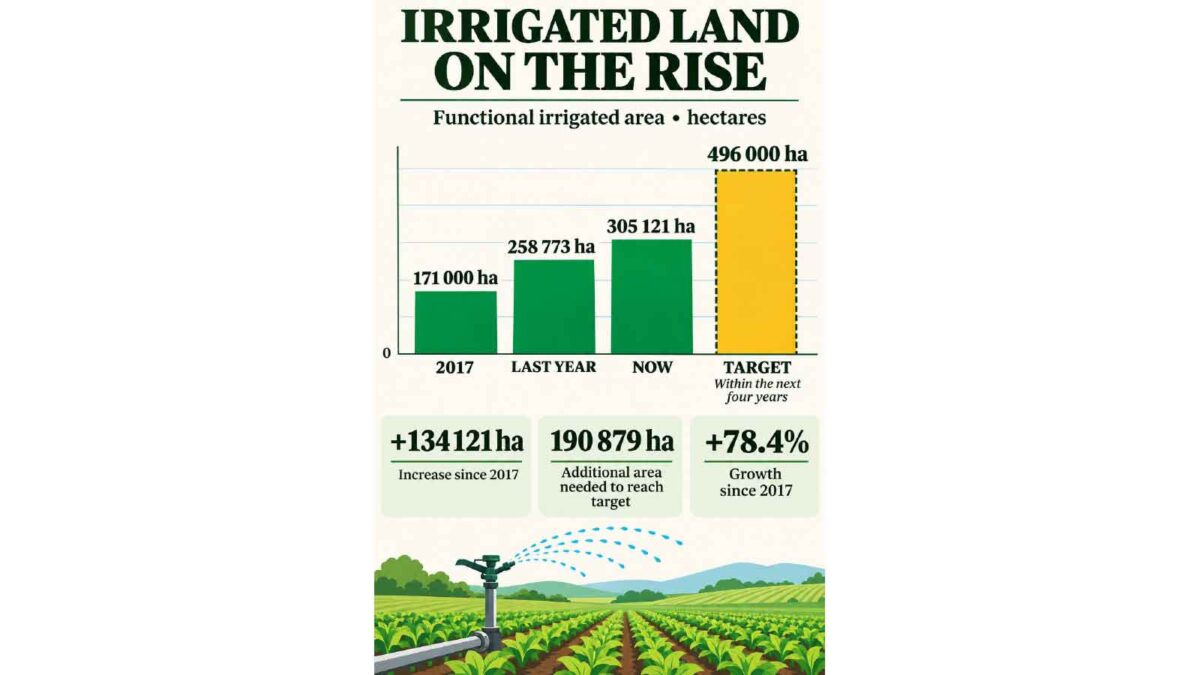
This year alone, the country brought 67 129 hectares (ha) under irrigation — the biggest annual expansion on record — pushing the total irrigated land to 305 121ha.
Read that again slowly, as you would a good verse.
That is not a press release; that is a sermon in soil and water.
You see, President ED realised years ago that the old hymn — “We will pray for rain and hope for the best” — was no longer a strategy but a gamble.
And a gambler’s faith is not the same as a farmer’s faith.
So, in his wisdom, he came up with a programmatic plan of action: rehabilitate the dormant irrigation infrastructure, develop new schemes, harness the country’s water resources and stop pretending that the skies will always be as generous as our grandfathers remembered.
Ensuring that 350 000ha are under irrigation, he declared, would guarantee that the country would wean itself from rain-fed agriculture.
And the country has been walking the hard miles in the past eight years.
This year alone, more than 35 irrigation schemes have been revived using resources channelled through the Grain Import Levy — which is a lovely piece of poetry when you think about it: Money that once went to importing grain now goes to developing our irrigation infrastructure.
Since 2017, functional irrigated land has risen from 171 000ha to 258 773ha last year, and now to 305 121ha.
The target is 496 000ha within the next four years.
We are not there yet, but we are closer than we have ever been.
We used to have such brilliant plans before but the genius of President ED is in translating them into action.
Among many other things, history will remember ED as a doer.
His craft competence has always been his clear-eyed strategic foresight, programmatic problem-solving and disciplined and results-oriented relentless follow-through.
This is why ED delivers.
So, the remarkable, record-breaking production we are beginning to see in our agriculture is not fortuitous.
It is not the ancestors smiling on us while we sleep. It is directly, demonstrably, mathematically related to the expansion of land under irrigation.
Every hectare that comes under a reliable pipe is a hectare that no longer gambles with the clouds.
Every scheme revived is a season rescued from suspense.
That is the winning formula — prayer for the rain, yes, but policy, investment and infrastructure to make sure the rain is not the only plan.
So, when the statistics come in, when the harvests surprise the sceptics, when the silos fill and the Grain Import Levy goes back to growing grain instead of buying it, do not call it a miracle.
It is a formula.
And then thank God for the wisdom to use it.
Bishop out!