Online Reporter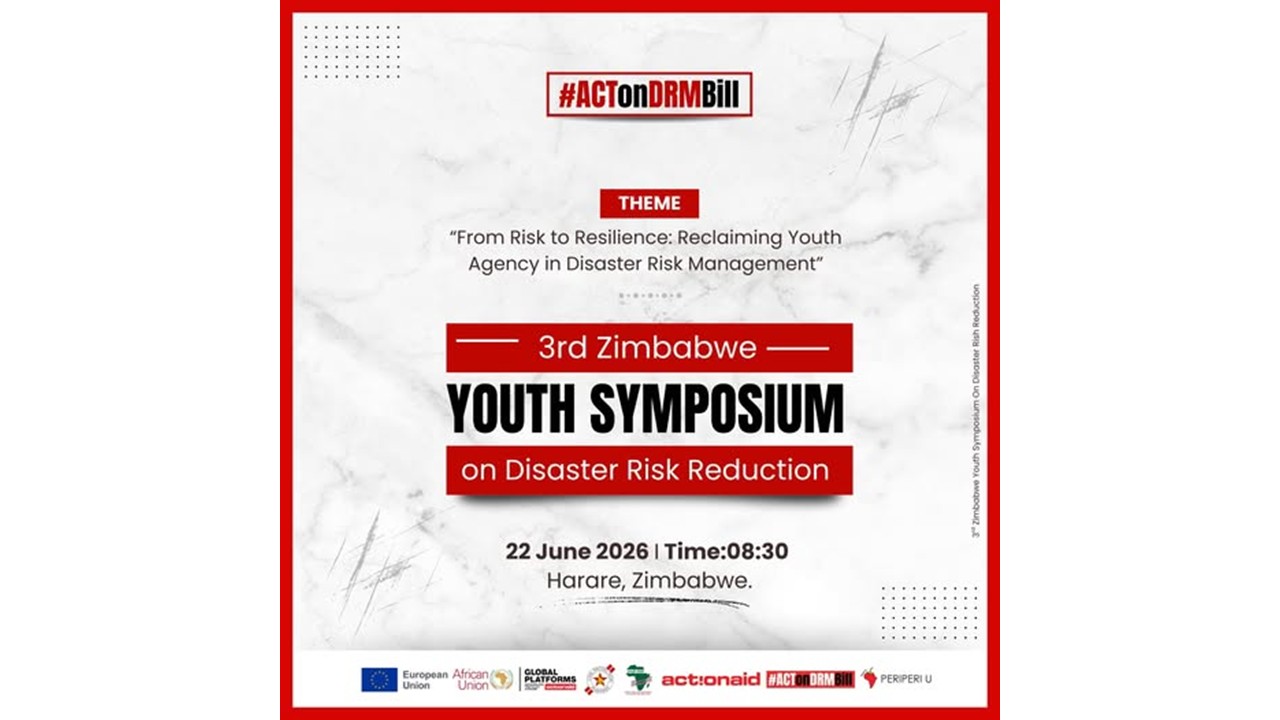
Theseus Mauruki Shambare
AT least 100 young people from Zimbabwe and across Southern Africa are expected to converge at in Harare on Monday for the 3rd Zimbabwe Youth Symposium on Disaster Risk Reduction, an event being organised by ActionAid Zimbabwe and its partners to strengthen youth participation in disaster risk governance and climate resilience.
Held under the theme “From Risk to Resilience: Reclaiming Youth Agency in Disaster Risk Management,” the symposium will bring together youth leaders, researchers, Government officials, parliamentarians, development partners, local authorities and civil society organisations to discuss strategies for reducing disaster risks and building resilient communities.
According to the symposium concept note, the gathering seeks to provide a structured platform for youth-led research and evidence to inform national disaster risk reduction policy dialogue at a time when Zimbabwe is facing increasingly frequent climate-related disasters.
The concept note notes that the country is exposed to a range of hazards, including droughts, floods, disease outbreaks and environmental shocks, which continue to place pressure on communities, public services and national development efforts.
“Young people are among those most directly affected by disasters, yet they remain underrepresented in the governance structures that shape risk management decisions,” read part of the concept note.
A key highlight of the symposium will be the presentation of the Zimbabwe Youth Position Statement on Disaster Risk Reduction by the chairperson of the National Youth Desk on DRR.
The agenda also includes a high-level policy dialogue on the relationship between natural resource governance, climate risk and community resilience.
Discussions are expected to focus on policy processes such as the proposed Disaster Risk Management Bill and the Mines and Minerals Amendment Bill.
Youth researchers will also present findings on artificial intelligence-powered early warning systems, climate finance accountability, epidemic preparedness, insurance exclusion, indigenous knowledge systems and gender-responsive approaches to disaster risk reduction.
Participants will later break into thematic groups to formulate policy recommendations and strengthen the Youth Position Statement, which organisers say will be submitted to relevant Government ministries and Parliamentary Portfolio Committees.