admin
admin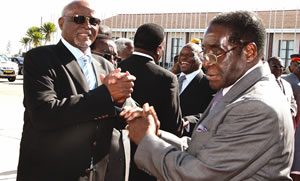
seeks a lasting solution to the crisis in Libya and to end continued bombardment of the North African country by NATO forces.
President Mugabe and his delegation were received at Addis Ababa International Airport by Zimbabwe’s Ambassador to Ethiopia Mr Andrew Mtetwa. There have been a number of meetings here already trying to hammer out a solution on the Libyan crisis, problems in the Sudan, Somalia and Cote d’Ivoire.
At the weekend there was the fifth Joint Consultative meeting of the AU Peace and Security Council (AUPSC) and the UN Security Council UNCS) at the AU headquarters to discuss some of the pressing matters affecting the continent.
LIBYA: RELATED OPINION PIECES
- Imperial aggression major threat to African growth
- When identity crisis kills Africa
- Africa Day and imperialist threat
- Libya: Where is the AU
According to reports, today’s meeting marks the continental body’s first major step towards ending fighting in Libya that has left thousands of people dead and others injured and buildings turned to heaps of rubble.
All along, it has been difficult for the AU to constitute a quorum as France, Britain and the US successfully divided Africa in order to pre-empt the summit.
However, the deliberative assembly mustered the requisite numbers last week, paving the way for the summit, which is expected to challenge the Western-led coalition’s brutal assault on Libyans under the pretext of UNSC Resolution 1973 of 2011.
The crucial meeting was organised at the behest of incoming AU chairman president Teodore Obiang Nguema of Equatorial Guinea. Last week, President Mugabe also advocated emergency sessions of the AU and UN to tackle the Libyan issue. President Mugabe said that the AU should have protested vigorously and convened an emergency session, leading to an urgent UN summit.
President Mugabe also expressed grave concern over the rebellions in North Africa.
“They are not pure protests. They are not as pure as they would want us to think. If they are true protests, how then do they involve Europe?
RELATED NEWS REPORTS
- NATO pounds Tripoli
- French planes to aid NATO offensive
- EU opens mission in rebel stronghold
“How does Europe get into protests that are in Africa?” President Mugabe told our sister paper, The Southern Times recently.
In its communiqué after Saturday’s consultative meeting at the AU headquarters, the UNSC and the AUPSC also called for the cessation of all forms of hostilities and violence against Libyans.
“The members of the UNSC and the AUPSC demand the immediate establishment of a ceasefire and a complete end to violence and all attacks against, and abuses of civilians, and a solution to the crisis which responds to the legitimate demands of the Libyan people. They stressed the need for such a ceasefire to be credible and verifiable and encouraged the African Union and the United Nations as well as other stakeholders to spare no efforts in achieving this objective.
“The members of the UNSC and the AUPSC expressed their deep concern over the continuation of violence in Libya and reaffirmed their commitment to the full implementation of the United Nations Security Council resolution 1970 (2011) and 1973 (2011) to ensure protection of civilians in Libya,” reads part of the communiqué.
The members of the UNSC and the AUPSC stressed the need for a political solution to the conflict in Libya.
The members also welcomed the efforts of the Special Envoy of the Secretary General (Mr Ban ki Moon) for Libya, Mr Abdel – Elah Mohamed Al – Khabib and those of the AU High Level adhoc Committee on Libya on the context of the AU roadmap.
They also agreed to continue supporting the UN and in accordance with OP 2 of Security Council resolution 1973 to find a solution to the crisis.
“The members of the UNSC and the AUPSC expressed serious concern over the deteriorating humanitarian situation in the country and called for full compliance with the human rights and International
Humanitarian Law and the creation of the required conditions for the delivery of assistance to all needy populations across Libya, including those seeking to leave the country,” reads the communiqué in part.
Diplomats are concerned with the developments in Libya, adding bombardment could be done in other countries on the continent.
Unrest broke out in Libya last February after rebels led a string of violent protests to force the North African country’s leader, Colonel Muammar Gaddafi, to resign.
The armed rebels exchanged fire with security forces and seized parts of the country, culminating in a fully-fledged war that has claimed thousands of lives.
As the fighting escalated, the AUPSC resolved to back Col Gaddafi’s clampdown on the insurgents.
However, the UNSC passed Resolution 1973 that provided for a no-fly zone over Libya.
Gabon, Nigeria and South Africa voted with the West, effectively going against the AUPSC’s decision.
China, Russia and Germany, however, abstained.
The US, Britain and France are pounding Libyan cities under the cover of the resolution and continue to pummel other parts of the country, including the capital, Tripoli, with the rebel forces following to takeover.
They have bombed Libyan leader Gaddafi’s residences, killing his son and grandchildren.
Last month, President Nguema condemned foreign military intervention in the Ivory Coast and Libya.
He said Africa must be allowed to manage its affairs.
“Africa does not need any external influence. Africa must manage its own affairs,” he was quoted as saying. “I believe that the problems in Libya should be resolved in an internal fashion and not through an intervention that could appear to resemble a humanitarian intervention.
“We have already seen this in Iraq,” he was quoted as saying.


 Online Reporter