admin
admin
Kennedy Mavhumashava
African leaders held an extraordinary session of the Assembly of the African Union (AU) in Addis Ababa, Ethiopia on Saturday. There was only one item on the agenda — the continent’s cold relationship with the International Criminal Court (ICC). In a communiqué issued after the session, the AU voiced largely muted criticism of the ICC, The Hague-based tribunal which, according to many in Africa, has tended to be exclusively used by powerful nations to punish African leaders while leaving western leaders who, in African eyes, would have committed graver crimes against humanity.
Among other resolutions, the African leaders agreed to tell the ICC not to summon sitting heads of state and government or anyone in a position to exercise their powers, to answer any charges, saying this does not make sense for the Netherlands-based court to try African leaders, who are not subject to prosecution in their local courts because they enjoy immunity to prosecution.
Also they resolved to send a high-level delegation to New York to request the UN Security Council to defer criminal proceedings against Kenya President Uhuru Kenyatta, his deputy, Mr William Ruto and Sudan President, Omar Hassan Al Bashir.
The Kenyan leaders are facing charges of instigating post-election violence that killed about 1 000 people and displaced many more in Kenya between 2007 and early 2008. President Al Bashir is wanted over alleged war crimes in Darfur and had an ICC arrest warrant issued against him.
However, analysts yesterday said that AU stance does not send a strong enough signal of the continent’s displeasure with the record and focus of the 11-year-old tribunal.
The stance, the analysts argue, is too narrow as it leaves room for leaders’ unjust punishment after they leave office while ordinary Africans suspected to have committed “grave” crimes would always be at the mercy of the ICC yet western leaders and their people cannot be subjected to the same.
Prominent lawyer and former minister, Cde Munyaradzi Paul Mangwana said Africa should have come up with a stronger resolution demanding equal treatment of all at the ICC.
“The decision by the AU is fine because running a country is not easy, so one has to fully concentrate on that,” he said.
“You can’t have 30 or 40 million people having their lives endangered by the possibility of their leader being tried and even jailed for life by a court that is instigated by foreigners. But my worry is to go begging at the UN.
“Instead, we should have come up with a stronger resolution that no sitting African head of state must be tried as long as European leaders who violated a no-fly zone UN resolution to invade Libya and kill its president, Muammar Gaddafi are free.”
He said Africa was a continent made up of “a few real men who are only found in Zimbabwe and one or two other countries, and some people who claim to be men,” which is why it often avoids taking stronger positions on matters that challenge neo-colonialism.
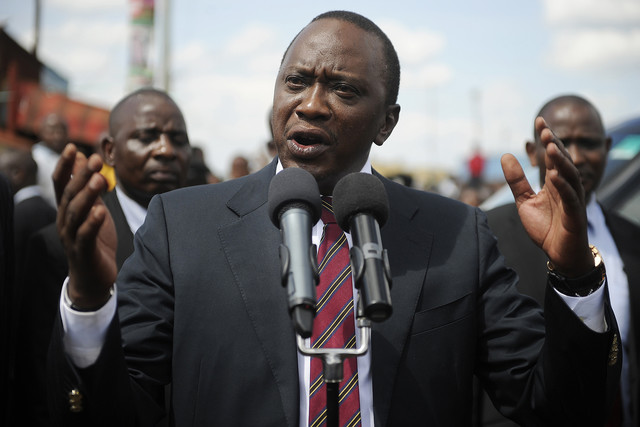
On Saturday, President Kenyatta spoke in a distinctly anti-imperialist tone against the ICC, echoing his nationalistic campaign for the March election he won convincingly against an opponent, Mr Raila Odinga who framed his electoral message on what he believed would be ramifications for Kenya if the electorate elected him (President Kenyatta).
President Kenyatta said western countries — many of which were themselves not ICC members — had turned the court into a tool for manipulation and neo-colonialism of African states.
“The ICC has been reduced into a painfully farcical pantomime,” he said, “a travesty that adds insult to the injury of victims. It stopped being the home of justice the day it became the toy of declining imperial powers. Before the ICC, African sovereign nations’ resolutions are nothing compared with the opinions of civil society activists.
“The AU is the bastion of African sovereignty, and the vanguard of our unity. Yet the ICC deems it altogether unworthy of the minutest consideration. Africa is not a third-rate territory of second-class peoples. We are not a project, or experiment of outsiders.
“We want to see the ICC as fair and even-handed throughout the world. We would love nothing more than to have an international forum for justice and accountability, but what choice do we have when we get only bias and race-hunting at the ICC?”
President Kenyatta, due to appear before the ICC on 12 November, highlighted that Britain and the US were using the ICC to intimidate Africans to extract favours.
“The threat of prosecution usually suffices to have pliant countries execute policies favourable to these countries. Through it, regime-change sleights of hand have been attempted in Africa. A number of them have succeeded,” he said.
Thirty-four AU members, including Kenya are among the 122 countries that ratified the Rome Statute which establishes the ICC. As such, they are bound by the court’s decisions. Zimbabwe signed the statute but has not ratified it. All the 33 cases before the ICC are for Africans.
African opposition to the ICC has been building up for some time but intensified since the election of President Kenyatta in March, a year after the tribunal issued summons against him. In May, AU members voted by 53 to one to ask the ICC to refer President Kenyatta and Deputy President Ruto’s cases to Kenyan courts.
Kenya took a stronger stand on 5 September when its parliament voted to have their country withdraw from the ICC’s founding statute. That was exactly five days before Mr Ruto’s first appearance at the court.
A withdrawal from the ICC takes a year to come into effect but does not stop ongoing proceedings. The Kenyan government has not yet formally written to the UN notifying it of the withdrawal.
If the ICC agrees to halt prosecutions of African heads of state, but proceed with matters involving ordinary citizens, President Al Bashir, the first sitting head of state and government to be indicted for trial at The Hague, would be off the hook for some time, but would be back on when he leaves office. President Kenyatta and his deputy would be safe too.
A Kenyan former journalist, Joshua Arap Sang, Mr Ruto’s co-defendant, could face a different fate. The ICC’s budget is largely funded by Europe. In 2008, for instance, the EU gave it 51 million euros, while Japan made available 19 million euros. Australia, Canada and New Zealand gave it a cumulative six million euros and Latin America and the Caribbean five million.
Bulawayo lawyer, Mr Sindiso Mazibisa argues that the AU would have made a strategic blunder if it had taken a stronger position. It was a clever decision, he said, to engage the ICC and not go for a mass withdrawal as some African media had speculated would happen on Saturday.
A resolution calling for a collective withdrawal, he said, would have complicated Mr Kenyatta’s case. A mass withdrawal, he added, was also impossible as ICC decisions affect individual countries and their citizens as only they are signatories to the Rome Statute.
“Joining the ICC is a voluntary act by individual states,” Mr Mazibisa said.
“Because it is a voluntary decision by an individual state, withdrawal from the statute has to be by the individual state. From a strategic position, Kenyatta had to seek a vote on the matter and get that political support, but collective decisions are only political, they are not legal positions.”
He said if the AU had taken a tougher decision of mass withdrawal or if Kenya proceeds to formally withdraw from the ICC at this time meaning President Kenyatta and Mr Ruto would refuse to appear in court, the tribunal would most likely harden its own position as well by issuing warrants of arrest against both.
“Kenyatta would suffer the consequences on his own,” Mr Mazibisa said.
“A warrant of arrest would be issued against him and this is an idea they (AU) did not want like the Bashir issue. It was a clever move for them to also seek an audience with the Security Council.”
He said the idea of an international court is good, wondering how domestic remedies would be enough to punish individuals like the late Angolan rebel leader, Jonas Savimbi, and to some extent, his Mozambican counterpart, Afonso Dhlakama. However, he said the challenge is how to make the ICC independent so that the powerful who fund and control it don’t manipulate it to unfairly target Africans.
On Sang, Mr Mazibisa said if his co-defendant, Mr Ruto gets the Security Council cover that the AU is seeking, that would leave the journalist isolated.
However, said the lawyer, the ICC would have to consider the procedural technicalities of the possibility of trying the journalist without his co-defendant. Cde Mangwana said Sang would automatically be saved if his co-defendant is freed.
Kenya, Sudan and DRC have the highest number of citizens to have been indicted. Kenya and Sudan have seven each, while the DRC has six.
Thomas Lubanga Dyilo, a former DRC rebel leader was the first person to be arrested on 17 March 2006 on an ICC-issued warrant. He was convicted of a war crime of conscripting and enlisting children under the age of 15 years and using them to participate actively in hostilities.
He was convicted and sentenced to 30 years in jail after a three-year trial.
Zimbabwe had a challenging experience with the Sadc Tribunal, which was western-funded. The court issued rulings that generally coincided with Anglo-American interests on Zimbabwe’s land question.
It declared the land reform programme “racist and illegal,” ignoring the history of the unequal land ownership structure in the country. Through strong pressure from Zimbabwe, Sadc dissolved the court in May 2011.
“Africa must decide to leave the ICC,” said Cde Mangwana.
“Courts don’t exist in isolation. They are influenced by what is around them, so we cannot expect to get equal treatment from it. If we don’t get fair treatment from the UN, how can we expect to get it from the ICC?”


 Online Reporter