Chronicle Editor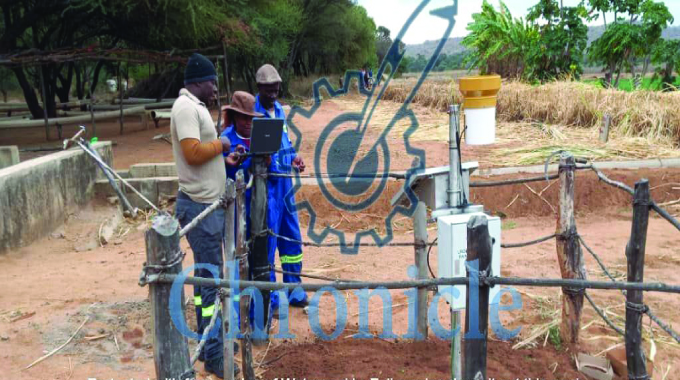
Yoliswa Dube-Moyo, Matebeleland South Bureau Chief
IN a milestone achievement, the Meteorological Services Department in partnership with Government and the United Nations Development Programme has installed automatic weather stations at various irrigation schemes across the province as part of efforts to mitigate the effects of climate change.
The move is set to assist in data collection and give area specific weather forecasts in order to improve food security and nutrition.
The project is being implemented under the Green Climate Fund (GCF), which is a unique global platform to respond to climate change by investing in low-emission and climate-resilient development.
The GCF was established by 194 governments to limit or reduce greenhouse gas emissions in developing countries, and to help vulnerable societies adapt to the unavoidable impacts of climate change.
An automated weather station is an integrated system of components that are used to measure, record, and often transmit weather parameters such as temperature, wind speed and direction, solar radiation, and precipitation.
Weather stations are used on land and sea for a variety of operational and research purposes.
Matabeleland South provincial meteorological officer Mr Rodgers Munyira said the thrust of the project is to ensure food security and nutrition.
“It’s a GCF programme being implemented by the UNDP with the Ministry of Agriculture as the leading implementing agency in the country.
The thrust of the project is food and nutrition security within the agricultural sector.
As the Meteorological Services Department, we’re in charge of the installation of the automatic weather stations and the automatic rain gauges across Matabeleland South, Masvingo and Manicaland provinces,” said Mr Munyira.
He said Matabeleland South province was allocated equipment for four automatic weather stations and four automatic rain gauges.
“We were the biggest beneficiaries of the programme. Out of the gadgets we’ve received, we’ve installed automatic weather stations at Chikwarakwara, Shashe, Nhwali and Masholomoshe irrigation schemes.
At Mankonkoni Irrigation Scheme, we installed an automatic rain gauge, as well as Mzinyathini in Umzingwane.
We’re installing two other automatic rain gauges in Matobo. We’re trying to mitigate the food and nutrition shortage due to climate change,” said Mr Munyira.
“As the Meteorological Services Department, we’ve realised that our measuring instruments and meteorological stations are too far apart. With the rainfall variabilities due to climate change affecting food production, we’re saying we need more stations to talk about exactly what is happening at a place and its surroundings.
For example, we have a meteorological station in Bulawayo, and if you’re going south, the next station is at West Nicholson and then in Beitbridge.
If we look in the Beitbridge District, cutting across from Chikwarakwara to Plumtree, there is no other meteorological station except in Kezi. Our stations are too far apart and they may not represent actual weather phenomena happening at each place.”
With the advent of climate change, Mr Munyira said, the meteorological practitioner needs to have more information to make an informed decision on the actual weather patterns at every place.
“We want to have area specific forecasts. Matabeleland South starts from Bulilima, and to get to Chikwarakwara, it’s more than 700km. These two areas fall under two different regions but we’re giving a blanket forecast. We’ve installed the equipment at irrigation schemes such that we’ll be using the data to help get the forecast for that particular place. This will be useful to the agricultural activities happening in those areas,” said Mr Munyira.
Matabeleland South provincial agricultural officer Mr Mkhunjulelwa Ndlovu said the automatic weather stations will provide critical information needed for agricultural programming.
“Weather is a denominator factor in agriculture because in order to make any intervention, you need to understand the weather patterns in terms of rainfall, heatwaves and cold waves.
You can plan your enterprise accordingly when you know what’s happening with the weather. We have a new map showing the zoning aspect within the country; we have region 1A up to 5B. In most cases, the Met Department has very isolated weather stations.
In Gwanda District, we have West Nicholson and if you go down to Nhwali, Mankonkoni and Rustlers, the weather and rainfall patterns have a vast difference,” said Mr Ndlovu.
He said there is need to understand the rainfall patterns and temperatures for the southern part which is classified under region 5B in order to plan accordingly.
“This determines what can be done in terms of farming. During the rainy season, we need to understand the amount of rainfall received in relation to irrigation scheduling.
If we get enough rain, we know how many days we can come in with irrigation or when irrigation needs to be supplemented as well as the season length in terms of choosing crop variety. In terms of livestock, we need to plan in relation to biomass. If the season length is very short, we have to quickly mobilise resources to support our livestock,” said Mr Ndlovu. — @Yolisswa


 Online Reporter