Chronicle Editor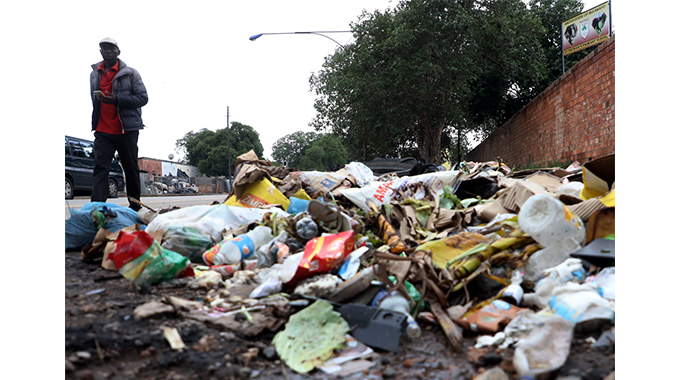
Mashudu Netsianda, Senior Reporter
A HEALTH crisis is looming in Bulawayo as the city council is struggling to collect refuse in both residential and commercial areas resulting in illegal dumping of waste in open spaces and sanitary lanes.
As a result of Bulawayo City Council (BCC)’s failure to collect refuse, residents have resorted to dumping garbage in undesignated areas, forming breeding grounds for diseases and vermin.
In its latest council minutes, BCC acknowledged that due to fuel challenges, it was now failing to adhere to scheduled refuse collection timetables.

A Chronicle news crew visited selected suburbs and the city centre and observed that heaps of garbage continued to pile up in sanitary lanes and open spaces in residential areas.
Sanitary lanes are designed to provide leeway for service vehicles such as delivery and garbage collection trucks, but the situation in the city has become an eyesore. Vermin that include rats, flies and mosquitoes breed in rubbish piles.
According to council minutes, refuse is collected fortnightly in the eastern areas and weekly in the western suburbs.
“Refuse was collected fortnightly in the eastern areas and weekly in the high-density areas. Some areas did not have their refuse collected on scheduled days due to fuel shortages,” read the council minutes.

“As a result, such areas went for more than two weeks without refuse being collected. Illegal dumping increased in such places.”
When disease-causing vectors come into contact with human beings or food, they may transmit bacterial diseases that include salmonellosis, skin infections and tetanus.
They are also capable of causing viral diseases like trachoma, hepatitis A and gastroenteritis as well as parasitic diseases that include hookworm, threadworm and roundworm.
The homeless are also taking advantage of the sanitary lanes that are not closed off to the public in the city centre to defecate and urinate in them. The lanes are also being abused by street kids who burn garbage and use them as sleeping areas.

Environmental Management Agency (EMA)’s environmental education and publicity manager, Ms Amkela Sidange, said the effects of environmental pollution were compromising the public health system.
“The litter that we have in the environment can become fertile ground for breeding of diseases causing vectors and end up having diseases such as cholera and typhoid. At the moment we have so much litter in the environment and it becomes an environmental concern in that we will be talking about environmental pollution, which we need to take into cognisance,” she said.
“The other thing that we need to consider is that when we have litter in the environment it reduces the aesthetic value since we are a nation that actually thrives so much on tourism and to think of it having its aesthetic value reduced then it means it will impact negatively on our tourism potential.”
Ms Sidange said illegal dumping of litter remains a punishable offence in terms of section 83 of the Environmental Management Act.
Bulawayo City Council spokesperson, Mrs Nesisa Mpofu, attributed the piling of garbage in sanitary lanes and open spaces in residential areas to the local authority’s inability to collect waste on time due to few refuse compactors.
She said council was considering engaging private players to assist in refuse collection and clearing sanitary lanes as soon as the modalities are worked out.

“A weighbridge is also being installed at the Richmond Landfill site and as soon as it is done it may be easier to engage private waste collectors who will be paid on tonnage. Waste is deposited along these lanes by our street sweeping teams and while awaiting collection by compactors, some people may rummage through the garbage looking for valuables and, in the process, scattering litter causing unsightly scenes despite that it would be in plastic bags and tied up,” she said.
Mrs Mpofu also accused some residents of dumping waste in sanitary lanes and open spaces in the city centre urging them to utilise refuse bins provided by the local authority.
“We have some unscrupulous residents who deliberately block sanitary lanes, be it in the city centre or residential areas. This causes a lot of pollution,” she said.
BCC has 17 refuse compactors, six of which have broken down and two refuse box trucks, which are both down. — @mashnets



 Online Reporter