peter
peter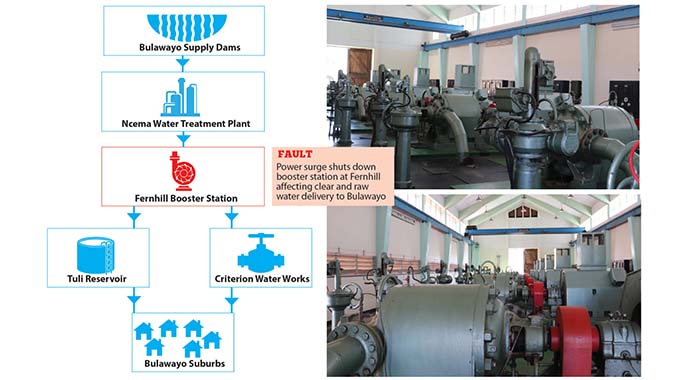
Nqobile Tshili, Chronicle Reporter
THE Bulawayo City Council (BCC) has fixed the electrical fault at Fernhill Booster Station which had caused a citywide water shutdown with normal starting last Friday.
Council last Tuesday announced that a power surge at Fernhill Booster Station had affected delivery of clear and raw water at Tuli and Criterion reservoirs forcing the local authority to indefinitely suspend provision of water across the city while it worked to fix the electrical fault.
Water from all the city’s supply dams is first pumped to Ncema Water Treatment plant and treated water is pumped to Fernhill Booster Station then to Tuli reservoirs for distribution to various residential areas across the city.
Raw water is also pumped from Ncema to Fernhill then to Criterion Water Works for treatment before distribution to the city’s reservoirs.
In a statement on Friday, Town Clerk Mr Christopher Dube said:
“Following the power surge at Fernhill Booster Station that affected clear water and raw water delivery to Tuli Reservoir and Criterion Water Works which subsequently affected the city’s water supply system, the city would like to advise that the electrical fault has been fixed and the clear water pumps have been repaired and are running for both Fernhill and Criterion,” said Mr Dube.
“However, reservoir levels are still building up and have not yet stabilised. To this end, water remains closed for both western and eastern areas until the system is recharged. Consumers will be able to get water thereafter. We anticipate to start opening Nkulumane and Nketa areas tomorrow (today) using the usual restoration schedule of 5PM (opening) and 7AM (closing),” he said.
Technical faults continue to worsen the city’s water supply while water levels at the city’s supply dams have dropped to 24 percent as three of the city’s six supply dams have been decommissioned.
The city consumes at least 150 megalitres (ML) per day but the council can only supply an average of 80ML per day.
The water demand is expected to increase this summer as council stated that more water is used when it’s hot.
The water crisis has led to the outbreak of diseases claiming 13 lives and infecting 2000 people in the process.
The water shortage has also led to an increase in open defecation cases as residents opt for the bush with authorities warning that this could lead to an outbreak of diseases especially towards the rainy season.
To address the crisis, Government has released ZW$205 million to the Zimbabwe National Water Authority (Zinwa) which has started working on augmentation projects at Epping Forest aquifer in Nyamandlovu which will run at the same time with a 42km duplication pipeline from Mtshabezi dam to Ncema dam.
The projects are expected to deliver 20ML per day which could ease the 144-hour water shedding exercise that residents are being subjected to as some areas in high lying suburbs have gone for more than six months without tap water.
-@nqotshili



 Online Reporter