

 admin
admin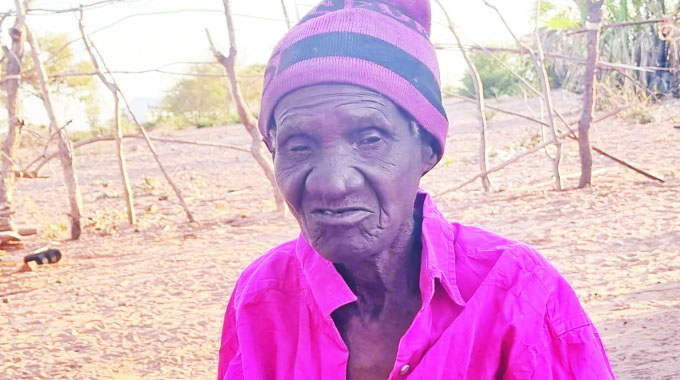
Phyllis Kachere
Deputy News Editor (Convergence)
As the effects of the El-Nino-induced drought experienced in Zimbabwe’s last agricultural season continue to increase vulnerability among the country’s population, a needs assessment exercise done in Binga District in Matabeleland North, Mwenezi in Masvingo and Gokwe in Midlands has revealed that people with disabilities and child-headed households are at high risk of food insecurity.
The needs assessment exercise was conducted by the Zimbabwe Red Cross Society (ZRCS) with funding from the International Federation of the Red Cross and Red Crescent Societies.
Eighty-four-year-old Mrs Salia Munsaka, whose age has greatly contributed to her poor eyesight which has rendered her semi-blind, lives in Kadika Village in Siansundu, in Binga district, Matabeleland North.
While Banene Salia, as she is addressed in her Tonga language has not been diagnosed with dementia, she exhibits such, as her mind wanders off as she attempts to explain events that occurred to her during her youth.
Banene Salia lives with her daughter, Ms Ndimba Mudenda (47), who has walking disability and is the head of their household.
Ms Mudenda, who has difficulty in walking, is also responsible for caring for her two children, a visually impaired sister Ms Kelesia Mudenda (60) who is unable to fend for herself, her elderly mother Banene Salia and Kelesia’s grandson Ashley.
“Our family relies entirely on farming as our main source of livelihood. Due to the drought, we did not harvest anything. I struggle to make ends meet as I fend for the six of us. Our situation has grown increasingly dire, especially after the loss of our livestock. I had five goats which were all devoured by crocodiles in the now receding waters of the Zambezi River, about 3km from our home.
“Because this season was a poor one, it only rained once, we did not harvest anything despite having practiced the climate smart agriculture we had been trained to do. I am at the end of my wits. I do not know how else I will provide for my family being a single parent. My eldest son should be in Form three, but stopped going to school soon after Grade 7. I could not afford to pay the school fees and uniforms,” narrated Ms Mudenda.
Despite her efforts to secure support through the Department of Social Development’s cereal distribution programme, the village committee responsible for her registration claim that a mismatch in her name prevented her from receiving any assistance during the last distribution.
“As a result, our household of four adults and two children now faces extreme vulnerability, with all eyes looking to me for survival, I do not know what else to do. I am now hopeless,” said Ms Mudenda.
She said the food situation in her household was dire as neighbours who used to assist them were also facing a critical food insecurity due to the drought. This was made worse by Binga’s location, in Agro-region V, which is characterised by low rainfall.
“We have one meal a day and rely on wild fruits. When we get some mealie-meal, I prepare porridge because if I prepare sadza, the mealie meal will quickly run out. Without a reliable support system, I don’t know how we will get through this drought.”
Unicef says people with disabilities make up around 15 percent of the global population.
This proportion is higher in developing countries, largely because of the cyclical relationship between disability and poverty.
The ZRCS, in partnership with Finnish Red Cross (FRC) and Danish Red Cross (DRC) is implementing a climate resilience project in Binga district from 2022 to 2025.
In an interview, ZRCS secretary general Mr Elias Hwenga, said the project aims to tackle the increased frequency and severity of disasters due to climate change, which predominantly affect vulnerable groups and disrupt food security and livelihoods.
“The project’s overarching goal is to boost community resilience via inclusive climate-smart adaptation initiatives. It offers practical methods for implementing climate-smart Disaster Risk Reduction and livelihood activities at the community level. It has three strategic goals: ensuring people can anticipate, respond to, and recover quickly from crises.
“This project is crucial given the challenges posed by erratic weather patterns and their impact on communities. These climate changes have heralded disasters that continue to impact negatively on the communities and causing serious shortages and lowering livelihood income-generating projects.
It is against this background that the climate-smart intervention seeks to build capacities of targeted communities and institutions to effectively prepare for, withstand, respond and recover from climate-induced disasters and crises,” said Mr Hwenga.
In Chikuni Village in Gokwe district’s Ward 12, Shingai Edward Mpofu (16) and his brother Tanaka (11), who stay alone, say food insecurity remains a real threat to their livelihood as the drought take a toll on their food reserves.
“Our father died some time ago and we stayed with our mother. Because our livelihood was under threat, she left us in search of employment in Botswana. We last spoke to her a week ago. She used to do menial jobs there and send us food and school fees. But now some misfortune befell her, she was hit by a car and is now disabled. She can’t walk and crawls for mobility and runs a small stall there in Botswana.
“She clearly is not making much money due to her disability, because even the regular food parcels that she used to send which we would supplement with our harvests from the field have dried out. We also did not harvest anything from the fields because of the drought,” said Shingai.
Shingai said while he will soldier on and attend classes at Nyoka Secondary School where he is enrolled, it was increasingly becoming difficult for them to get food, further exposing them to the harsh reality of food insecurity.
At another child-headed homestead in the same village, Delight Tsaura (17), whose mother died and was abandoned by his father who now stays in Empress with another wife, narrated his food insecurity situation.
“I stay with my now 18-year-old sister, who recently left me in search of domestic service job in Harare a week ago. I cannot afford to eat three meals a day. Before this drought, we would harvest surplus which we would sell and use the money to pay for my fees. Now, my fear is that my sister may end up in an early marriage to escape our poverty. I am unsettled, she is still young,” said Delight.
At Mrs Shaulani Makanganise’s homestead in Bhukuvhani Village in Ward 14 in Mwenezi, the situation was no different. The 71-year-old said she and her five grandchildren, one of whom is living with disability and cannot sit or feed himself have no food.
“Four of my grandchildren lost both parents and I am their only relative. I had to take them in. My 12-year-old grandson suffers from a disability whose cause I don’t know. Martin cannot sit, feed himself or speak. He just lies there. I have to lift him up for his toilet needs. I literary to everything for him. His mother went to South Africa when he was four years old. I do not know if she is still alive or dead. She has never sent word of her situation. I am struggling to feed them.
“Four of my grandchildren are of school going age, but they have since dropped out because of our situation. It worries me, but I have no choice. It is what it is,” said Mrs Makanganise.
According to the ZIMSTAT, people with disability in Zimbabwe make up an estimated 9 percent of the population, which represents more than 1.2 million people.
In April, President Mnangagwa declared a nationwide state of disaster and appealed for US$2 billion to the UN, aid agencies and individuals to avert hunger caused by the El Nino-induced drought.
The 2023 Zimbabwe Livelihoods Assessment Committee (ZimLAC) projected that 26 percent (2 715 717 people) of the country’s population would be food insecure during the lean period of January-March with 2 722 tonnes of grain comprising 405 tonnes of traditional grains and 2 317 tonnes of maize have been distributed to 247 576 food-insecure people, under the Food Deficit Mitigation Programme.


 Online Reporter