Sunday Mail Reporter
THE just-ended 2027 Pre-Budget Seminar in Bulawayo painted a compelling portrait of Zimbabwe’s economic transformation, revealing a nation that has not only weathered significant global challenges but has fundamentally restructured its economic foundations since 2017.
The data presented offers a striking narrative of resilience, growth and strategic vision that positions Zimbabwe as one of Africa’s most dynamic economies.
A decade of dramatic expansion
Perhaps the most striking revelation from Finance Minister Professor Mthuli Ncube’s address is the sheer scale of economic expansion Zimbabwe has achieved.
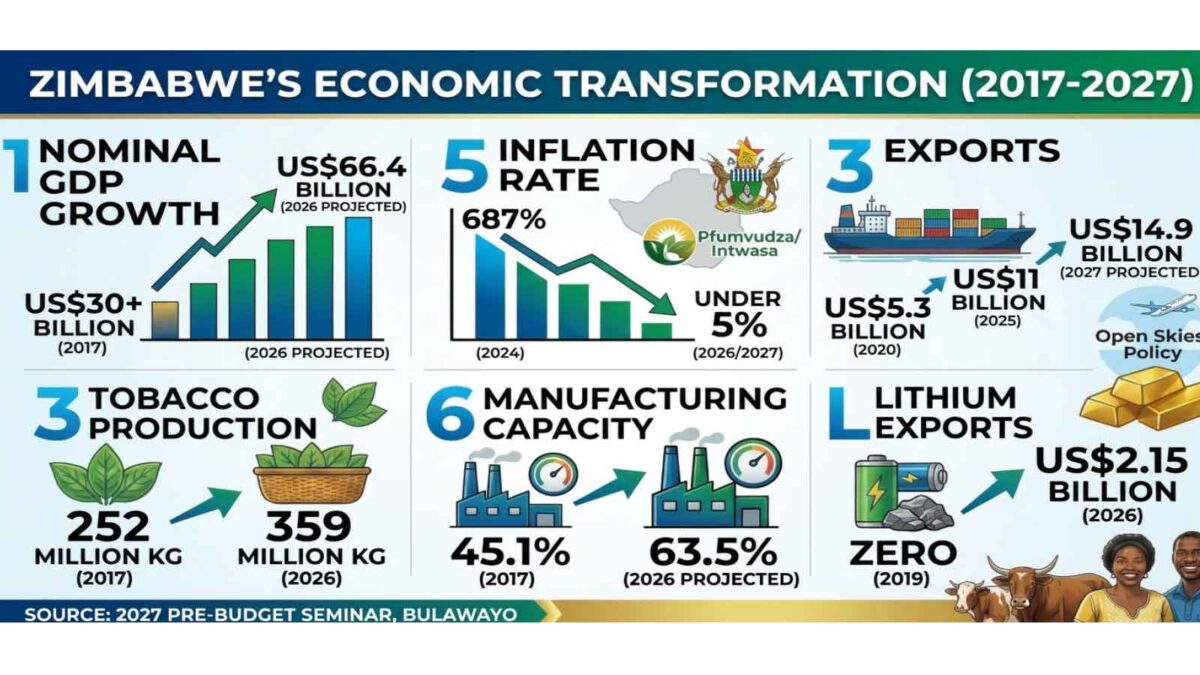
The national economy is now more than twice the size it was in 2017, with nominal gross domestic product (GDP) projected to reach US$66,4 billion this year and US$69,1 billion in 2027.
This expansion signals a fundamental transformation in the scale and sophistication of economic activity across all sectors.
Last year, the economy grew by 8,3 percent, making it the second-fastest-growing economy in Africa, surpassed only by Ethiopia.
This achievement placed Zimbabwe ahead of continental heavyweights such as South Africa, which grew by just 1,1 percent, and Nigeria, which recorded 4 percent growth.
Since stabilisation efforts began in 2018, Zimbabwe’s cumulative growth has outpaced the Southern African Development Community average, reaching approximately 16 percent compared to the regional bloc’s 10 percent.
Conquering the inflation demon
Perhaps no statistic better illustrates Zimbabwe’s economic turnaround than the dramatic reduction in inflation.
The country’s inflation rate has plummeted from a staggering 687 percent in 2024 to under 5 percent today, bringing Zimbabwe in line with regional norms. Monthly Zimbabwe Gold (ZiG) inflation remained subdued in the first nine months of 2026, averaging just 0,4 percent, while annual inflation averaged 4 percent over the January-September period.
September 2026 marked a historic milestone — inflation stood at 3,7 percent, representing single-digit inflation for the first time in three decades.
US dollar inflation has similarly stabilised around 3 percent. This achievement cannot be overstated for a nation that has historically struggled with currency instability and price volatility, and it represents the cornerstone upon which broader economic recovery has been built.
Agricultural resurgence and food security
The agriculture sector has emerged as a powerful engine of economic recovery, rebounding strongly in 2025 with growth of 27,9 percent. This recovery was supported by climate-smart farming practices under the Pfumvudza/Intwasa programme, alongside comprehensive Government input support.
Tobacco production has been particularly impressive, breaking records for two consecutive years — reaching 355 million kilogrammes in 2025 and 359 million kilogrammes this year, with contract farming accounting for 91,1 percent of deliveries. While the 2027 output is projected to adjust to 310 million kilogrammes due to anticipated El Niño conditions, the Government believes the foundation remains “ironclad”. The trend in livestock and dairy production is equally significant.
Milk production has nearly doubled from 66 million litres in 2017 to 131 million litres in 2026, aggressively substituting imports and empowering local value chains.
Egg production has surged from 37,8 million dozen in 2017 to 125 million dozen in 2026, putting cash directly into rural pockets.
The national cattle herd has recovered to 5,9 million in 2026 and is projected to break the six million mark at 6,1 million in 2027, driven by aggressive tsetse fly eradication, local vaccine production and artificial insemination programmes.
Industrial transformation and mining growth
The manufacturing sector has undergone significant structural transformation, with capacity utilisation climbing from 45,1 percent in 2017 to 61,2 percent in 2025 and projected to surpass 63,5 percent in 2026.
Manufacturing output is now 41,4 percent higher than in 2022, with total quantified private and public investments in the sector standing at an incredible US$3,56 billion.
The mining sector has delivered equally impressive results.
Gold output has doubled since 2017 to over 55,5 tonnes, while the lithium industry has scaled from zero in 2019 to 2,6 million tonnes in 2026. Domestic lithium exports reached US$2,15 billion in 2026, accounting for 45,6 percent of total mineral exports excluding gold, and overtaking platinum group metals in significance.
Tourism is also experiencing a remarkable boom, with arrivals surpassing 792 000 during the first half of 2026 alone, while tourism receipts grew by 6 percent to US$537 million.
The “Open Skies Policy” has proven successful, with airlines flying into Zimbabwe surging from just three during the Covid-19 era in 2020 to 20 in 2026.
Infrastructure modernisation continues at pace through the Infrastructure Development Fund. Major projects include the dualisation of the Harare-Mazowe section, rapid progress on the Harare-Beitbridge and Bulawayo-Victoria Falls highways, as well as the commissioning of major bridges.
Water security remains paramount, with Gwayi-Shangani Dam at 76 percent completion and Kunzvi Dam at 72 percent, supported by 5 395 boreholes drilled nationwide.
Robust export growth
Zimbabwe’s external position has strengthened considerably.
Exports doubled from US$5,3 billion in 2020 to US$11 billion in 2025, with momentum continuing into 2026 — exports rose by 60,7 percent to US$9 billion during the first eight months and are projected to reach US$14,9 billion by year-end. Diaspora remittances surpassed US$1,55 billion in the first half of 2026, 41,4 percent higher than the same period last year, and are projected to exceed US$3,2 billion for the full year. The country recorded a current account surplus of US$1,1 billion during the first half of 2026, compared with US$248,2 million during the corresponding period in 2025.
Gold and foreign exchange reserves have doubled from US$697 million in June 2025 to US$1,5 billion in June 2026.
By year-end, the reserves are expected to have grown to US$2,2 billion — covering roughly four times the entire stock of ZiG reserve money and market deposits.
Navigating global headwinds
Minister Ncube acknowledged significant global challenges, including elevated oil prices that surged to around US$120 per barrel in April 2026 due to Middle East tensions.
However, this same geopolitical uncertainty created opportunities for commodity exporters, as demand for safe-haven assets pushed gold prices to record levels above US$5 500 per ounce. The Government also responded swiftly by removing diesel taxes during the crisis to cushion domestic fuel prices.
Next year, economic growth is forecast to moderate to 3,5 percent due to anticipated climatic risks, particularly a potential super El Niño, and a more challenging external environment.
The 2027 National Budget will, therefore, focus on 10 priority areas, including macroeconomic stability, inclusive growth, infrastructure development and social protection.
Treasury emphasised that the Government will sustain structural reforms designed to enhance public spending efficiency and foster private sector-led growth.
“Our collective success rests on this shared momentum,” Prof Ncube said.
“By joining forces to pinpoint and unlock high-potential sectors, we will not merely sustain progress; we will propel a resilient, future-ready economy that delivers long-term prosperity.”
The data presented reveals a Zimbabwe that has fundamentally transformed its economic trajectory since 2017. From conquering hyperinflation to achieving Africa’s second-fastest growth rate, from agricultural resurgence to industrial expansion, the nation has built a foundation for sustained prosperity that few would have predicted a decade ago.
While challenges remain — particularly regarding climate risks and global economic volatility — the remarkable progress highlighted by Treasury suggests that Zimbabwe’s economic renaissance is not merely a statistical artefact but a genuine transformation with tangible benefits for its people.