peter
peter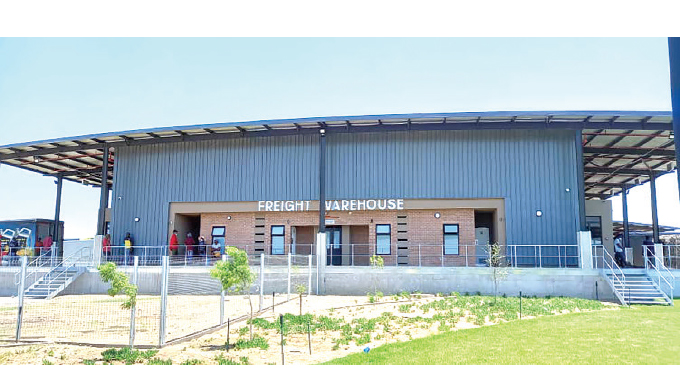
Thupeyo Muleya, Beitbridge Bureau
In the last 24 months, Beitbridge border town has been the centre of a massive infrastructure development revolution as the country gradually drifts towards attaining a middle-class income economy by the year 2030.
Some of the notable projects include the US$300 million border modernisation, Emergency Roads Rehabilitation Programme (ERRP), water, sewer, and housing development, among others.

The story of Beitbridge took a turn in 2018 when the New Dispensation introduced the 100 days cycle monitoring and evaluation concept.
It is understood that the main idea behind the initiative is to ensure that all tiers of government are fully equipped to meet development challenges to attain Vision 2030 and to achieve national priority goals as stipulated in the Transitional Stabilisation Programme.

For Beitbridge town, its transformation since independence had become a perennial mirage.
The town has been growing steadily at the instigation of the government through the National Economic Development Priority Programme in 2006, which gave birth to the Beitbridge Redevelopment Programme (BRP).
The government at that time spent millions of dollars in face-lifting the port into a modern urban centre, after the port was granted town status in the same year before upgrading into a municipality in 2018.

The BRP programme includes the construction of 16 blocks of flats to house 64 families, mainly middle-class civil servants, 250 core houses (for homeownership), 52 by F14 houses for civil servants, road dualisation, upgrading water supply, and sewer infrastructure in the town.

Other institutional facilities are a hospital, primary school, secondary school, civic centre, a new government composite office block, a modern truck inn, a shopping complex, a five-star hotel, an aerodrome, and the upgrading of the current border post to meet world-class standards.
Civil works on two-thirds of these projects are nearing completion, while others have been completed, and the government needs a further US$6,2 million to complete the outstanding civil works.

The town has an estimated population of 70 000, a daily transit population of 15 000 people, and the border clears about 7 million travellers annually.
In addition, 2 100 buses, 25 000 private cars, and 15 000 trucks pass through the town monthly.
A decade after the launch of the BRP, the government’s ambitious programme started folding and the town’s economic development plans went off the rails owing to a number of factors.
However, things have started to turn around again for the better since the coming in of the New Dispensation led by President Mnangagwa.

A lot of money has been invested in the town on infrastructure development, with Treasury pouring $597 million into the BRP housing projects last year.
Additionally, the government through the Zimborders consortium is modernizing the border at a cost of US$300 million.
The project also includes the off port works such as the construction of a new fire station, an animal quarantine, sewer oxidation dam, a landfill, road upgrading, construction of 220 staff houses, and 11,4 megalitres are some of the out-of-port facilities under construction.

The government and the Zimborders Consortium are implementing the massive infrastructure development initiative on a 17 and half year Build Operate and Transfer (BOT) concession. Zimborders Consortium’s General Manager, Mr Nqobile Ncube said the fire station will address the perennial fire and emergences rescue services decencies in the border town.
He said the project will be completed in the next five months.

“As you have noted, the Beitbridge border post-transformation project has some spillover effects on the local town’s infrastructure development.
Inside the port of entry we are building the freight terminal (already operating) under phase 1, a buses terminal under phase 2, and the pedestrian and light vehicles terminal (phase 3).
The last two terminals will be ready for use in June and November this year.
So, we are now carrying out full-scale civil works inside the Beitbridge community and this fire station is going to be a milestone achievement.”
He said the new fire station was an assurance for the broader Beitbridge community in relation to emergencies and fire rescue services.
Mr Ncube said that since time immemorial the Beitbridge Municipality and the Rural District Council had been struggling to attend to fire-related emergencies due to inadequacies in the requisite equipment.
“You will recall that in the past there have been a lot of issues in the media about fires and challenges within the local authority in their ability to attend to fire and related incidents.
The trigger aspect of the challenges which the border post on its own had when some State-warehouses got burnt down and all the other infrastructures”.
He said the consortium was working on creating a safe environment during and post the transformation of the port of entry.
“At the end of the day there must be a legacy benefit to this massive project is taking place.
It must not only be the people that utilize the border post that is going to be end beneficiaries,” he added.
The organisation’s (Zimborders) chief executive officer, Mr Francois Diedrechsen said that following the opening of the new freight terminal, issues of efficiency had started to improve.
“We have been able to return commercial traffic to the Zimbabwe transit route via Beitbridge border post where we are processing around 900 trucks daily up from 6000 before October 2021.
The town around time has improved from when truckers would spend five days to three hours because of the automated systems were are gradually introducing,” he said.
Beitbridge Town Clerk, Mr loud Ramakgapola said they were excited with the spillover effects of the border modernisation project.
“The border post-transformation comes in with a lot of infrastructure development initiatives some of them have been in our plans for a long time, but could not take off due to limited resources.
Our sewer has been upgraded and we have a fire station that is coming up, the road network is being upgraded from the border post towards the major cities including Bulawayo and Harare.
In addition, the Zimborders Consortium is also going to assist us to modernise our dumpsite in the west of the town, where we have already identified a site.”
He said the construction of a new 11, 4 megalitres reservoir will boost the town’s water supply capacity to supply at least18 megalitres of water daily.
A total of 28 F14 houses for civil servants were completed last year by the Government and have already been allocated to the beneficiaries.
In addition, the Beitbridge municipality is in the midst of upgrading major roads under the ERRP after getting $57 million from the government last year.
Towards the end of 2021, the government started upgrading the Beitbridge to Harare road starting at the border post entrance.
Ms Netsai Chikwanda of Dulivhadzimu suburb said, “The amount of development in the town is impressive and it’s pleasing to note that many residents were employed to carry out various projects.
You will also note that reliable infrastructure allows a smooth flow of business, for example there is the separation of traffic at various terminals at the border which is good to minimise congestion.
It also pleasing to note that the roads are getting surfaced while others are being maintained.”
A career community development worker, Mr Enock Kwinika said infrastructure was a key driver of economic development.
He applauded the government for investing in public infrastructure.
“For Zimbabwe to achieve an empowered and prosperous upper-middle society by 2030, there is a need for investing in public infrastructure.
We need to applaud the government for the development.
Modern infrastructure is giving Beitbridge a new face which is quite befitting for a town with the busiest border in the country,” said Mr Kwinika.
A local businessman, Mr Remember Ndou applauded the Second Republic for recognizing Beitbridge, through expediting the completion of outstanding major infrastructural development projects.
He said the town had been set on the right path for real transformation.
“I applaud the Second Republic and President Mnangagwa for recognising the need to transform our town.
Vision 2030 is attainable,” he said.
– @tupeyo.


 Online Reporter