Online Reporter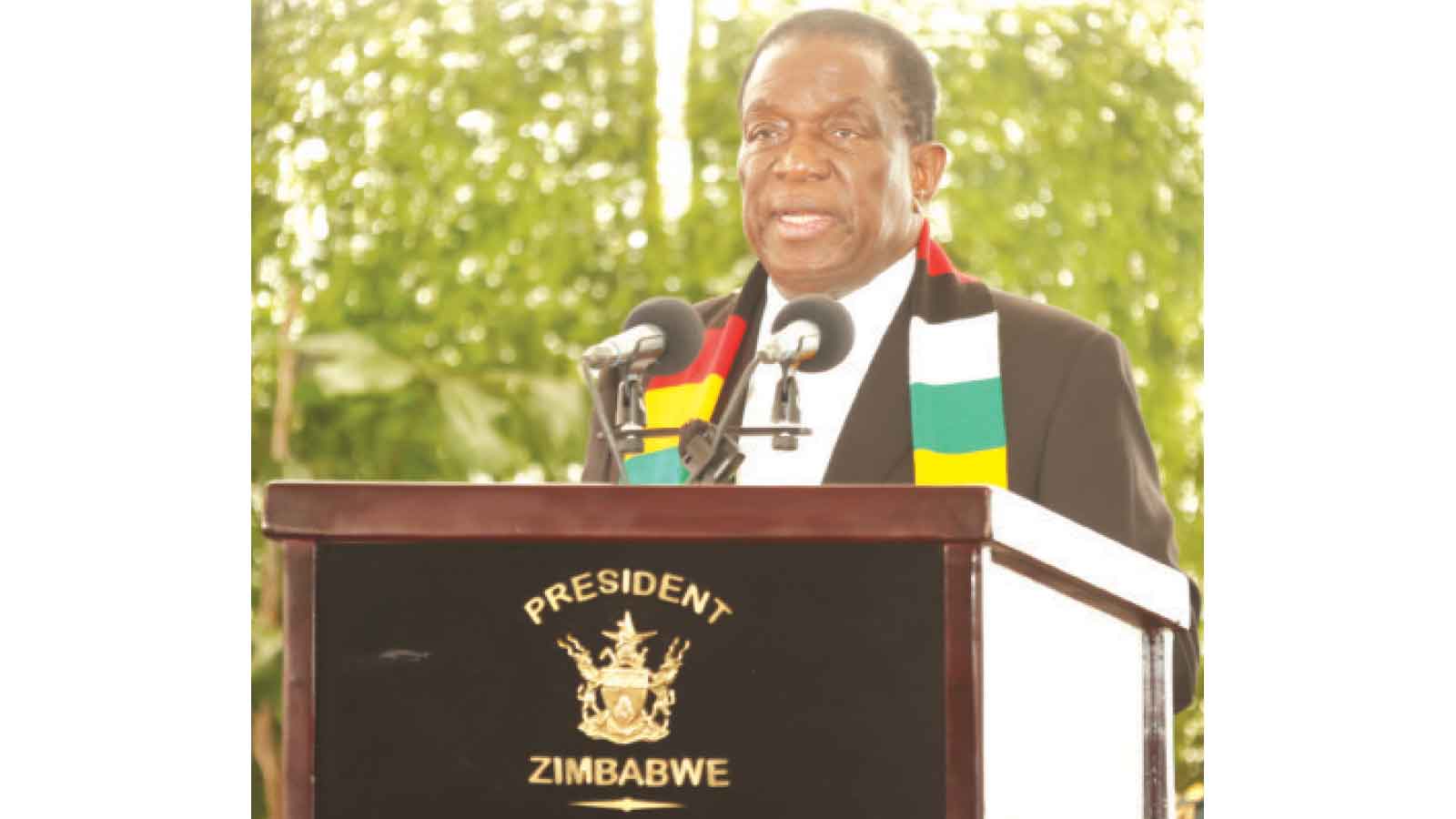
Zvamaida Murwira [email protected]
THE appointment of commissioners to five independent commissions is a significant step towards strengthening Zimbabwe’s constitutional democracy, with the new office bearers expected to advance accountability, justice and national development, President Mnangagwa has said.
The commissioners, who assumed duty yesterday, were sworn in by the President at State House in Harare.
President Mnangagwa said the commissioners carried an important responsibility to serve Zimbabweans through the mandates of their respective institutions.
“Today at State House in Harare, I had the honour of swearing in new Commissioners for our Chapter 12 Independent Commissions. These appointments are a vital step forward in strengthening our constitutional democracy,” said President Mnangagwa.
“Each of these institutions carries a profound mandate to serve the people of Zimbabwe. Zimbabwe Gender Commission (ZGC) – to promote true gender equality and equity. Zimbabwe Human Rights Commission (ZHRC) – to protect, promote, and enforce human rights. Zimbabwe Land Commission (ZLC) – to ensure accountability, fairness, and transparency in land administration. Zimbabwe Media Commission (ZMC) – to safeguard media freedom and uphold professional journalism standards. Zimbabwe Electoral Commission (ZEC) – to manage and oversee free, fair, and credible electoral processes.”
He urged Zimbabweans to work together towards national development.
“I congratulate all the newly sworn-in Commissioners. Your expertise and dedication will be instrumental in fostering accountability, justice, and progress across our nation. Let us work together to build the Zimbabwe we want,” said President Mnangagwa.
Speaking to journalists after the swearing-in ceremony, Information, Publicity and Broadcasting Services Minister Dr Zhemu Soda said Government expected the newly constituted Zimbabwe Media Commission (ZMC) to accelerate media modernisation, strengthen the sector and promote professional integrity.
He said the commission had a critical role to play in harmonising the media landscape following the expiry of the previous commission’s term.
Two chairpersons, Mr Anele Ndebele and Dr Leslie Ncube, were sworn in to lead the Zimbabwe Human Rights Commission and the Zimbabwe Gender Commission respectively.
Dr Soda said he expected the ZMC to strengthen the operating environment for the media sector.
“It has been a while since the last commission was in office. So with the coming in of the new commission, we expect a lot of modernisation of the media landscape in terms of researches that are supposed to be done and in terms of also strengthening the media ecosystem. There is also need to promote integrity, especially from the journalists, it is something that we expect to be achieved immediately with the new commission, and also to harmonise the media landscape,” said Dr Soda.
The newly appointed ZMC commissioners are Susan Makore, Caesar Zvayi, Munyaradzi Hwengwere, Rufaro Ellen Mhandu, Thokozile Chitepo, Merit Thokozile Munzwembiri, Tapiwa Mashakada and Tanaka Muganyi.
The ZMC is the constitutional body mandated to promote, develop and uphold media freedom and independence in Zimbabwe.
Speaking after being sworn in, Dr Mashakada, a former Cabinet Minister in the Inclusive Government, said he would carry out his duties in line with the Constitution and the Zimbabwe Media Commission Act.
“This is a constitutional duty that I will serve. I need to discharge my duties and responsibilities. Its the mandate that I was conferred upon by the constitution and the Zimbabwe Media Commission Act,” said Dr Mashakada.
He said his appointment followed a transparent and merit-based process.
“This is merited. I went through a rigorous interview, through parliament, and eventually appointed. So everything is in order,” said Dr Mashakada.
Mrs Makore said she would continue contributing towards the development of the media industry.
“I think it’s just to continue with the good things that we have been doing. As you know, the media is always evolving. So there is always something new and something to learn,” said Mrs Makore.
Zimbabwe Electoral Commission commissioner Mr Sheuneni Kurasha said elections must produce credible outcomes that ultimately benefit citizens.
“The role of the commission is to make sure that the environment is fair for everyone. Elections are critical because they are the only legitimate means of selecting national leadership. Post-election, it is even more important that we have an outcome that is capable of delivering for the citizens. Elections are not an end in themselves. They must be a means to an end,” said Comm Kurasha.
“For an average person, the value of elections comes from a legitimate government that has capability to be able to deliver on the economic front. And this is the mandate that ZEC carries.”
He said elections should serve as a vehicle for national development.
“Elections would have failed if in the end they do not help contribute to national development. When you look at elections in terms of the cost to fiscus, it is quite high. The value of that, the only way we can redeem value is if those elections then produce an outcome that is legitimate, that produces an establishment or an administration that is capable so that it delivers, to the citizens.”
Mr Ndebele said his appointment should be viewed as a call to national service rather than a personal achievement.
“I view it as a challenge to put shoulder to wheel and do national duty as expected. I am moving from being a backbencher into the executive branch of Government,” said Mr Ndebele.
Dr Ncube said one of his priorities would be to broaden public understanding of gender issues and the role of the Zimbabwe Gender Commission.
“In my tenure of office, there are quite a number of issues that we need to also demystify that gender issues are not only women, but also as men we have to lead. And when us as men lead on the output desk, we make a big and huge difference. So, in my office, I am actually going to work with quite a lot of people in the academia,” said Dr Ncube.
“It is going to be actually a multisectoral approach. There are quite lots of issues that we will have to deal with. We are going to work with all stakeholders. Gender issues need all of us to come in a multisectoral manner to address them. We need to also ensure that the girl child is protected and the boy child as well.”
The swearing-in ceremony was attended by Justice, Legal and Parliamentary Affairs Minister Ziyambi Ziyambi, Chief Secretary to the President and Cabinet Dr Martin Rushwaya, Deputy Chief Secretary for
Presidential Communications Mr George Charamba, Permanent Secretary for Information, Publicity and Broadcasting Services Mr Nick Mangwana, and other senior Government officials.