admin
admin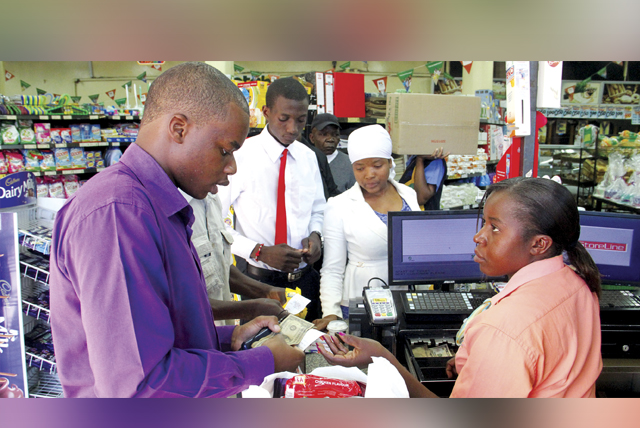
Livingstone Marufu —
FAIR is foul, and foul is fair, or so it has become in the retail industry. The cash crunch, which became progressively worse in January, has resulted in unimaginable pain for the informal sector whose lifeblood is cash transactions.
But for big retailers such as OK Zimbabwe and TM Supermarket, they have the infrastructure and capacity to process plastic money transactions through Zimswitch-enabled point of sale (POS) devices and therefore the convenient flight to plastic money has been very rewarding to them.
There is also an added carrot through the cash-back facility, where consumers are given an option to redeem a portion of the cash balances sitting in their debit cards, that is if they have bought some groceries.
Though the market has caught onto plastic money and bank transfers as alternatives to cash — with such transactions jumping from US$4, 8 billion to US$5, 5 billion between May and July 2016 — people still require money in their pockets for miscellaneous transactions.
It has become an irresistible draw card, especially in an environment where withdrawing cash from the bank has become a punishing undertaking.
Big retailers are now squeezing out the informal businesses, the majority of which are teetering on the brink.
OK Zimbabwe reported in the half-year period to September 30, 2016 that its bottom line, or net profit, rose 87 percent to US$2,3 million from US$1,2 million realised in the same period a year ago.
Revenues also jumped 2,3 percent to US$218 million in the period. Most interestingly, the growth in both revenues and profit was attributed to the growth in basket size (number of goods sold in a single purchase) and the increased usage of plastic money.
POS purchases now account for more than 80 percent of the group’s sales, up from 70 percent. The retailer indicated that consumers seem to be making a shift from informal traders to conventional stores with point of sale facilities in search of convenience and cash back.
OK Zimbabwe’s chief executive officer Mr Willard Zireva recently noted that business operations had shifted to electronic payment systems.
It was not the same story last year. In its interim financials released on November 13, 2015, OK Zimbabwe reported that revenues had declined by US$17 million to US$214 million.
Net profit also slumped 79 percent to US$1,2 million from US$4,3 million a year earlier. TM Supermarkets, in which South Africa’s second-largest supermarket chain store Pick n Pay holds a 49 percent stake, also reported rich pickings in its half-year results to August 28, 2016.
Notably, Pick n Pay’s share of TM’s earnings rose 81,5 percent to 28,5 million rand ( about US$2 million) But it is a different story for informal businesses, especially those that operate in downtown Harare.
Where informal businesses used to leverage on heavily discounted prices, which were made possible by virtually non-existent costs for rentals, wages and statutory obligations, the dynamics have since changed. In a survey conducted by The Sunday Mail Business at many “tuck shops” along Cameron Street, most of the businesses were lowly stocked.
Much of the weaknesses are being blamed on soft demand and cash shortages. With neither the wherewithal nor the capacity to have POS devices, informal businesses have another handicap.
They haven’t embraced mobile commerce (m-commerce) as yet since they also restock their goods using cash. As a result, big retailers are the ones capitalising on mobile payment platforms such as EcoCash, Telecash and OneWallet.
One trader, who requested anonymity as his business is not registered said, “Business here is at an all-time low as most customers are buying from big retailers where they can swipe and get cash.
“We are well aware that people are moving to plastic money but at the moment we can’t go down that route as our suppliers only require cash services.
“Even if we use point of sale machines and mobile money transactions, we still need cash to purchase our goods, but if the situation continues to deteriorate, many of us may be forced to close shop.”
The Zimbabwe Chamber Of Informal Economies Associations (ZCIEA) said there is need for Government to play a part in the transition of the informal economy to the formal economy. According to ZCIEA secretary general, Mr Wisborn Malaya, the current situation is even more challenging for individuals who were relying on their small ventures for sustenance.
“As we speak, business is very low, no one (is) coming to buy at our small shops due to liquidity crunch. People are preferring (sic) to buy in large retail shops where they can get some bit of cash.
“If the situation persists, many will close shop – which is not a good sign for our ‘informal’ economy.
“This will trigger unemployment levels to an unprecedented level. We also need swiping machines but the monetary authorities didn’t offer us even one, and we are now willing more than ever to transact using the swiping machines in a bid to survive the trying times.
“They should have carried out awareness campaigns, promotions and sensitisation as far as that issue is concerned but nothing like that was done.
“Very soon most of our members will be in rental arrears and more goods will be lost. This is not a good indication for the country’s economy which is mainly informal.”
But market watchers say the more transactions are captured in the mainstream economy, the more revenue accrues to Government, particularly in an environment where fiscalisation is gradually taking root.
Fiscalisation allows the Zimbabwe Revenue Authority (Zimra) to get information on transactions in real time, which minimises the chances of revenue leakages.



 Online Reporter