

 admin
admin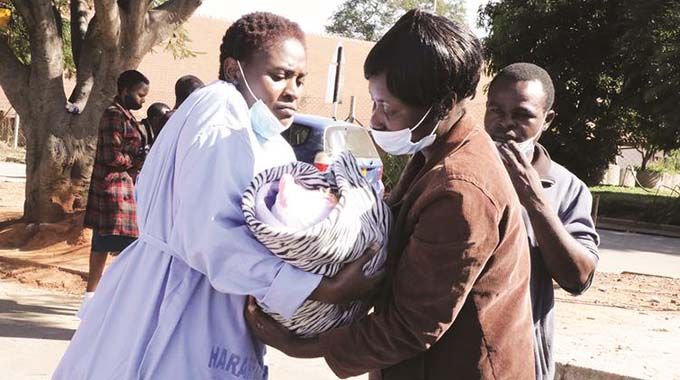
Rumbidzayi Zinyuke
Senior Health Reporter
Oblivious to the bittersweet story of her life, little Anotidaishe slept peacefully in her mother’s arms.
She has gone through a lot for such a tiny human being.
And she survived.
Sadly, her conjoined twin sister did not.
Anotidaishe and Atipaishe Mutare were born in December in the small town of Banket, joined at the abdominal-pelvic region, sharing a liver and some parts of their intestines.
At 73 days, a surgical team from Sally Mugabe Central Hospital (Harare Hospital) carried out an extensive operation to separate them.
After staying in hospital for almost five months, the Mutares left the hospital on May 12, without Atipaishe who died on April 20.
The twins’ mother, Martha Nyampipo (31) said she never knew that she was carrying twins, conjoined for that matter.
“Mine was a normal pregnancy. I never suspected that I was carrying twins. When I started getting early labour pains, the nurses at our local clinic told me I should go for a scan since my baby seemed to be in a breech position. That is when I discovered that I was expecting twins,” she said.
Three scans later, she was confused.
One scan showed that she was carrying twins, the other showed that the twins could be sharing some organs and yet another one told her each baby was in her own sac and not sharing any organ.
She only confirmed that the children were conjoined the day she delivered at Banket Hospital.
“I delivered at 35 weeks and we were transferred that same day to Sally Mugabe Children’s Hospital where we spent two months while the doctors were preparing for the operation to separate them. Although I was worried at first, I was happy when the surgery went according to plan. I was happy that my children would live a normal life. But God had other plans for us, on April 20 Atipaishe died.
“I was devastated. Words cannot begin to describe the pain of losing my child but I have accepted that it was God’s decision for this child to pass through our lives for a short time before leaving this earth,” she said.
Anotidaishe, however, is doing very well.
She started breastfeeding shortly after her operation and has not had any complications after that.
She lay peacefully as her parents narrated the story of her little eventful journey on this earth.
Hers has been a life of firsts.
Even the father Mr Tapiwa Mutare (37) said he had never heard about conjoined twins before this.
“I have never seen anything like to this; I did not even know that conjoined twins existed before ours were born. It took me time to understand and accept that this was the gift that God had given me and my family,” said the father who was torn between being happy that the operation to separate his daughters had been successful and grief that one of them had not made it.
“I didn’t know what to expect before or after the surgery but when the doctors explained everything, I put my trust in them. We prayed to God for these children to survive the operation and live a normal life.
“The day they were separated was the happiest of my life. Our prayers had been answered,” he said.
He said the doctors had, however ,warned them that for twin two (Atipaishe), the journey to healing would not be smooth. Being the smaller of the two, Atipaishe also got the smaller share of their liver and large intestine.
“We were prepared to face some challenges along the way but we hoped she would heal like her sister.
“I spent the week she died here at the hospital and I was here as her condition deteriorated until the day she died. I have accepted her death and that God had intended for us to have her for only a short while,” said Mr Mutare.
For Anotidaishe, the road to total health is still long.
She still has to undergo another procedure to allow her to pass stool normally.
“For now, everything looks well but the doctors said the challenge is not yet over, she still has another procedure to undergo. Because they shared the large intestine, the doctors inserted a tube into Anotidaishe’s large intestine through the abdomen which she is using to pass stool. The procedure will be to create a way for her to pass stool normally,” he said.
Atipaishe might be gone but, a major part of her will always live on in Anotidaishe, said Mr Mutare.
He said they had kept all pictures of the girls from the day they were born until the last day of Atipa’s life.
Anotidashe will grow up knowing she was born different.
“That she had a sister and they shared more than their mother’s womb.
“Although Atipaishe is no longer with us physically, she will always be a part of Anotidaishe’s life. We have kept all records of the journey they shared together and we have the pictures. We will always tell her that she was born different. She will know that although her sister did not make it, they were a unique set of twins,” he said.
But as they left the hospital, which had been a sanctuary for five months, the Mutares were a worried lot.
They have no steady income to support their growing needs.
With two other children, aged eight and five, Anotidaishe’s medical bills and travelling costs for her doctor’s appointments, life will get tougher.
Mr Mutare earns his money doing menial jobs that he gets paid for, his wife also helps out here and there, but the family has been living from hand to mouth.
“I am grateful to the team at Harare Hospital for all they did for us. The separation procedure was done for free and so was our stay in hospital.
“But we will have to cater for Anotidaishe’s special needs when we get home. She needs diapers because she cannot wear reusable napkins until her wound heals and we will be travelling to Harare a lot for her doctor’s appointments. We are not in a position to afford all of this and we are appealing to well-wishers to assist us as we go through this journey with her,” said Martha.
Anotidaishe will be back in Harare this week for her doctors to assess her condition.
Anotidaishe and her sister were the second conjoined twins to be separated in Zimbabwe after the first major operation on another set of conjoined twins in July 2014. Kupakwashe and Tapiwanashe were joined from the lower chest to the upper abdomen and also shared a liver.
There have been other documented cases of conjoined twins where one was referred to Canada for separation, while in two other instances the babies died before surgery.
Conjoined twins are rare and it is estimated that their occurrence ranges from 1 in 50 000 births to 1 in 200 000 globally.
The overall survival rate for the conjoined twins is approximately one in four.
According to experts, conjoined twins develop when an early embryo only partially separates to form two individuals. However, the separation stops before the process is complete, leaving the babies joined most often at the chest, abdomen or pelvis. The twins normally share one or more internal organs.
There has been no evidence to show that conjoined twinning can be attributed to genetics, the mother’s behaviour, trauma, a virus, illness, environmental issues or any other factors which means there is no known way of preventing it from happening. It remains a mystery that only the few who encounter it, like the Mutares, can relate to.
◆ Feedback [email protected]


 Online Reporter