admin
admin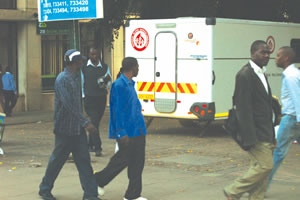
ringed in the name of a national body mandated with collecting blood for life-saving purposes.
The caravan, sitting under a large tree, is as solitary as its next door neighbour on Harare’s First Street, which happens to be a police post.
As people go about their business, the contrast between the general languor in and around the white caravan and the hustle and bustle at a nearby bank, on the street or on the other side of the street where a communication giant has shop, is distinct.
One thing is clear: people seem to find more urgency in other things than popping into the white caravan, despite its being placed at a traditionally prominent area. Suffice to say, if and when the caravan is removed after a stint on First Street, not many people will take notice. Or care, really.
Blood transfusion is critical where people lose a lot of blood during road traffic accidents, and in the management of malaria.
However, Zimbabwe’s national blood bank, which refers to a cache or bank of blood or blood components, is facing a great liquidity challenge. The solitary mobile blood bank on First Street provides a clue to this.
Zimbabwe’s national blood bank has only 1 200 units out of the optimum 3 000, representing, according to the National Blood Services of Zimbabwe, seven days’ supply.
A blood unit is a unit of volume for human blood and various blood components or products, with a “whole” unit said to be 450 millilitres. The adult human body contains roughly 12 units of whole blood.
It is estimated that only 4 out of 1 000 people donate blood in Zimbabwe against the World Health Organisation’s minimum of 10 in 1 000. A statement by the NBS on World Blood Donor Day, marked every June 14, pointed that Zimbabwe once had 37 722 donations in 2007 but currently the number stands at 41 213″.
“We get 70 percent of blood collections from the youth 16-19 years of age and the balance from adults,” says Esther Masunda, Public Relations Manager of the NBS.
The reliance on schools for blood donations has turned out to be Zimbabwe’s major challenge.
Masunda cites shortage of resources for donor recruitment/mobilisation activities for example funding for awareness campaigns and equipment such as caravans and vehicles; low uptake of post donation counselling, shrinking factory/industrial panels due to factory closures, non-availability of permanent facilities to establish static clinics, among other things impinging on the collection of blood.
“Any activities that have a negative impact on the school calendar will inadvertently affect our outreach programme,” she complains on what has come to be blood donation’s fat cow.
On the other hand, adults have been giving many excuses when called to give blood.
“I last donated blood when I was in high school seven years ago, now I simply do not have the time,” says mother of one Sheila Muponda (25) from Harare’s Msasa Park.
“We used to get the blood transfusion people coming to our school and I would go like many of my colleagues, after all there were free bread and drinks,” she added.
She maintains that if she had a bit of time to spare in her airtime vending job she would voluntarily give blood like she did in the past.
“My church does not allow me to give or receive blood, it’s unclean,” is the belief of 52-year-old Samson Vheremu of Sunningdale a devout Christian with an international denomination.
“Even if it means death, I won’t receive or let my children get someone else’s blood,” he declared. A worker at a mobile clinic in Harare told The Herald that some people got nervous at the prospect of having their blood examined for fear that they might be found to be HIV positive, which is the worst case scenario for many people.
“Some people prefer to stay in the dark, you know,” observed the lady.
If someone’s blood tests positive for HIV, hepatitis B, Hepatitis C and syphillis the donor is notified through post and the donated blood discarded. Shying from donating blood, however, is a global problem, which authorities hope should be overcome sooner rather than later. One journal lists 10 reasons that make people reluctant to give blood.
These are:
lFear of, or discomfort with, needles
lPreoccupation with other things
lLack of personal initiative; not realising that there is need to donate
lHaving already donated that year
lFear of contracting HIV through needles
lThinking one’s blood “isn’t the right type”
- Thinking that one may not have “any blood to spare”
- Fear that one might feel weak afterwards
- Uncertainty over age or past health problems
- Believing that a “rare” blood type should be donated where there is a special need
However, the NBS in its official website www.bloodbank.co.zw states that donating blood is a simple, rewarding exercise.
It says: “Donating blood is a safe, simple and rewarding experience that usually only takes 40-60 minutes. The donation itself is only about 10 minutes.”
To donate blood one has to first register where one will be required to read information about donating blood if a first time donor and complete a donor registration form with demographic and basic health information.
Pre-donation screening involves a blood bank employee asking the donor some questions about individual health, lifestyle and disease risk factors. These details are kept confidential.
During this process a blood donor’s weight and blood pressure are checked. A drop of blood from the finger will also be tested to ensure the donor’s blood iron level is sufficient before the donating.
Assures NBS: “All medical equipment used for this test as well as during the donation process is sterile, used only once and then disposed.”
The third process, the donation itself, involves the donor being ushered to a donor bed/chair where his or her arm will be cleaned with an antiseptic and a needle for the blood drawing procedure is inserted. The donor will have 7-10 minutes to relax while the bag is filling and when approximately 450mls of blood has been collected, the needle will be removed and a bandage is placed. The last step, the post-donation, entails the donor will receive refreshments. The donor is encouraged to stay until he or she feels feel strong enough to leave.
The NBS advises: “After donating, you should increase your fluid intake for the next 24-48 hours; avoid strenuous and physical exertion, heavy lifting or pulling with the arm for about 5 hours.
“If you have any questions concerning your donation or experience any unexpected problems please call the centre where you donated blood.”
Tradition has also come to accept the necessity of donating blood.
“In the old days it used to be taboo to give or receive blood because the blood is sacred and belongs to the ancestors,” said traditionalist Professor Gordon Chavhunduka.
“It is no longer the case and actually it helps people in need. I urge people to donate blood because it saves life.”
Emmanuel Nyamande, who was involved in a horrific accident in Masvingo that claimed his left arm and lost a lot of blood in the incident, has lived to testify to the importance of having a ready blood bank.
After a life-threatening delay of 10 hours during which time he lost almost half of his blood and he fell unconscious, blood transfusion was the only way he could be saved.
“I received over five units of blood, which is no small amount of blood by any measure,” he narrated at the launch of the World Blood Donor Day in Harare.
World Blood Donor Day, focuses on the importance of donating blood, motivating people to donate, and the need to clear misconceptions about blood donations. The day also encourages the developing world, where donations are fewer than 10 per 1 000 and the need for blood is high.
The theme for this year was: “More blood, More Life.”
“If it was not for the timely transfusion, I definitely would have died. It is everyone’s responsibility to give blood since you do not know who it might save tomorrow,” Nyamande said.
[email protected]


 Online Reporter