Online Reporter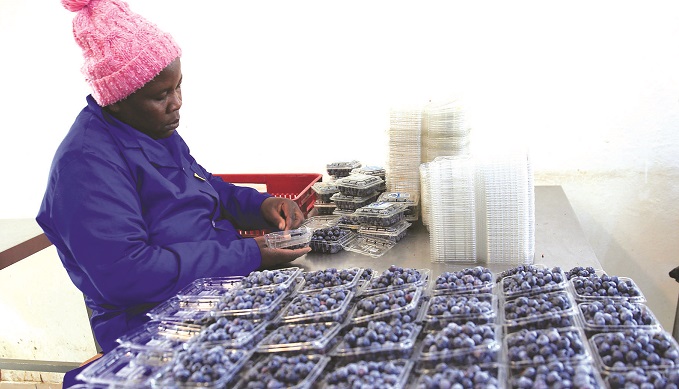
Word From The Market
Tina Nleya
OVER the past few weeks, there has been a surge in interest around blueberries. Zimbabwe is making headlines as one of Africa’s emerging leaders in premium blueberry exports, thanks to investments through both commercial and outgrower models.
Before farmers rush into what appears to be a blue revolution, it is crucial to understand that blueberry production demands knowledge, patience and serious financial commitment.
Why blueberries?
Blueberries are globally in demand, prized for their health benefits and high antioxidant content. Major markets like Europe, the Middle East and Asia are driving up the demand. Additionally, Zimbabwe’s favourable climate and export windows, particularly when northern hemisphere producers are off-season, give our farmers a strategic edge. According to data from the Agricultural Marketing Authority (AMA), blueberry exports from Zimbabwe have been steadily growing, with international buyers praising the quality and timing of our produce.
Despite the glitter, farmers must enter this space with their eyes wide open.
The crop itself
Blueberries are grown as shrubs that typically reach 1-1,5 metres in height. The berries start green and turn a rich dark blue when ripe.
A fully mature bush can yield about 4-6kg of fruit annually under optimal conditions.
In the first year of planting, yields are minimal and the focus is mainly on establishing the plant structure through careful pruning and nutrient management.
In fact, blueberries should not be expected to generate meaningful returns until the third year onwards, a reality many new farmers may not be prepared for.
Getting started: What you need to know
- Capital investment
Starting a hectare of blueberries requires a significant upfront investment. Key costs are on the following:
Land preparation and raised bed construction
pH adjustment (blueberries prefer acidic soils)
Irrigation infrastructure
Netting and bird-proofing
Planting materials (often imported)
Fertigation and monitoring systems
It is not uncommon for setup costs to exceed US$20 000 per hectare, excluding operational costs.
- Soil and water requirements
Blueberries thrive in acidic soils (pH 4,5-5,5) with excellent drainage. Many farmers are using peat moss or coco peat to amend soils. Quality water is a must, free from bicarbonates and with low salinity. A water test is mandatory before you invest.
- Fertilisation and flushing
Blueberries are highly sensitive to fertilisers, especially nitrates. The fertilisation programme is delicate and farmers must engage in a period of flushing the plant with water to prevent nutrient burn, particularly before and after pruning. Getting this wrong can kill your plants or severely compromise yields.
- Pruning and structure building
The first year is about building the right plant structure. Farmers are advised to prune back the main stem to promote 6-8 strong lateral branches per plant. More branches may seem better, but this often reduces berry size and increases the risk of structural failure when fruiting begins.
- Pest and disease management
Despite being a high-value crop, the blueberry is vulnerable to a wide range of pests and diseases. These include:
Botrytis, mummy berry and anthracnose (diseases)
Thrips, stink bugs, root weevils and bud mites (insects)
What complicates matters is the export market’s strict residue limits. Excess spraying can disqualify your product, while underspraying can lead to damage and rejection.
Know your market
The global blueberry market is growing, but it is also extremely competitive. Export buyers have strict requirements on berry size, firmness, sugar content and absence of blemishes. Moreover, logistics must be spot on: blueberries are delicate and require cold chain handling from harvest to market.
Local demand is growing too, especially among health-conscious consumers, hotels and niche retailers. However, the local market still offers lower prices compared to the export market and can only absorb a fraction of what is produced.
Key takeaways before you dive in
Start small and learn. Begin with a pilot hectare and grow gradually.
Partner with experienced players. Consider joining an outgrower scheme that can provide training, planting materials and a ready market.
Have a market before you plant. Never assume demand; talk to potential buyers first.
Invest in knowledge. Attend training sessions, field days or consult experienced agronomists.
- Understand the time lag. You won’t make money in year one or two. Plan your cash flow accordingly.
Final word
Blueberries represent an exciting opportunity for Zimbabwean horticulture, but they are not for the faint-hearted. They demand precision, patience and proper planning.
If done right, they can yield an impressive return, but if approached casually, the losses can be just a great. As always, Word from the Market encourages farmers to adopt a market-first mindset. The crop must not lead the market; the market must lead the crop.



 Online Reporter