admin
admin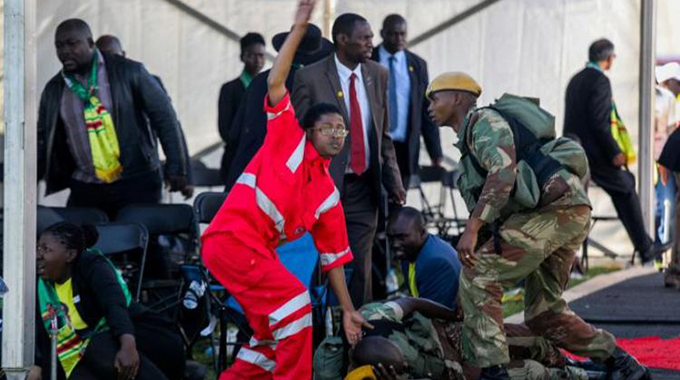
Climate Story Jeffrey Gogo
The bomb attack at White City Stadium is heartbreaking in many ways, but once again exposes the extended danger and risk that people living with disability face at a time of disaster, man-made or natural. In the disturbing video footage shown on national television and circulated widely on various social media platforms in the aftermath of the June 23 blast, one event is particularly distressing.
It is the sight of Zanu PF disability focal person Joshua Malinga stuck in his wheelchair, unable to wheel himself to safety, as everyone else around him able of body scurried for cover.
He was just there seated, hoping for Divine intervention or that there wouldn’t be a second explosion.
Thankfully, there wasn’t.
Noone cared to move him to safety, even though he was surrounded by thousands of people.
The image of an exposed and helpless Mr Malinga, overwhelmed by his own disability and abandoned by those around him as they ran for their lives, has largely gone unnoticed in the chaos following the attack.
But it is clear from the brief material available that he was terribly shaken by the events of that day, events that even if he wanted to, could not escape.
Seconds before the blast, as dignitaries led by President Mnangagwa made a beeline off the podium after he had finished addressing the thousands of Zanu PF faithful, the video footage shows one who looks like Vice President Constantino Chiwenga leaning over towards Mr Malinga for a quick handshake.
As the hands connected to heartfelt comaraderie, disaster struck.
Everyone scattered and many took to their heels, some engulfed in the plumes of dust and smoke tossed into the air by the explosion, and yet others attended to their own injuries.
Malinga became the last man standing – well, sitting – if only because he did not have any other choice.
The footage does not reveal any other detail on the fate of Mr Malinga after this.
Though he later tweeted, “Now home and safe.”
The assumption here is that whoever helped him get home safely did so only after they had first ensured their own safety.
A natural reaction, perhaps, but one that doesn’t completely break-free from the feeling of an after-thought.
Climate bomb
There are around 900 000 people living with disability (PWDs) in Zimbabwe, but many with physical disabilities are not known to or supported by the social services department.
The incident involving Mr Malinga at White City – an unfitting name to the occasion of a dark event – illustrates the sort of vulnerability and risk that PWDs face at a time of disaster.
In a sphere teeming with poverty and lack of opportunity, some people with disability will look at Mr Malinga as privileged by virtue of his position as Special Advisor on disability to the President.
But even his high office did little to save him at a time of mayhem, something that thousands of other PWDs in Zimbabwe grapple with more frequently now due to climate change-induced flooding and drought.
People with disability are often excluded from disaster response efforts and particularly affected by changes in terrain resulting in disaster.
Due to inadequate physical accessibility or loss or lack of mobility aids or appropriate assistance, the disabled are likely to be deprived of rescue and evacuation services, relief access, safe location/adequate shelter and other services.
Emotional distress and trauma caused by a crisis situation often has long term consequences on people with disabilities.
One can only imagine what Mr Malinga, the White City bomb survivor, a leader in disability advocacy, is going through right now. Brave man!
Not enough preparation
Much of the problem though isn’t about the sort of action taken during disaster, but that which isn’t taken prior.
In 2017, as the deluge from Cyclone Dineo swamped rural villages in the hotpots of Muzarabani, Tsholotsho and Chipinge, disability lobby group NASCOH estimated that thousands of people with disability were affected.
The full extent of the impact is not known.
What is known, according to the then NASCOH executive director Farai Mukuta, is that the number of PWDs in these areas was not clearly defined, and that a lack of understanding of their needs with regards to rehabilitation therapy, accessible housing or sanitation facilities heightened vulnerability.
This lack of preparedness means that people with disability can easily become invisible during emergency situations, as did Joshua Malinga at White City.
And because at a time of disaster everything becomes urgent, the success of any rescue operation depends of the kind of preparation made before the emergency.
Here, Constitutional provisions for people with disability aren’t absolute.
Unlike provisions for other vulnerable groups like women or children that are binding, those for PWDs depend on Government’s benevolence, whether there is any money to provide the facade of social protections that are a Constitutional guarantee.
It applies now and in future, what Mukuta said a year ago, in light of Mr Malinga and the bomb.
“This is the right time for communities to understand and deal with disabilities, they discover how to think about and understand the special needs of PWDs during disaster management,” he said.
God is faithful.


 Online Reporter