
Nyasha Tanyanyiwa-Correspondent
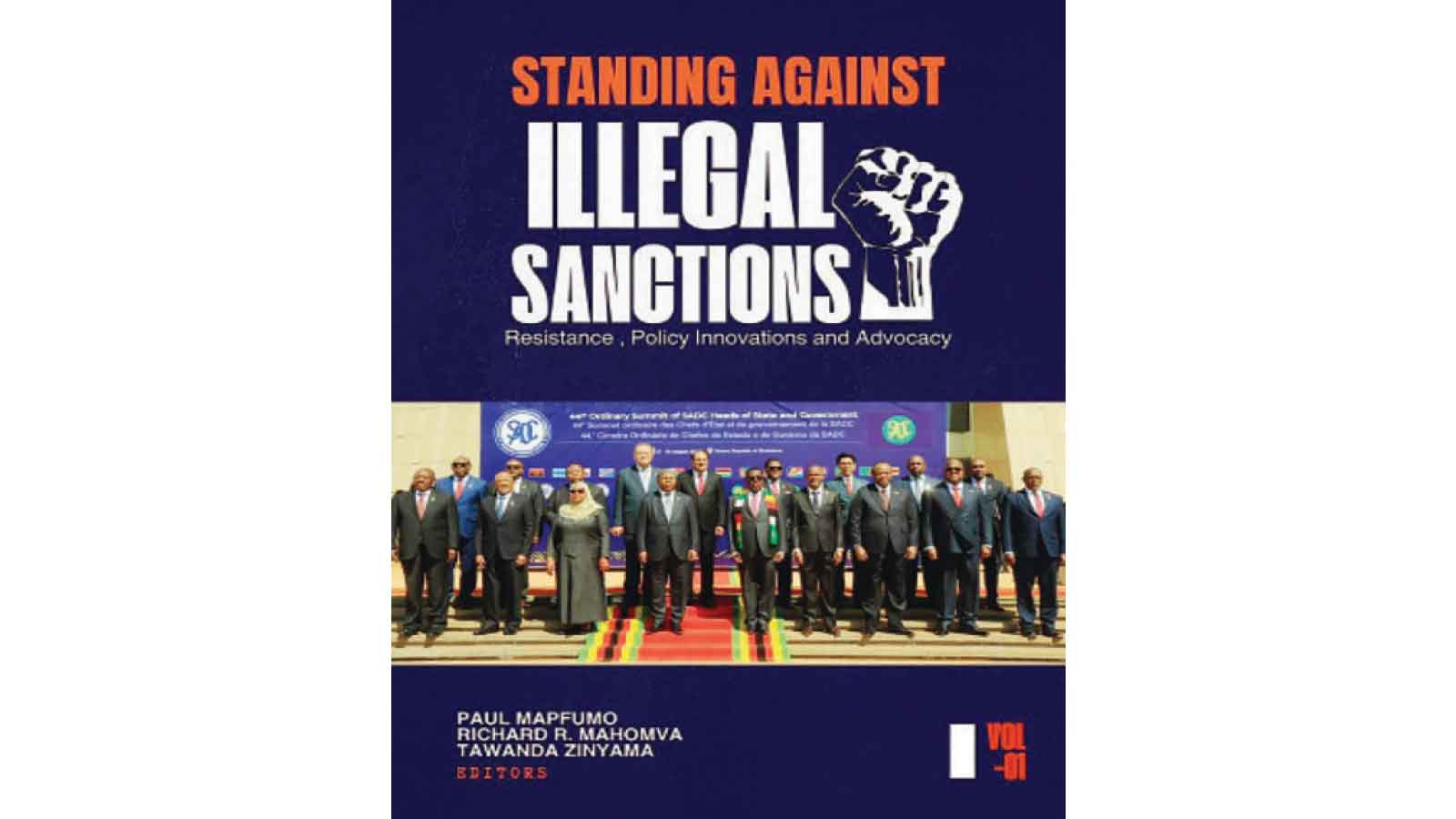
The recently launched book, “Standing Against Illegal Sanctions Resistance, Policy Innovations and Advocacy” presents a much-needed to the discourse of democracy between the Global-North and the Global-South.
Through the introduction the central thesis is established: sanctions imposed on Zimbabwe by the United States and the European Union are not only illegal under international law, but constitute a deliberate neo-colonial strategy to undermine the nation’s sovereignty and reverse the gains of its liberation struggle!
The editors, Prof Paul Mapfumo, Dr Richard Runyararo Mahomva, and Mr Tawanda Zinyama, frame the economic hardships in Zimbabwe not as a result of domestic policy failures, but as the intended outcome of a Western-orchestrated “political-economic crisis” designed to catalyse regime change (Mapfumo et al, 2025, p1).
This perspective aligns with a broader school of thought in African political science that views international relations through the lens of continued imperialist domination, albeit in new forms. As argued by the Cameroonian historian and political philosopher Achille Mbembe in On the Postcolony, the end of formal colonialism did not signify the end of Western hegemony, which often persists through economic and diplomatic coercion (Mbembe, 2001, p66).
The book’s foundational argument resonates with this, positing that ZANU PF’s continued stay in power is, in itself, the primary indicator of the sanctions’ failure and the nation’s resilience against this neo-colonial pressure (Mapfumo et al, 2025, p1), a point that is pivotal to the Government’s own narrative of patriotic history.
The book proceeds to dismantle the Western justification for sanctions, particularly the Zimbabwe Democracy and Economic Recovery Act (ZIDERA) and the EU’s targeted measures, arguing that they are disingenuous and have a collective, structural impact that harms the general populace rather than a few political elites.
This critique is supported by referencing scholars like Damrosch (1993) and Gordon (2002), who highlight the indiscriminate nature of economic sanctions. To bolster this with a specifically African legal perspective, one could cite the work of Nigerian scholar Obiora Chinedu Okafor, who in “The African Human Rights System, Activist Forces and International Institutions” explores how external interventions often exacerbate human rights issues rather than alleviate them (Okafor, 2007).
The book convincingly argues that the real targets are Zimbabwe’s public services education, health, and infrastructure thereby creating mass discontent intended to turn the citizenry against the Government (Mapfumo et al, 2025, p2), a strategy the authors label as a weaponisation of economic pressure.
Historical Context: Land, Liberation, and the Lancaster House Legacy
The historical contextualisation provided is crucial to understanding the Zimbabwean government’s stance. The book accurately traces the roots of the conflict to the land question, framing the post-2000 fast track Land Reform Programme not as an arbitrary act of seizure, but as the fulfilment of a “sacred promise” of the liberation struggle to redress historical injustices (Mapfumo et al, 2025, p5).
This narrative draws heavily from the work of Zimbabwean scholars like Sam Moyo, whose extensive research on the land issue argues that “the colonial Land Apportionment Act of 1930 created a fundamental racial and economic disparity that demanded correction” (Moyo, 1995, p45).
The book powerfully characterizes the sanctions as an “extension and unjustified perpetuation of colonial condescension” (Mapfumo et al, 2025, p6), directly linking contemporary international policy to a historical continuum of dispossession.
This aligns with the arguments of scholars like Mahmood Mamdani, whose “Citizen and Subject” explores how colonial administrative structures created enduring political identities and conflicts, which in Zimbabwe’s case, crystallized around the land (Mamdani, 1996, p24).
Furthermore, the book addresses the Lancaster House agreement, accusing Britain of reneging on its legal obligations regarding land compensation. This, it argues, exposed the agreement as a temporary suspension of the armed struggle rather than a genuine decolonisation of economic structures (Mapfumo et al, 2025, p.6).
This perspective is supported by Ibbo Mandaza’s (1986) analysis, which views the negotiated settlement as having preserved significant colonial and white-settler interests (Mandaza, 1986).
The book thus situates the sanctions within what it terms the “unfinished business of colonialism,” arguing that they are a punitive response to Zimbabwe’s attempts to achieve genuine economic sovereignty (Mapfumo et al, 2025, p7). This view is echoed by Sabelo J. Ndlovu-Gatsheni, a prominent Zimbabwean intellectual, who in “Empire, Global Coloniality and African Subjectivity” argues that the global order remains structured by colonial power matrices, and resistance to it, as in Zimbabwe’s land reform, is often met with fierce opposition from the core capitalist states (Ndlovu-Gatsheni, 2013).
The Second Republic: A Shift in Tactics and the Diplomacy of Re-engagement
“Standing Against Illegal Sanctions Resistance, Policy Innovations and Advocacy” is dedicated to analysing the political transition from Robert Mugabe to President Mnangagwa and the subsequent policy shift. It notes a strategic move away from Mugabe’s “radical diplomatic delink” towards a policy of “Engagement and Re-engagement,” under the banners of “Zimbabwe is Open for Business” and “Friend to All and an Enemy to None” (Mapfumo et al, 2025, p8).
The authors present this not as a capitulation to Western demands, but as a “smart advocacy thrust” and a “remodelled statecraft outlook” that continues the anti-sanctions resistance through different means (Mapfumo et al, 2025, p8).
They list various national development programs, such as the Transitional Stabilisation Programme (TSP) and the National Development Strategy (NDS 1), as evidence of the Second Republic’s commitment to endogenous growth and resilience (Mapfumo et al, 2025, p11). This narrative of policy renewal and economic innovation is central to the government’s claim of legitimacy and effectiveness in navigating the sanctions regime.
The book also highlights Zimbabwe’s diplomatic successes, particularly its chairmanship of SADC and the regional bloc’s establishment of an Anti-Sanctions Day on October 25. This is framed as a major victory for African solidarity and a testament to Zimbabwe’s role as a “citadel of African diplomacy” (Mapfumo et al, 2025, p11).
From a Pan-Africanist theoretical standpoint, this aligns with the ideas of Kwame Nkrumah, who consistently argued for African political and economic unity as the only viable defence against neo-colonialism (Nkrumah, 1965). The SADC solidarity is presented as a practical manifestation of this principle, isolating the West and exposing the futility of its sanctions policy.
The book argues that this collective African stance, combined with internal policy reforms, positions Zimbabwe as a “template of sovereign reclamation” for the Global South (Mapfumo et al, 2025, p11), a claim that, while aspirational, underscores the symbolic importance of the nation’s resistance in post-colonial discourses.
Media, Civil Society, and the Battle for Narrative Control
The book offers a critical analysis of the domestic media and civil society landscape, which it portrays as a key battleground in the sanctions war. It accuses sections of the private media and Western-funded NGOs of being complicit in a “pro-sanctions propaganda” campaign, peddling “crisis narratives” that justify the continued imposition of sanctions (Mapfumo et al, 2025, p13).
These entities are characterized as agents of neo-colonialism, operating as “stooges,” “puppets,” and “sell-outs” to advance Western interests (Mapfumo et al, 2025, p9). This perspective reflects the government’s long-standing suspicion of civil society organizations that it perceives as aligned with the opposition and foreign agendas.
The work of Kenyan scholar Issa G. Shivji, in Silences in “NGO Discourse: The Role and Future of NGOs in Africa”, critiques the way some NGOs can function as conduits for Western interests, undermining genuine local democratic processes (Shivji, 2007, p34), a view that resonates strongly with the book’s argument.
In contrast, the book champions government-led and citizen-led anti-sanctions advocacy, including the use of music and national commemorations as soft-power tools (Mapfumo et al, 2025, p14).
It calls for “Afrocentric interventions” in policymaking and media representation, urging a rejection of “fake Western decoys” of human rights and democracy in favour of authentically African interpretations rooted in resource sovereignty (Mapfumo et al, 2025, p12). This call for epistemic freedom, the right to define one’s own reality using one’s own conceptual frameworks is a major theme in contemporary African scholarship, championed by figures like Ndlovu-Gatsheni and the Nigerian philosopher Olúfẹmi Táíwò, who argues for a philosophy grounded in African historical and material realities (Táíwò, 2022). The book’s advocacy for an Afrocentric critique is thus situated within this broader intellectual movement seeking to decolonize knowledge and policy in Africa.
Conclusion: A Normative Foundation for Continued Resistance
In conclusion, this inaugural volume serves as a comprehensive normative and scholarly defence of the Zimbabwean Government’s position on the illegal sanctions.
It successfully weaves together historical grievance, legal argumentation, political analysis, and cultural advocacy to construct a coherent counter-narrative to the dominant Western discourse.
Its strength lies in its firm grounding in the specific historical context of Zimbabwe’s liberation struggle and land reform, and its skilful use of Pan-Africanist and anti-colonial theoretical frameworks.
By incorporating a multitude of African scholarly voices, from Moyo (1995) and Mandaza (1986) to the promise of Afrocentric policy prescriptions in subsequent books, it makes a compelling case for understanding the Zimbabwean situation as a poignant example of the ongoing struggles against neo-colonialism in the 21st century.