admin
admin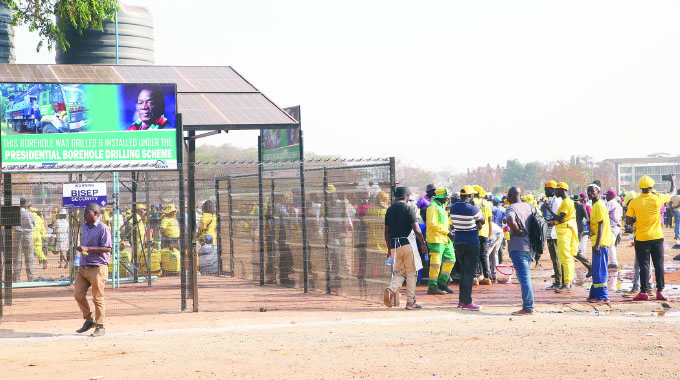
Fungai Lupande and George Maponga
The Rural Infrastructure Development Agency (RIDA) has completed the grading and re-gravelling of 2 603km of rural access roads in Mashonaland Central, Mashonaland West and Masvingo provinces, in a development that will increase access to polling stations tomorrow as the nation votes and then continue allowing farmers to move their harvests for sale.
In Mashonaland Central, 903km have been covered while in Mashonaland West, 600km have been completed, and in Masvingo, 100km have been re-gravelled, with 1 000km graded.
Towards the end of June, Government launched a blitz maintenance of access roads to polling stations throughout the country to allow every eligible voter to easily access their nearest polling station and exercise their democratic right to vote.
A target of 4 145km was set and by the time Cabinet sat in June and announced the blitz, about 4 000km had been repaired.
Boreholes are also being drilled in the villages and areas around polling stations so that voters have clean water as they wait for their turn to cast ballots.
During a tour of projects in Mashonaland Central last week, RIDA provincial coordinator Ms Molly Shoniwa said their target was 1 400km.
She said by the time people vote on Wednesday, the target for roads and clean water around polling stations will have been met. Where boreholes cannot be drilled, water bowsers would be provided.
The Nzou-Bvunda bridge at Chadereka in Muzarabani is almost complete. Ms Shoniwa said for years, the people of Musengezi, Chimoio and Mozambique, were cut off during the rainy season.
Less than 200 metres from the bridge is where Chadereka clinic, Chadereka secondary and Primary schools, Government offices and the business centre, are located.
The sick had serious challenges crossing the bridge after rains, with some having been swept away after they tried to cross the flooded river.
Children were also forced to suspend classes during the rainy season as they could not cross the river.
Said Ms Shoniwa: “This is a critical bridge here in Muzarabani and construction work started sometime last year and it should be complete by September this year.
“In Mt Darwin, we are working on 17km of the Nyakasikana-Masango Road, which leads to Karanda Hospital. We started this road after President Mnangagwa launched the Emergency Road Rehabilitation Programme Phase 2, after commissioning the Karanda Bridge.”
Ms Shoniwa said they have completed the surfacing 12km of the road, with the remaining 5km now at different stages of construction.
The Bvochora-Chemutamba Road in Guruve was washed away by incessant rains this year, but has since been gravelled.
RIDA is now doing protection works to culverts across the province.
Ms Shoniwa said they were working on roads leading to the remaining 15 polling stations in Rushinga and Muzarabani. “We are sure that the remaining polling stations will be complete on election day. As tents are being moved to polling stations, we are confident that the roads are passable.
“We prioritised all roads despite falling under local authorities or Department of Roads to ensure that all polling stations are reachable,” she said.
Water and sanitation Engineer, Godfrey Musiwa, said they had done 12 piped water schemes, drilled 60 new boreholes and rehabilitated 237 boreholes.
“We have enough spares to rehabilitate all boreholes in the province.
“We are also implementing small irrigation schemes and we are rehabilitating 30 hectares at Cranham Scheme in Mazowe. “We also construct small dams and have earmarked one in Guruve. Our mandate is to ensure that people have access to potable water.”
Sabhuku Tauzeni, born Takawira Chikota, said Chimoio Village uses Chadereka Clinic and people would struggle to cross the river during the rainy season. “Buses would drop everyone off at Chadereka Business Centre and people from the other side of the river had to cross on foot. We are very excited that the Second Republic has made our life easier,” he said.
“Chadereka is our centre where we get the majority of services. Also, the people of Chadereka cross the river to Mozambique to trade and the absence of the bridge was preventing people from engaging in commercial activities.”
Mrs Rose Bandera from Chibodo Village said life was hard during the rainy season, adding that the brave ones would cross the flooded river and would walk for a kilometre with water reaching the waistline.
“We used a footbridge but it was submerged. Schools are on the other side of the river, 6km from our village and school children would stop going to school. We are grateful to our President and we appeal to him to continue with developmental work.
At Chadereka Business Centre Mrs Tapiwa Chibondo, who runs a canteen, said the piped water scheme had improved hygiene. She used to rely on water from shallow wells but now she has access to clean water.
Another trader, Ms Chiedza Mafunga, thanked RIDA for providing clean water at the centre. “We used to bring water from home and we experienced many diarrhoeal diseases because there was not enough water to wash hands after using the toilet,” she said.
In Masvingo, RIDA has drilled over 700 boreholes over the past five years as President Mnangagwa’s Government moves to ensure improved access to clean water and uplift the living standards of people in rural areas.
Provision of clean water and good roads is seen as critical to rural industrialisation and modernisation, and consequently the attainment of an upper middle income society by 2030, under the mantra “leaving no one and no place behind”.
RIDA’s Masvingo Provincial Coordinator Mr Marasha Gutukunhuhwa, last Friday said they have had a huge presence in rural parts of the province in the last five years. “We drilled 733 boreholes since 2018, with the highest number of boreholes being drilled in 2022 when we drilled 200 boreholes across all the districts,” he said.
“Since the beginning of this year, to date, we drilled 54 boreholes across the province and we are satisfied with the progress that we have made as part of the drive to improve access to potable water in rural communities in line with Vision 2030.”
Apart from humans, the water is also benefiting livestock, giving impetus to ongoing efforts to rebuild the national beef herd.
About 20 boreholes have also been drilled for traditional chiefs across the province and they have been solarised or the process is underway. “‘Some of the chiefs that have benefited from the RIDA borehole drilling initiative are Chiefs Chiwara, Nemauzhe, Chitsa, Chimombe, Serima Charumbira, Negari, Mazetese, Maranda, Chitanga Neshuro, Murove, Sengwe and Gezani.
In terms of roads, RIDA has covered a lot of ground. In Chiredzi, RIDA has re-gravelled the Makambe-Matihwa Road covering 20km together with the Paplea-Davata and Mupinga-Gonarezhou roads.
The Chivi-Maringire Road in Chivi District has also been re-gravelled, together with the Gutu-Majonokonjo and Soro-Mupembezi roads in Gutu District.
In Masvingo, RIDA re-gravelled the Bhati-Musogwesi Road while in Mwenezi, they worked on the Furidzi-Mboyi road whose trafficability has vastly improved.
Mr Gutukunhuhwa said since 2018, they have graded nearly 5 000km of rural roads across Masvingo Province.



 Online Reporter