admin
admin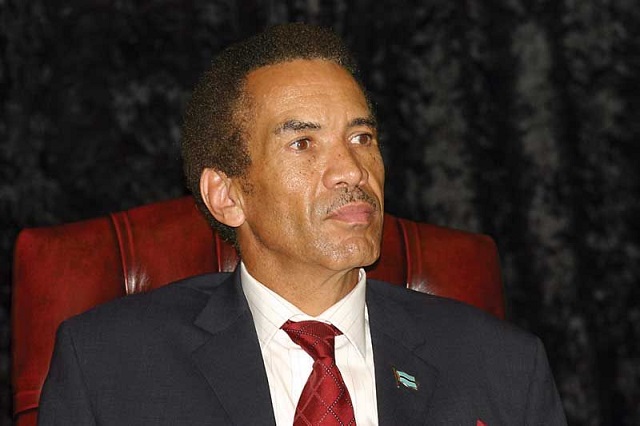

CAN natural geography really make mistakes? If it does, then the placement of Botswana on the African continent or is it its President Ian Khama is a big one if one takes into consideration how the Southern African country and its leader seem to be enjoying breaking ranks with regional counterparts.
There are a number of incidences where the Batswana leader has been found wanting in promoting the pan-Africanist values, choosing instead to take a Westernised but unAfrican stance.
His sentiments when South Africa announced its decision to pull out of the International Criminal Court (ICC) all but confirms that President Khama is not reading from the same page and stanza as most African leaders.
South Africa clearly outlined the ICC’s perceived biases against African states, and highlighted the dilemma it faced when Sudanese President Omar al-Bashir — wanted for war crimes by the ICC — attended an African Union summit in Johannesburg last year.
It also laid bare the inequalities that give the assumption that the ICC was created as an instrument or the West’s rod of anger against African leaders who refuse to toe the line on its neo-colonial attempts.
“There is also perceptions of inequality and unfairness in the practice of the ICC that do not emanate only from the Court’s relationship with the Security Council, but also by the perceived focus of the ICC on African states, notwithstanding clear evidence of violations by others,” reads part of the declaratory statement explaining South Africa’s position.
Notwithstanding the reasons for South Africa’s intention to pull out of the ICC which were very clear, Botswana went on to issue a statement saying it was regrettable that South Africa was pulling out of the ICC.
Botswana remains the largest defender of Western interests in the region. Part of the statement issued by the country’s foreign affairs department reads, “While Botswana fully respects the sovereign right of any country to become a party to, or to withdraw from any international instrument, the Government of Botswana nonetheless regrets that the Government of South Africa reached this decision.
“Botswana is convinced that as the only permanent international criminal tribunal, the ICC is an important unique institution in the international criminal justice system. Botswana therefore wishes to reaffirm its membership of the Rome statute and reiterate its support for a strong international criminal justice system through the ICC.”
Last month he drew criticism from Zimbabwean politicians who told him off after he told Reuters that at 92 years President Mugabe, a revered African Statesman and iconic pan-Africanist should without doubt have vacated office years ago.
“Without doubt. He should have done it years ago. They have got plenty of people there who have got good leadership qualities who could take over,” he said.
Presidential spokesman Cde George Charamba described President Khama as a continental oddity who lacked the moral ground to pass those sentiments to an elected President of an African country.
He said President Khama had recklessly exceeded the bounds of both geography and authority.
Cde Charamba said, “If the sentiments attributed to President Khama are accurate and true, then the Batswana President has certainly exceeded the bounds of both geography and authority.
“He is not a citizen of Zimbabwe; not even a resident. That means he does not vote, itself the only democratic way of determining the term of a sitting President in Zimbabwe. That makes his views on the matter not just impertinent, but impudent as well,” said President Mugabe’s spokesman.
It also drew the ire of Zanu-PF Politburo member Prof Jonathan Moyo who is also Higher and Tertiary Education, Science and Technology Development Minister who said Khama’s sentiments were an attempt at subverting constitutional democracy in Zimbabwe and illegitimising an elected Government.
“Sadc leaders, like Khama, who want to promote and support unconstitutional calls in Zimbabwe, are an embarrassment to the regional bloc which worked tirelessly and in a dignified way to facilitate the making of Zimbabwe’s new constitution between 2009 and 2013.
“Let Khama mind the desert that is Botswana’s troubled business while we mind our own challenges and exploit our country’s opportunities by taking seriously Mugabe’s call that the time has come for us to work together to industrialise and modernise Zimbabwe,” said Prof Moyo.
That was not the end of Botswana’s white face as it manifests again at the Convention on International Trade in Endangered Species (CITES)’s Conference of Parties (CoP 17) held last month in South Africa.
Botswana shocked regional counterparts when she all of a sudden sided with Eastern and Western Africa countries in opposing the position of Southern African countries which they had agreed on prior to the meeting on the lifting of restrictions on trade in ivory.
Ironically, she is a bona fide member of the Southern African Development Community (Sadc) which is proudly headquartered in Gaborone, her capital city but that feat did nothing to make her revere the Southern African philosophy.
But the country seems not to belong to the African whole. She has over the years alienated herself from the dictates of African ideology and is now living as an extension of some Western States. Regional and continental co-operation with other African States especially Zimbabwe and recently South Africa has proved painful for Botswana and one is tempted to assume that it goes as far as politics is concerned.
President Khama has adopted a very unAfrican stance in dealing with African political problems. He has taken the white man’s stance where individualism is more honoured than the spirit of togetherness, the spirit of unity and oneness that has been known to bind Africa and that saw the continent fighting in one corner against colonial rule.
The “I am because we are” philosophy that was entrenched in the minds of African nationalist leaders and founders such as Julius Mwalimu Kambarage Nyerere of Tanzania, Kwame Nkrumah of Ghana, Jomo Kenyatta of Kenya and Kenneth Kaunda of Zambia seems to be eluding Khama.
Their philosophy inspired leaders of the generation of President Mugabe, Joshua Nkomo, Samora Machel and many other revolutionary leaders who carried it with pride and excitement.
These leaders rallied African nationalists to work together for the betterment of the continent in its entirety, something better explained by Nkrumah in 1957 when Ghana attained its independence when he said Ghana was not independent until the whole of Africa was freed from the shackles of colonialism.
They were unique in their disavowal of pomp and perquisites. They looked at the greater good of their nation states and the continent at large.
Such calibre of leaders is now rare. They are now very scarce as some African nations have adopted the each man for himself and God for us all political mantra that is anti-development and anti-unity.
The founding generation understood that they needed each other and they indeed assisted one another whenever there was need, something that explains why the execution of the liberation struggle was easy after some countries got independence.
Had it been now with some of the leaders we have in Africa, some countries would have still been labouring under the weight of colonial rule.
Reports from the Convention on International Trade in Endangered Species (CITES)’s Conference of Parties (CoP 17) in South Africa is a strong pointer to the lack of unity of purpose among regional African countries.
According to reports, Botswana made an about turn, a radical redirection and a dramatic somersault from the agreed stand point that was adopted by Southern African countries prior to the conference.
Southern African countries such as Zimbabwe, South Africa, Zambia, Namibia and Botswana had agreed to lobby for the lifting of restrictions on the commercial trade in elephant products and defend that the African elephant remain in Appendix II against a counter-lobby from other African countries to maintain the ban and possibly transfer the elephants from Appendix II to Appendix I which meant more restrictions.
Sadly, Botswana has arguably the largest herd of elephant population in Africa and is struggling to cope with its growing numbers and one would assume that the lifting of restrictions on trade in ivory was going to help Botswana benefit from its natural resources but it opposed the lifting of the ban.
It was a big betrayal in the face of Southern African countries that they have to contend with. It raises the question however, on whether such a neighbour has to be trusted in future regional engagements.
That Botswana is in Southern Africa seems therefore to be a mistake of geography and was it in its choice it would have long relocated to some other place on the globe, preferably to the West.


 Online Reporter