daniel chigunwe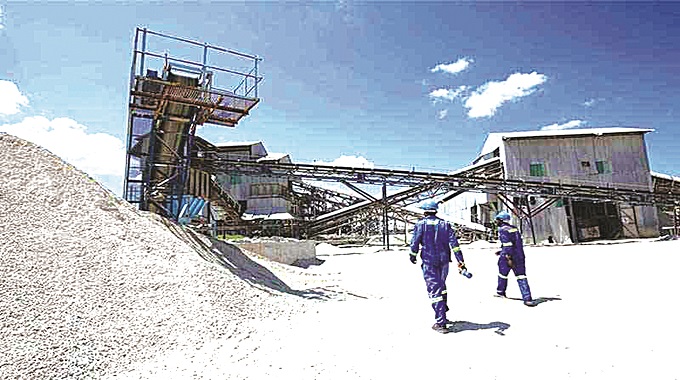
Nelson Gahadza
Manhattan Corporation, a South African company that manufactured the Dense Media Separation plant (DMS) for Bravura Holdings Kamativi lithium project, says the plant is energy efficient enough to operate profitably even when lithium prices stay in a difficult space.
The plant, which is awaiting shipment to the Kamativi lithium project site, operates with synchronised 1,5 MVA diesel generators, providing a combined output of 5 MVA. According to Bravura, the generators are already in Zimbabwe, awaiting deployment to Kamativi.
The lithium project in Kamativi is expected to come online next year following the completion of the DMS plant and civil works.
The Kamativi dump contains around 25 million metric tonnes of material, which translates to an annual capacity of 70 000 metric tonnes per year of spodumene concentrate.
During a media tour of the plant and equipment in South Africa last week, Manhattan chairman Chris Pouroullis, said that the operating cost of a DMS is lower than crushing milling flotation because the Kamativi dump is minus two millimetres, hence it is right sized for the project.
“We have about 50 percent of our material already prepared for the DMS; we are just removing the fine material that won’t go through the DMS.
“Because you do not have to crush and you do not have to mill, you save all those energy costs, and then we can remove 50 percent of the fine material using the scrubbers and the screen, which is not a highly energy-intensive process,” he said.
Pouroullis added, “So you end up removing 50 percent of your material as not to be processed; now you’re left with half.
“That half material mark goes straight into the DMS without preparation, but in a conventional plant, you may need to crush it to get it to the right size for a mill, then you have to put it into a milling plant, and that is high energy consumption.”
According to Carbon Credits.com, lithium carbonate prices have experienced a significant decline in China, dropping from a record high of $81,360 per tonne in November 2022 to $20,782 per tonne in the current month, marking the lowest level in two years and reflecting a 67 percent decrease year-on-year.
The prices have bottomed out but have struggled to meaningfully rebound, partly because miners, refiners, and carmakers are still working through a mound of surplus stock clogging up the supply chain.
The current low prices have led to some mine closures, but there’s a newfound recognition across the industry that supply could be brought back into the market almost as quickly as it’s being removed.
According to Pouroullis, the rule is that the bigger you can treat your material by size, the lower the cost, hence optimising the energy cost and the operating cost.
“Therefore, with time, if the lithium price stays in a difficult space at the moment, the high cost produced will not survive. But the low-cost producers will. This plant is designed to produce a product at a very economical rate, which is a benefit for Bravura,” he said.
He noted that his company did tests three times to validate the recovery process, and the recovery will be as good as milling and flotation.
According to Pouroullis, the plant, when complete, is about four and a half stories high with a 450-metre footprint.
He added that the plant’s design ensures energy efficiency and high-quality production, crucial for maintaining economic viability in fluctuating market conditions.
The plant is set up to process coarse material, with future potential for fine material processing if economically viable.
The design includes multiple conveyors and emergency stockpiling to ensure continuous operation, even during maintenance.
The final product is spodumene, produced at approximately 10 metric tonnes per hour, depending on the input feed grade.
Meanwhile, apart from the lithium project Bravura, other projects in Zimbabwe are the Bravura platinum project in Selous and the iron ore project in Manhize, which are at different stages of implementation.
Bravura has since completed exploration work at its platinum project site in Selous and is now conducting feasibility studies ahead of actual mining.
Bravura project geologist Farirai Kambanje said the company has since acquired four pieces of mechanised mining machinery, which will enable the company to commence the box cut for the platinum project.
He said there are four sets of dampers, rigs, bolters, and load-haul dumps (LHDs). “This is the equipment that we are waiting for to open our box cut at the mine,” he said.
Bravura was awarded a 3 000-hectare (7 400-acre) concession in Selous, about 80 kilometres south of Harare, in 2019, upon which the company applied for an extension of the concession, which has since been granted.
According to group general manager Gbenga Ojo, having three mining projects in Zimbabwe was a calculated strategy to counter fluctuations in global metal prices and cost dynamics.
Recently, commodities such as platinum group metals (PGM), nickel, and lithium, which are key revenue contributors, have been declining, resulting in some companies retrenching and posting losses while others have suspended expansion projects.
However, Ojo said he is optimistic about the price rebound and is bullish considering that the demands and the supply circle will cause prices to correct themselves.
According to the World Platinum Investment Council (WPIC), Zimbabwe has the world’s third-largest platinum group metals (PGM) resource along the mineral-rich Great Dyke, after South Africa and Russia.



 Online Reporter