admin
admin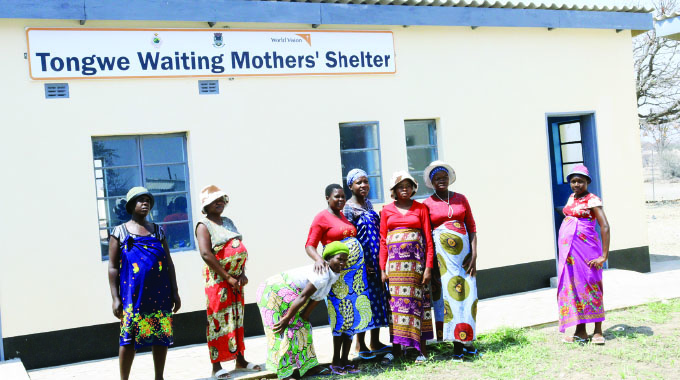
Thupeyo Muleya Beitbridge Bureau
Beitbridge Rural District Council has started courting development agencies so it can improve service delivery in public health, water and sanitation, and education.
Council chief executive officer, Mr Peter Moyo said yesterday they had set aside funds to implement many capital projects in line with the Government’s thrust as enshrined in the National Development Strategy 1.
Partnerships between the local authority and development agencies would speed up the completion of many rural transformation projects.
Mr Moyo was speaking during the official handover to the local authority of a maternity shelter at Tongwe Clinic in Ward 4.
This will help expecting mothers who are part of the area’s estimated population of 7 000.
Tongwe Clinic caters for villagers from the Matshiloni, Penemene, Mugaladivha, Jopembe, Manazve, Tongwe, Makhawa and Gukhunze areas.
The new maternity home is able to handle 16 expecting mothers at a time and was constructed under a partnership involving the local authority, the community and World Vision Zimbabwe which provided funding.
“As a local authority, we are seized with improving service delivery on issues to do with public health, education, infrastructure development, water and sanitation,” said Mr Moyo.
“It is through partnerships like these which will see us transforming the rural areas at a faster pace. So, as a local authority we will continue on that path so that we meet our obligations as enshrined in the NDS1.”
World Vision’s National Country Director Mr Assan Golowa Phiri said his organisation had worked with the local communities to set up a 4km solar-pump water pipeline and the construction of the maternity shelter.
He said the piped water scheme had three reservoir tanks able to hold 35 000 litres of water for Tongwe Clinic, the local primary school and Gukunze and Tongwe villagers.
Mr Phiri said the NGOs were complementing what the Government was already doing in addressing some United Nations sustainable development goals.
“The initiatives we are handing over today, which include health, education, water and sanitation and food security, are a complement of what the government of Zimbabwe is addressing through the NDS1,” he said.
“This is not necessarily a World Vision project, but we have the community members and their leaders and the local authority playing their roles. Working collectively is critical in covering all the service delivery gaps.”
Mr Phiri said the community provided labour and material resources while World Vision provided funding for the Tongwe project.
Before the latest developments, ward 4 villagers were enduring hardships due to limited water supply at the clinic and the primary and secondary schools.
In addition, the clinic was relying on two rooms as the waiting mothers’ shelter.
“We are happy that our dignity has been restored as women through the completion of this project. Previously some expecting mothers had to travel for 25km to Mtetengwe or for 40km to Beitbridge town to access neo and post-natal services,” said an expecting mother, Mrs Portia Moyo.
Another expecting mother identified only as Bokang said the upgrading of the maternal services at Tongwe Clinic will help minimise the number of risky home deliveries.
Mrs Gertrude Ndou said since the introduction of piped water, community members could now access water closer to their homes compared to the previous set-up where they had to scramble for water at the few boreholes in the area.
“As the community, we will continue working with development partners to improve our situation,” she said. “So, going forward, we will be constructing a kitchen to cater for the needs of the mothers here during power cuts and creating a nutrition garden to address issues of food nutrition security for expecting mothers.”
Vice chairperson of the Tongwe Piped Water Scheme, Mr Shadreck Milimo, said issues of water and sanitation had greatly improved and that they were looking forward to rolling out similar initiatives across the whole ward.



 Online Reporter