Online Reporter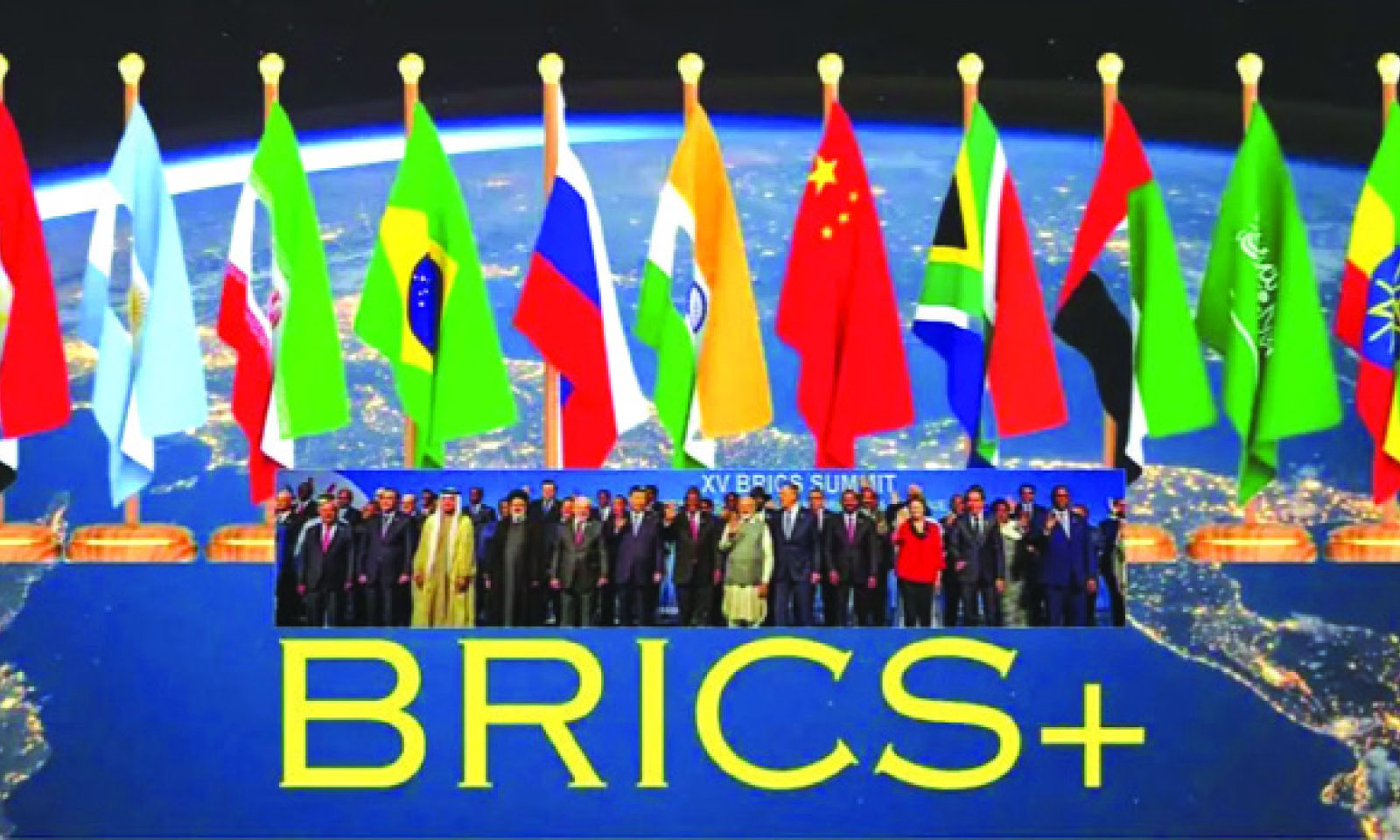
Stewart Patrick and Erica Hogan
At their October 2024 summit in Kazan, Russia, the original five members of the BRICS coalition—Brazil, Russia, India, China, and South Africa—welcomed into their fold four new members: Egypt, Ethiopia, Iran, and the United Arab Emirates.
In January 2025, Indonesia became the bloc’s 1oth member.
Nine other nations have been officially designated as “partner countries,” and some two dozen have either been invited to join (for example, Saudi Arabia) or expressed interest in doing so (for example, Türkiye). BRICS states including Russia have touted the group’s expansion as a defining moment, heralding the dawn of a post-Western world order in which the “global majority” is finally empowered.
Among analysts, the significance of the BRICS expansion remains a matter of debate. On paper, “BRICS+” has the potential to become a major geopolitical and geoeconomic force.
The bloc already boasts about 45 percent of the world’s population, generates more than 35 percent of its GDP (as measured in purchasing power parity, or PPP), and produces 30 percent of its oil.
BRICS countries have also established an extensive and thickening latticework of intergovernmental cooperation.
In addition to founding dedicated institutions such as the Contingent Reserve Arrangement (CRA), created in 2014 with an initial funding of US$100 billion, and the New Development Bank (NDB) established in 2015 with an initial subscribed capitalisation of US$50 billion, the coalition has (like the G7 and G20 forums) embraced networked minilateralism, launching transnational partnerships and working groups on topics of shared interest from energy security to health, climate change, sustainable development, and technology transfer.
BRICS avowedly seeks to challenge Western-dominated institutions of global economic governance, as well as to displace the US dollar from its entrenched role in the world economy. Many analysts therefore depict BRICS expansion as a watershed moment in the shift to a more egalitarian international system.
However, the ultimate implications of these developments for world order remain unclear. No doubt, the expanding coalition will shape prospects for—and the nature of—international cooperation in a turbulent world. The main uncertainty is whether BRICS+ signals a turn against rather than simply away from the West. Some analysts anticipate that BRICS could evolve into a coherent, anti-Western bloc and complicate prospects for multilateralism, including by deepening divisions within the G20 and the United Nations.
Heightened tensions between the United States and China (which dominates the bloc), as well as US President Donald Trump’s confrontational approach toward BRICS, make this a possibility. Other observers are more sanguine, pointing to the group’s heterogeneity—which will only increase as the coalition expands—and to the fact that most BRICS members and aspirants have no desire to create a world of rigid blocs.
They may view the coalition as a useful platform and vehicle to pursue reformist aims, but they remain open to cooperation with Western countries (and other middle powers) on matters of common concern.
These uncertainties—about the motivations of individual BRICS countries and aspirants, the bloc’s likely significance in concrete domains and its potential impact on world order, and the possibilities for cooperation between BRICS and the West—are obstacles to informed policymaking, as well as to nuanced consideration of how the coalition’s trajectory could be steered in the direction of global bridge-building.
To fill these gaps in understanding, Carnegie’s Global Order and Institutions (GOI) Programme has launched a new initiative on BRICS Expansion: Understanding Its Motivations, Significance, and Implications for World Order. The ultimate objectives are fourfold:
To better understand the goals and perceived benefits of BRICS for individual members and aspirant countries, including where these align and diverge.
To identify those global domains where an expanding BRICS coalition has the potential to make its biggest impacts.
To explore alternative scenarios for the evolution of BRICS and their implications for global order and multilateral problem-solving.
To consider possibilities for bridge-building and practical cooperation between Western and BRICS countries on matters of shared interest, including in the G20 and other forums.
As an initial, scene-setting exercise, the GOI programme solicited short commentaries from prominent experts on seventeen countries, including the five original BRICS members, the five new members, and seven nations—Colombia, Nigeria, Saudi Arabia, Senegal, Türkiye, Venezuela, and Vietnam—from different regions of the world that are either partner countries or aspire to or are considering joining the bloc.
In each case, the GOI programme invited authors to respond to three questions. First, what is “your” country’s primary interest in BRICS? Second, in what spheres do the country’s leaders expect BRICS to have the biggest impact? Third, how are recent geopolitical and international trends—such as Trump’s return to the US presidency or US-China tensions—shaping the country’s preferences regarding, and the likely trajectory of, BRICS?
Despite their brevity, the commentaries provide some important, if preliminary, insights. To begin with, country interests and motivations regarding BRICS vary markedly. Some nations perceive opportunities for expanded trade and investment with other BRICS members as a key benefit of membership or association.
Others are more politically motivated, seeking higher-profile leadership roles on the global stage, especially within the Global South, or greater decision-making power in multilateral forums.
A common thread across these disparate interests and motivations is the need to respond to and manage the consequences of American dominance. Some countries are seeking in BRICS a safe harbour from US diplomatic coercion and economic statecraft, an escape from pressure to democratise, and a means to mitigate the impact of sanctions and tariffs.
Even countries that enjoy relatively positive relationships with the United States value BRICS as a vehicle for greater international economic integration in an otherwise fragmenting Western-centric global economy, as well as an opportunity to garner greater power than they hold within traditional, Western-dominated multilateral forums.
For developing countries, BRICS also offers a compelling prospect for obtaining development financing without political conditions and in local currencies rather than in dollars or euros. Countries engaged with BRICS are united in their desire to shift the global balance of power away from American unipolarity and in their belief that BRICS can help facilitate this transition.
At the same time, BRICS member states, partner countries, and aspirants remain divided on their engagement with the US, and in particular on the extent to which BRICS is or should be an explicitly anti-American bloc, designed to counter US interests.
Some countries desire to maintain positive relations with the US, even as they welcome the advent of a more egalitarian world system. Others, not least Russia, seek to position BRICS as a rival bloc to the US-dominated West.
The potential of BRICS members and partner countries to fulfil their individual aspirations via the bloc —whether to create a more egalitarian mode of global governance, to hedge against Western instability while maintaining a geopolitical neutrality, or to participate in an alternate international economic system outside of the reaches of American sanctions—hinges on which vision of the future of world order ultimately wins out.
It will also depend on the degree of common purpose demonstrated by countries of the West themselves—whose like-mindedness and solidarity the second Trump administration has suddenly called into question—as well as on the Trump administration’s willingness to countenance a more egalitarian global order rather than force middle powers to choose between BRICS membership and friendly relations with the US. – carnegieendowment.org