admin
admin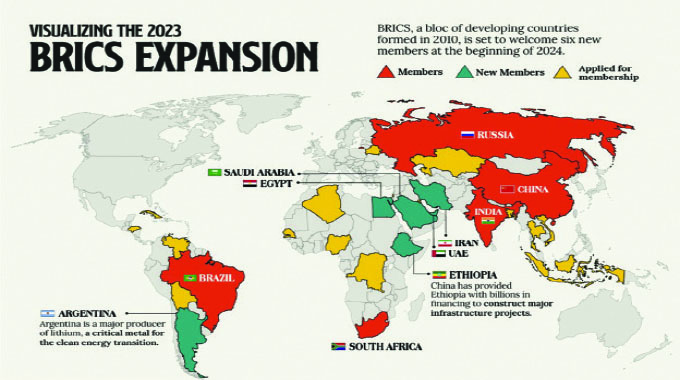
BEIJING. – BRICS grouping major emerging economies of Brazil, Russia, India, China and South Africa is to more than double its members with the admission of six more countries.
This historic expansion, which was recently announced at a press conference during the 15th BRICS Summit in Johannesburg, South Africa, involves Argentina, Egypt, Ethiopia, Iran, Saudi Arabia and the United Arab Emirates, and their membership will take effect from Jan 1, next year.
Observers told Xinhua that the expansion bears witness to BRICS’ charm and vitality, helps amplify the voices of the Global South, and mirrors the resolve of the group and the wider developing world to safeguard global equity and justice and promote peace and development.
Seventeen years since its inception, BRICS has witnessed fruitful cooperation results in economic, political and cultural spheres, and continues to prosper in a spirit of openness, inclusiveness and win-win cooperation. The BRICS countries have written a wonderful story of the joint development of countries with different systems, cultures and regions, which has become a flagship of South-South cooperation.
Experts believe the expansion will represent a historic and new starting point for BRICS cooperation.
Mohammad Jamshidi, the Iranian president’s deputy chief of staff for political affairs, tweeted his felicitations to Iran’s accession to BRICS, calling it a “historic move.”
BRICS’ expansion in a well-studied manner “would increase its strength and effectiveness and enhance its regional and international role, in a way that contributes to achieving greater and faster development rates,” said Abdel-Sattar Eshrah, secretary-general of the Cairo-based Egyptian-Chinese Business Council.
“It would create many opportunities for joint cooperation among BRICS members in various fields,” the Egyptian business leader said, adding that BRICS’ expansion is to boost the abilities of its members to address economic, financial and political crises and challenges.
Filipe Porto, a researcher at the Federal University of ABC and a member of the Brazilian Foreign Policy Observatory, said although the five founding member states have very different national conditions, the spirit of win-win cooperation has kept the BRICS mechanism dynamic and drawn interest from more countries.
The rise of emerging economies, represented by BRICS nations, is fundamentally altering the global landscape. With the historic expansion, the BRICS mechanism will have a greater voice in driving global governance reforms toward a more just and equitable direction, infusing the world with greater certainty and stability, said experts.
For emerging markets and developing countries, joining BRICS enables them to jointly pursue development while safeguarding national sovereignty and economic independence. This allows them to engage in global development with equality and dignity, said former Bolivian Foreign Minister Fernando Huanacuni.
Ahmed Ibrahim, a Saudi political analyst, said the BRICS mechanism has “introduced a new model of global governance,” which has generated a strong cohesive force among emerging economies and developing countries.
The BRICS cooperation mechanism, which features openness, transparency, inclusiveness and non-discrimination, caters to the needs of developing countries and strengthens their say in global governance, said Bambang Suryono, chairman of the Indonesian think tank Asian Innovation Research Centre. – Xinhua



 Online Reporter