Online Reporter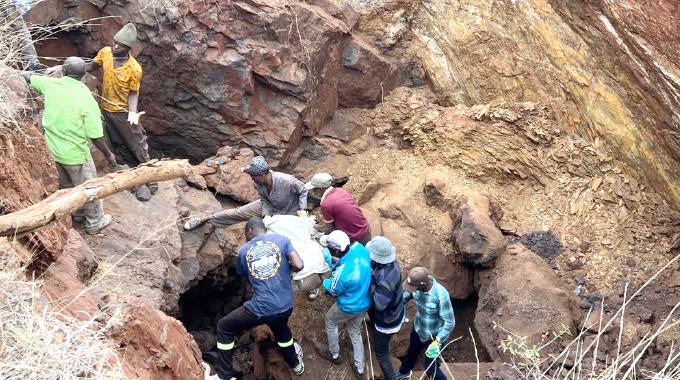
Gibson Mhaka, Zimpapers Writer
WHILE Artisanal and Small-Scale Miners (ASM) shoulder the weight of Zimbabwe’s gold production, significantly bolstering the nation’s mineral output, this immense economic contribution comes at a devastating price.
The sector is characterised by a horrific prevalence of accidents, injuries and sudden death.
It is a heart-rending reality that reports of miners being trapped beneath the earth—victims of sudden mine collapses are a tragic, regular feature in the national news cycle.
For example, the recent incident involving illegal gold miner Dolphin Moyo (32), who died when a disused mine shaft they were working in collapsed in the Jacaranda area of Gwanda — while his counterpart escaped unharmed — left the deceased trapped beneath boulders..
These incidents illustrate the constant peril faced by those who feed the gold rush.
Adding to this profound human cost is the near-total absence of a safety net. Despite being the backbone of Zimbabwe’s gold production and facing extremely high-risk factors daily, ASM operators function without crucial protections.
Latest statistics from Fidelity Gold Refinery (FGR) underscore the sector’s vital role. Total gold deliveries for the first nine months of 2025 jumped by 37 percent to 32,9 tonnes, compared to 24,02 tonnes in the same period last year.
Small-scale miners delivered 24,45 tonnes of that total through September, a massive 67 percent growth from the 14,6 tonnes produced in the corresponding period a year earlier.
The recent launch of the National Development Strategy 2 (NDS2), which lays down an ambitious roadmap for 2026 to 2030, signals the Government’s unwavering commitment to achieving an Upper Middle-Income Society.
However, the paradox of the ASM sector driving phenomenal economic growth while remaining deeply vulnerable — presents a critical challenge to this national vision.
Despite driving the nation’s gold output, the sector is overwhelmed by a critical lack of funeral cover, medical aid and insurance.
The informal status of these operations, coupled with the inherently high-risk nature of their activities, creates significant challenges in accessing insurance products tailored to their needs. This institutional void leaves miners and their dependants acutely vulnerable to catastrophic financial ruin.
Accidents, illnesses, or sudden deaths transfer the entire economic burden of this high-stakes work directly onto impoverished families.
The human tragedy behind the production statistics was brought into sharp focus by Mr Mthulisi Moyo (29), an artisanal miner in Filabusi, Matabeleland South Province, whose face was etched with exhaustion and fear.
“Every day we go down that shaft, we know we might not see the sun again. We are digging for gold that builds the country, but we are exposed to risks and accidents all the time.
“We are dying every day, trapped, crushed, or just running out of air,” Mr Moyo recounted, his voice heavy with emotion. “If you die, there is nothing for your wife and children. We are not insured. There is no funeral cover, no nothing.
“We beg the Government, the banks, anyone, to help us get insurance so that our families are not left begging when the ground swallows us.”
This desperation was echoed by Mr Ndabezinhle Ncube (45), a small-scale miner from Bubi District in Matabeleland North Province. “We are very concerned about the health and safety of our miners, and we do everything possible to keep our workers safe by following mining practices,” Mr Ncube said.
“However, despite our best efforts, most of our workers do not have insurance coverage in the event of a tragedy.
“This is a massive problem because insurance companies are refusing to partner with us, as many small-scale operations still lack full formalisation and are seen as too high-risk.”
The institutional void
Secretary-General of the Insurance Brokers Association of Zimbabwe (IBAZ) Dr Richard Mutyavaviri acknowledged this grim reality.
“The sector is characterised by the horrific prevalence of accidents, injuries, and sudden death,” Dr Mutyavaviri said.
He lamented the “near-total absence of a safety net” for these essential workers, noting that the lack of coverage leaves dependants vulnerable to financial ruin. Echoing this sentiment, Young Miners Foundation (YMF) chief executive officer Mr Payne Farai Kupfuwa, stressed the moral imperative of protecting miners.
“Our miners are providing over 60 percent of our gold, yet they are the most vulnerable and marginalised group in the entire economy.
“We are constantly mourning colleagues,” Mr Kupfuwa lamented. “The lack of accessible, affordable insurance is a betrayal.”
Insurance brokers: The crucial intermediary
To bridge the gap between informal mining and formal finance, insurance brokers are emerging as crucial intermediaries.
Dr Mutyavaviri explained that brokers offer specialised expertise in assessing risks, structuring tailored insurance programmes, and navigating the complex landscape to secure coverage.
He said brokers are key to “transmitting the unique risks faced by ASM like material damage and third-party liability to the insurance market.”
Beyond policy placement, brokers offer comprehensive risk management services to help groups identify and mitigate hazards before accidents occur.
Innovative solutions for affordability
and accessibility
To make insurance viable for miners with irregular incomes, Mr Kupfuwa stressed the need for innovative collaboration between brokers and underwriters.
He urged brokers to campaign for group schemes or communal risk-pooling mechanisms, which allow for the aggregation of miners into large risk pools to lower per-person costs.
To address the income volatility and affordability challenges faced by the ASM sector, Mr Kupfuwa proposed several innovative solutions for premium collection and policy structure, asserting that policies must feature Flexible Premium Structures. “To address the income volatility, policies must feature Flexible Premium Structures, allowing weekly or monthly micro-payments via mobile money platforms instead of demanding large lump sums,” he said.
Furthermore, he suggested introducing “pay-as-you-dig” models, where miners contribute small percentages after each gold sale, directly linking insurance payment to production revenue.
Finally, to maximise initial uptake and value, Mr Kupfuwa advocated for tiered coverage packages that bundle basic accident, funeral and medical covers affordably, noting that coverage should often be “anchored around funeral cover, as it is the most culturally valued, increasing initial uptake.” To overcome the challenges of remote locations and lower financial literacy, Mr Kupfuwa called for innovative accessibility solutions.
This includes leveraging mining co-operatives as “aggregators” or “premium collectors” and ensuring simplified policy language by translating policies into local languages like Shona and Ndebele, complete with pictorial guides.
Beyond the policy: Risk mitigation and advocacy
Mr Kupfuwa stressed that a broker’s role must extend beyond merely placing a policy.
It must involve extensive capacity building for risk mitigation, including regular health and safety training on PPE usage, shaft reinforcement, and safe blasting practices. Furthermore, brokers must commit to a powerful advocacy role.
In the event of a catastrophe, the broker must act as the miners’ official representative, ensuring swift verification of documentation and negotiating for provisional payments. Crucially, they must ensure direct beneficiary payments, leveraging mobile money to transfer funds immediately to family members to avoid costly delays.
The formalisation hurdle
Weighing in on the crisis, Zimbabwe Miners Federation (ZMF) chief executive officer Mr Wellington Takavarasha noted that the ASM sector is caught in a debilitating “catch-22”.
“We are pushing for full formalisation, but the reality is that many legitimate miners cannot meet the stringent requirements of local insurance companies,” Mr Takavarasha explained.
“The risk profile of an informal operation is considered too high. Until we can fast-track formalisation and improve on-site compliance, our members will tragically remain unprotected.”
Financial institutions also perceive uninsured operations as excessively risky.
Speaking recently at the Planet GOLD Zimbabwe Annual Stakeholders Conference 2025 in Harare, NMB Bank representative Mr Stewart Makenga acknowledged the sector’s US$3 billion contribution but stressed that formalisation remains a barrier.
“As a bank, we rely on depositors’ funds…We must ensure that where we deploy those funds, the businesses comply with local statutes,” Mr Makenga said. To mitigate risk, NMB has adopted a strategy of partnering with off-takers and co-operatives rather than individual miners.
A call to action: The way forward
The ultimate solution requires a multi-stakeholder approach involving the Government, insurers, and mining communities, with insurance brokers acting as the crucial pivot to enable these solutions.
To secure the welfare of the ASM sector, the Government must actively promote insurance by providing subsidies and creating a supportive regulatory environment that encourages coverage for high-risk, low-income workers.
The insurance broker’s role here is advocacy and technical advice. Brokers must actively lobby the Government to recognise the specific, unique needs of the ASM sector.
More critically, they should act as technical advisors to the Government, using their industry expertise to help design subsidy frameworks and regulatory mandates that are practical, effective, and capable of reaching the intended beneficiaries in remote mining areas.
Insurance brokers are the essential bridge required to ASM with formal financial protection.
Their role is three-fold: driving product innovation, facilitating formalisation and leveraging local distribution.
Insurers must also move beyond rigid models to develop specialised, affordable products that account for the miners’ income volatility. The broker’s key function here is to “package the miner’s reality” for underwriters.
This involves providing accurate, comprehensive data needed to correctly price risk and, consequently, encouraging insurers to enter the ASM market.
Furthermore, brokers should actively facilitate partnerships between insurance companies and mining co-operatives to create scalable group schemes that lower costs for individual miners.
Formalisation is vital for unlocking financial services, as a lack of regulation correlates directly with high safety and environmental hazards.
The broker must lead the charge in risk education and mitigation. By dedicating resources to help miners implement better safety standards and navigate registration processes, brokers actively work to lower the “risk profile” of ASM operations.
This practical assistance transforms informal, high-risk groups into compliant and attractive clients for insurers. It is important to note that while the ASM sector drives Zimbabwe’s economy, it is the insurance broker who must drive the safety of the miner. By bridging the gap between the dark shafts of the underground and the corporate boardrooms of insurers, brokers hold the key to turning a perilous livelihood into a dignified profession.