admin
admin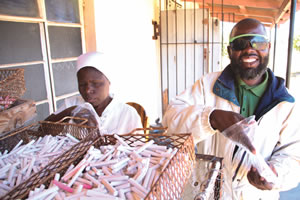
could be said to be a huge boon.
This could well amount to the proverbial silver lining to a dark cloud as schools, mainly due to the “generosity” of the likes of the United Nations Children’s Fund can now even afford to have more than they require.
In an ironic twist of fate, though, that to some this blessing has been a dark cloud in and of itself.
This is the absurd situation in which a co-operative of visually impaired people at Murambinda Growth Point in Buhera, Manicaland Province, is facing.
The group of six men and women, led by Enerst Masenda, is in the business of making chalk.
Like everyone else, the rain started beating on them in the hyper-inflationary period of 2007-8.
However, with the stability ushered in by the formation of the inclusive Government in 2009 and the subsequent macro-economic recovery came interventions such as the aforementioned Unicef one.
For better — and worse.
“They came in 2010 and supplied all the schools here with books and chalks,” laments Masenda, his eyes hidden from his face by large dark glasses and his hands cryptically but gingerly fingering the brown Braille on his desk.
“We tried to engage them to buy chalks from us and even went to their offices in Harare, but we got no audience and somebody told us that logistically donors had materials ordered beforehand.
“We had thought that when they came into an area they would find local suppliers,” he said.
His voice reverberating in the empty office, which has known days of the din of workmen and women, Masenda continues with his story.
“We hear they supplied each school with about 400 boxes of chalk and it means we will stay out of business for a while longer,” he says.
He explains that primary schools require — or used to buy — 10 to 20 boxes per month while secondary schools bought between 30 and 40.
Each box contains 100 sticks.
The statistics Masenda gives roughly translate to a primary school at most requiring 180 boxes per year and 360 for a secondary school.
Could the group’s time be nigh?
It well could, if nothing dramatic happens, or, more specifically, if another boon does not come with another doom.
Business is very slow, in this darkest hour.
“We may supply one or two customers per month and the money we make — between US$20 to US$40 — is only enough to pay water bills.
“Our electricity has since been disconnected and I wonder where we would be if this building was not ours,” he says, reflecting on the meagre US$1 per box price in these lean times.
His mind wanders back to the good old times.
He tells The Herald that the co-operative used to produce up to 500 boxes per month and they used to work through the night to meet their targets.
They supplied all schools in Buhera District and parts of Chivhu and Gutu.
Those were the days, between 1996 to 2007, when the original six members from Copota School of the Blind in Masvingo used to walk with their heads high.
“We employed two more people,” recalls Masenda.
He adds that they could feed their families, clothe them and send children to school and even help their able-bodied brothers.
Some bought residential stands and built houses.
Critically, the group managed to build the building that has a provision for a workshop, warehouse and an office with the help of the African Development Fund in 1996.
This saw graduating from the dusty village of Mudanda, east of Murambinda Growth Point, the nerve centre of business.
“Now some of us are back to begging for alms,” he decries.
“It is something that we had condemned from the beginning and when we came from college we told ourselves we would not do it.
“However, as things stand, we do not have much of a choice: some go begging to feed their families. It is degrading because you know you are better than some people who give you those alms,” he says.
The desolation in his voice — only matched by the blank stare he posts to the nearby wall as his mouth is involved in the mechanical churning out of history and hope — tells of a man who has clearly known better days.
That all his peers but one are not here adds to the desolation of this place.
In the workshop, hundreds of chalk sticks lie unpacked in pans on the worktable where there are a couple of moulding instruments.
To the right facing the door thousands of chalks are also unpacked on racks.
There are more on the veranda rack, all seemingly suggesting that there is no real hurry to stow them away in the boxes.
That could be such an act of hope, which Masenda does not have in much measure at the moment.
He reveals that the warehouse is now being leased to someone, for want of its original business intent.
With the decline of the venture, Masenda has been setting sights on other projects that could salve his and other blind people’s respectability.
“We are looking for funding so that we could start ventures such as poultry projects,” he says.
“Some of us hate begging because it is something we hated from the beginning. We need to sustain ourselves.”
A female companion, Norah Dauti, who no doubt came to the office entertaining the hope of a better day, adds: “We want to do things the way we did before.
“We want to work for ourselves so that we reduce the number of beggars on the streets. Since this project is currently down, we are seeking help to start others,” added the 42-year-old woman. And when gods smile at them again, the group hopes to up production and they require such things as more superfine powder, more chemicals, materials for dustless chalk.
They also look forward to secure loans to fund their business.
Masenda revealed that they have since applied for funds under the Indigenisation and Economic Empowerment Programme, which are yet to materialise.
Masenda is a man with a clear vision, especially where visually impaired people are concerned.
“They must form co-operatives and engage in self-help jobs and not rely on begging,” he says.


 Online Reporter