Vusumuzi Dube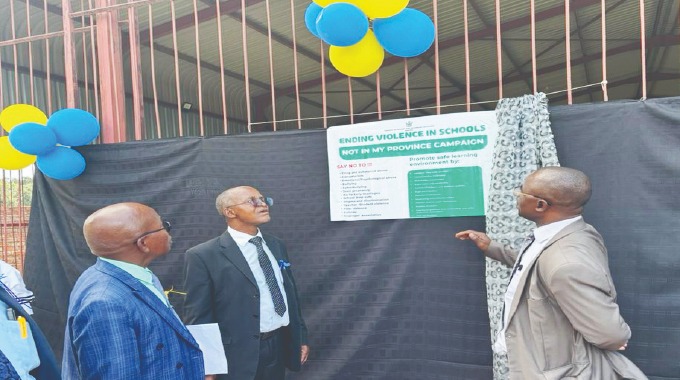
Tanaka Nkala and Michelle Musandinyoze
A POWERFUL message echoed through Mzilikazi High School in Bulawayo yesterday as learners, teachers and education officials stood together and declared a ’Not in My School’ pledge against gang violence and bullying.
The event marked the launch by the Ministry of Primary and Secondary Education’s ‘Safe to Learn Initiative’ and the ‘Not in My School’ campaign, an effort aimed at ending violence, bullying and abuse in schools across the province.
It brought together school heads, district school inspectors, students, members of the Junior Parliament, non-governmental organisations, and community representatives, all united by a shared goal of creating safe and inclusive learning environments for every child.
Addressing the crowd, Bulawayo provincial education director Mr Bernard Mazambane delivered a heartfelt speech anchored in official policy, urging students to take ownership of the campaign’s message and to look at one another, boldly rejecting violence in all its forms.
“As students, you need to adopt the ‘Not in My School’ phrase and be able to protect one another against violence,” he said.
“Teachers, heads and those from DSI normalise, including the statement ‘Not in my office, not in my district and not in my province’ when you conduct your meetings.”
Mr Mazambane spoke about the realities many learners face, which include peer pressure and exposure to harmful behaviours at a young age.
He highlighted how easily a young person can be influenced, stressing the importance of guidance and supportive environments.
“We are aware of the challenges our children face, but we must create spaces where they feel safe mentally, emotionally and physically to learn and grow,” he said.
The launch aligns with a global commitment made at an International Education Forum held in London in May 2025, where governments pledged to end violence in schools.
Zimbabwe has since committed to implementing policies that protect learners and promote positive discipline.
The initiative aims to reinforce the powerful idea that schools should be places of safety, not fear.
It also called for an end to practices such as corporal punishment, bullying, discrimination and substance abuse while promoting guidance and counselling, parental involvement and community engagement.
Hugh Beadle Primary School headmistress Mrs Sofilia Khumalo reaffirmed that schools are moving in the right direction.
“We are already taking guidance and counselling seriously at our school, but this launch has shown us that we need to go further, bringing in every learner and strengthening our efforts,” she said.
Mrs Khumalo highlighted a growing concern among educators and the influence of social media on children’s behaviour.
“What they learn at school is not always what they practise at home or online and that is why we need stronger partnerships with parents,” she said.
Students who attended the launch also left with a renewed sense of responsibility.
Leanne Kachitsa, a young pupil representing Matshayisikhova Primary School, said the programme inspired her to become an agent of change among her peers.
“We have learned that we must help each other and when we go back to our schools, we will share what we have learned so that we can build a better future,” she said.
Her words reflected the campaign’s broader vision, empowering children not just as beneficiaries but as active participants in creating safer schools.
However, according to Junior Councillor Patron, Mercy Furanayi, some students remain unrecognised in this situation.
She emphasised the need to include children with disabilities in the fight against school-based violence.
“Children with disabilities face more abuse because they are often misunderstood and discriminated against and schools must be inclusive and responsive to their needs,” she said.
Furanayi also called for early intervention at the primary school level, where many forms of bullying and abuse begin.



 Online Reporter