Nqobile Bhebhe, [email protected]
BULAWAYO’S drive towards re-industrialisation must be built on stronger partnerships between tertiary institutions, industry, enterprises and markets, with Bulawayo Polytechnic positioned to play a pivotal role in transforming academic knowledge and technical skills into productive economic activity.
This was said by Industry and Commerce Minister Nqobizitha Mangaliso Ndlovu while delivering a public lecture at Bulawayo Polytechnic titled “Harnessing Students’ Potential for Sustainable Industrialisation and Vision 2030”. During the engagement, the minister challenged students to look beyond obtaining qualifications and use their knowledge, skills and innovations to establish enterprises that support local production and create jobs.
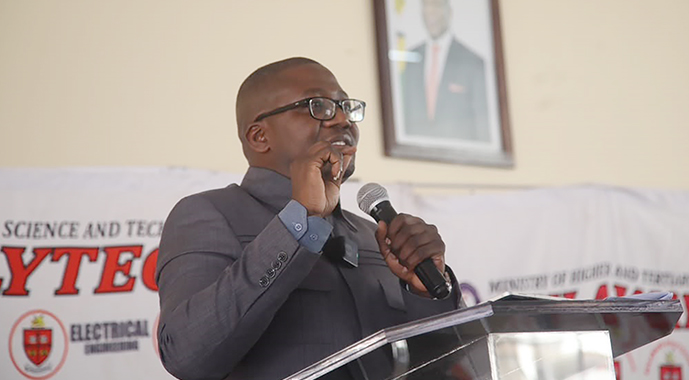
Minister Ndlovu said Bulawayo’s rich industrial heritage offers a strong platform for future growth, but stressed that the city must focus on building new industries capable of driving economic development in the years ahead.
“Bulawayo’s industrial heritage is a foundation, not a destination. We should honour the city’s past, but the forward-looking question is: what industries can Bulawayo build for the future?
“The opportunities include engineering and fabrication, machinery and equipment manufacturing, mineral-beneficiation support, food pharmaceuticals, automotive components and renewable-energy technologies,” he said.
“These industries are not isolated. They require technicians, designers, entrepreneurs, suppliers, quality systems, finance, logistics and market connections. They create room for many disciplines and many types of enterprise.”
Traditionally regarded as Zimbabwe’s industrial hub, Bulawayo remains well positioned to rebuild its manufacturing base by leveraging its existing infrastructure, skilled workforce and strategic location within the region.
Significant opportunities exist in sectors such as engineering, agro-processing, mineral beneficiation, machinery manufacturing and other value-added industries, particularly as the country seeks to boost local production and reduce dependence on imports.
However, achieving meaningful industrial growth will require stronger collaboration between Government, manufacturers, financial institutions, tertiary institutions and entrepreneurs.
Closer links between training institutions and industry can help ensure graduates possess skills that meet the needs of the market, while businesses benefit from research, innovation and emerging technologies developed within academic institutions.
Against this backdrop, Minister Ndlovu said Bulawayo Polytechnic has a crucial role to play in linking education with industry and economic production. “Bulawayo Polytechnic can serve as the bridge between education, skills and innovation on one side and industry, enterprise and markets on the other. Its workshops, laboratories, lectures, students and industry relationships are productive assets,” he said.
“The ambition should extend beyond the city. Bulawayo can become a stronger regional centre for technical skills, innovation, manufacturing and industrial services serving Zimbabwe and the wider SADC market.”
Minister Ndlovu said successful industrialisation requires clearly defined responsibilities among different stakeholders, with Government creating a conducive operating environment while businesses, financial institutions, academic institutions and young people drive production, investment and innovation.
“Industrialisation is a national undertaking. As Government we will create an enabling environment through policy, infrastructure, standards, regulation, financing mechanisms, market opportunities and investment facilitation,” said Ndlovu.
“The private sector must invest, produce, innovate and open its value chains to local suppliers. Financial institutions must develop financing solutions that support productive enterprise rather than consumption alone.
“Academic and research institutions must generate knowledge, develop relevant skills and produce practical solutions. Young people must take initiative and turn opportunities into productive ventures. These roles are different, but they are connected. Policy without production is incomplete. Innovation without finance may not scale.”
The minister said Vision 2030 should be viewed as a national undertaking rather than a Government programme alone, adding that young people have a critical role to play in shaping the country’s future economic landscape.
“The choices students make today are the seeds of the Zimbabwe we build together. The skills you acquire, the ideas you pursue, the networks you build and the enterprises you establish will shape future outcomes.”
“By 2030, many of today’s students will be leading businesses, factories, institutions and technologies. Some will be industrialists, researchers, investors, entrepreneurs and policymakers. Some will create companies that do not yet exist,” Ndlovu said.
“You must be present as entrepreneurs, innovators, skilled employees, suppliers, manufacturers, investors, researchers and business owners.
Minister Ndlovu also urged students to adopt a problem-solving and entrepreneurial mindset, encouraging them to view economic challenges as opportunities for innovation and business development.
“These questions change the mindset from waiting to acting. They turn an import into a production question, a supply shortage into a market question, an inefficient process into an innovation question and a student project into a commercialisation question,” he said.
The public lecture attracted students from various faculties and provided a platform for direct engagement between policymakers and young people on industrial development, entrepreneurship and Zimbabwe’s broader economic transformation agenda.