Chronicle Editor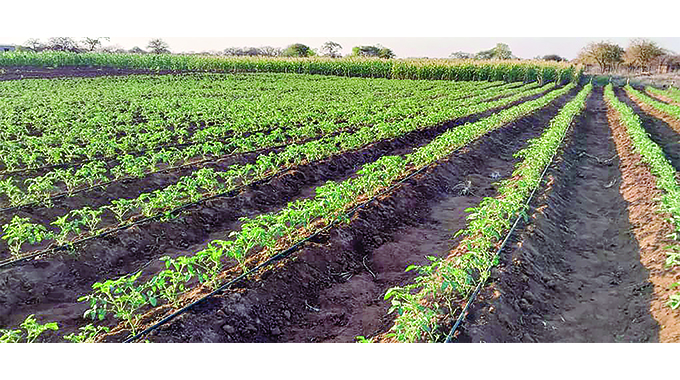
Canditar Chapanduka, Chronicle Reporter
AN enterprising Beitbridge-based bus driver, Mr Oscar Singo (39) has transformed a dry area, largely characterised by low rainfall and recurrent droughts into a green oasis in Tshapfutshe Village in Beitbridge district, Matabeleland South.
Despite the geographical location, Mr Singo, who has no formal qualifications in agriculture, has managed to turn his dream of becoming a successful commercial farmer into reality.
He has transformed a 12-hectare piece of land, previously used as family gardens, into a thriving horticulture project, employing four people on a permanent basis and several others on a seasonal basis, some of whom include youths, widows, and orphans.
Mr Singo grows tomatoes, green and red peppers, okra, onion, watermelon, butternut, tomatoes, strawberries and green maize.
A self-taught farmer who started his horticulture project four years ago, Mr Singo supplies supermarkets and local fresh produce markets in Beitbridge.
Mr Singo relies heavily on technical advice from the local agricultural extension officers and other experts in the field.
He also interacts with established large-scale commercial farmers in the province to tap into their knowledge on farming.
Through his efforts, he is defining the success farming story, contributing significantly to food security for the nation in line with the Agriculture and Food Systems Transformation Strategy (2020-2025) whose thrust is to see Zimbabwe achieving a US$8,2 billion agriculture economy by 2025.
The strategy, which was launched by President Mnangagwa in August 2020, is underpinned by growing the economy and ensuring Zimbabwe grows its own food and ensures the majority of rural families move from poverty to affluence.
“When I started this project, my intention was to produce food and be able to feed my family upon retirement. However, I noticed that farming is a viable business with the potential to generate money and decided to extend our gardens and venture into commercial farming,” said Mr Singo.
“I started by growing maize for our own consumption and with time I also added sugar beans. Later, I realised that there was a huge gap in the market in terms of tomatoes, peppers, and okra and decided to venture into commercial horticulture.”
Mr Singo is using a drip irrigation system, which saves water by 35 percent.
“Since Beitbridge is a semi-arid region with a low rainfall pattern, I had to make sure that I do everything possible to try and conserve the little water that is available. It’s quite a marvel for me to have managed to transform what was an idle piece of land into a viable commercial farming business in a short space of time,” he said
“With drip irrigation, there is less loss of water, labour, diseases, and weeding and I can also irrigate a bigger area at the same time.”
Mr Singo said he was lucky to have inherited a vast tract of productive land.
“When expanding land, you bump into different types of soils, which are not favourable for certain crops, but I managed to grow up to 11 000 tomato plants and still fail to satisfy the market,” he said.
“I started with 1 000 plants of tomatoes, but due to demand, I increased to 7 000 and then eventually got to 11 000 ad the demand keeps growing.”
Mr Singo said while tomatoes are the most laborious crop, they are a cash-intensive project and a bedrock of his successful farming venture.
“For now, I can’t talk of the export market. I am actually failing to meet the demand for the local market. My plan is further to expand and possibly up to 100 hectares and that is when I can start talking of exporting and ultimately supplying big markets like Tesco Supermarkets in London,” he said.–@NomqheleC



 Online Reporter