Raymond Jaravaza
MASSIVE works have resumed along the Bulawayo-Victoria Falls Road with construction equipment and hundreds of workers back on site to meet a target of 20km for each of the eight contractors by year end.
The eight contractors awarded the tender to rehabilitate the 440km Bulawayo-Victoria Falls Highway are back on site after Government secured a US$400 million infrastructure financing package to accelerate the upgrade of three major highways.
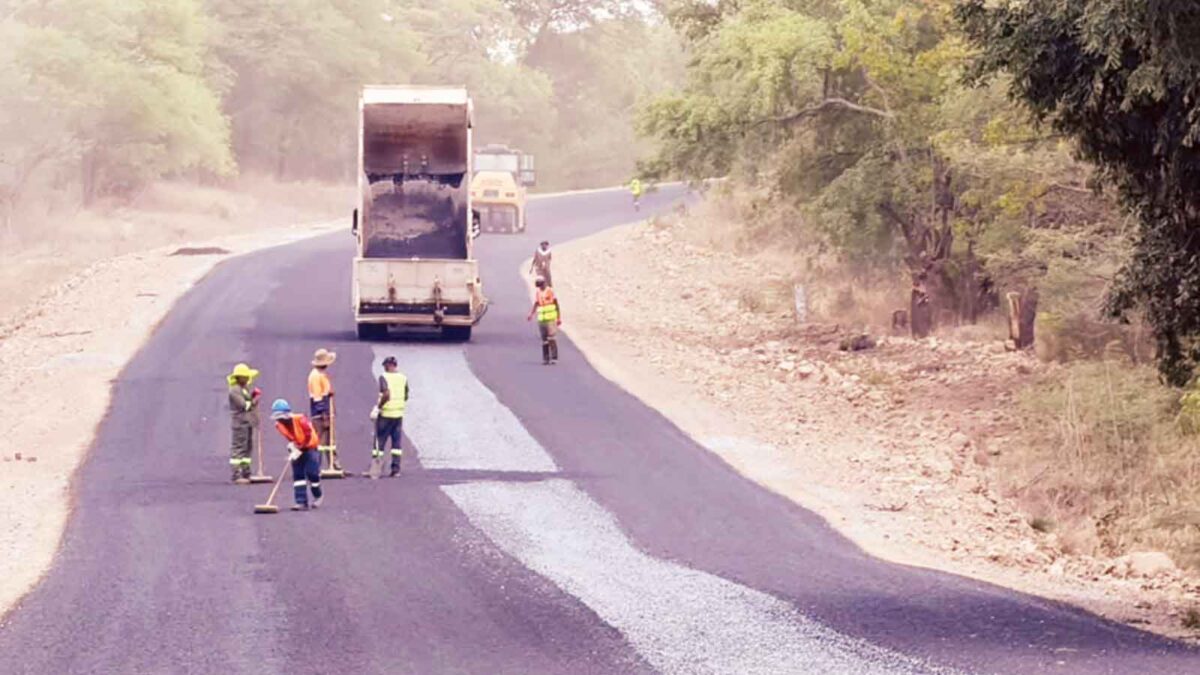
Yesterday, a Zimpapers crew conducted a snap survey along the critical Bulawayo-Victoria Falls Road, and noticed a hive of activity by teams from different contractors, undertaking bush clearing, detour construction, earthworks, drainage installation, surfacing road widening and application of bitumen.
A few kilometres from the Bulawayo-Victoria Falls tollgate, construction workers from Fossil Contracting (Pvt) Ltd were observed widening the 10km stretch of the busy highway, while another crew from the same company was applying bitumen after Bernice Business Centre.
The next contractor – Masimba Holdings – working on the Bulawayo-Victoria Falls Highway after Insuza Business Centre, has already opened over 15km of the highway to traffic and started resurfacing and compacting a section of the road before the application of bitumen.
Further up the highway before Phulula Business Centre, the contractor, Syvern Investments construction are back on site and their yellow equipment was observed doing heavy earthworks in preparation for drainage installation, surfacing road widening and application of bitumen.
Matabeleland North Minister of State for Provincial Affairs and Devolution Richard Moyo urged contractors to prioritise the worst affected sections of the highway.
“Government has secured funding to mobilise contractors back to site for the rehabilitation and widening of the Bulawayo-Victoria Falls Road. So, we expect the contractors to speed up the upgrading of the highway,” he said.
“The contractors must, however, prioritise fixing the worst damaged sections first so that motorists don’t spend more than an hour driving a small stretch of the road.
“I have instructed Engineer Xolani Ncube (Matabeleland North Roads Engineer) to relay the message that contractors must rehabilitate the badly damaged areas first,” said Minister Moyo.
The release of funds by Government has ended months of uncertainty that had stalled progress in the critical infrastructure project.
The funding provides an opportunity to accelerate work on key transport routes at a time when the country seeks to strengthen its productive capacity, improve logistics and derive greater value from its strategic position within the region.
The three major highways – Beitbridge/Harare, Harare/Chirundu Highway and Bulawayo/Victoria Falls Highway – serve as economic lifelines, linking production centres, tourism destinations and regional trade corridors.
Government has moved in to expedite the rehabilitation of critical transport corridors to ensure smooth travel by motorists, enhanced trade and tourism business connectivity.
The Zimbabwe National Road Administration, a parastatal responsible for mobilising, collecting and managing funds for the maintenance of the country’s national road network, secured the CBZ infrastructure bond backed by its ring-fenced funds to finance works on the three major highways.
The investment comes as the Second Republic intensifies efforts to modernise the country’s transport infrastructure, recognising that reliable roads are essential for reducing the cost of doing business, improving the movement of goods and people and strengthening Zimbabwe’s competitiveness as a regional trade and investment destination.
The three highways have strategic economic significance beyond domestic connectivity.
The Beitbridge-Harare Highway is a critical route for trade with South Africa and the movement of imports and exports. At the same time, the Harare-Chirundu Highway connects Zimbabwe to Zambia and markets further north.
The Bulawayo-Victoria Falls Highway links the country’s second-largest city to Matabeleland North and Victoria Falls, one of Zimbabwe’s prime tourism destinations.
Under the Second Republic, infrastructure rehabilitation has been a crucial component of the Government’s development agenda, with investment in roads, bridges, energy and other enabling infrastructure intended to support economic growth and the attainment of an upper-middle-income economy by 2030.