MacDenias Moyo-Correspondent
In the annals of our democratic journey there arises moments when the guardians of truth must unsheathe the sword of reason against the merchants of distortion.
Today that moment is upon us. The clause in the Constitution of Zimbabwe Amendment Act No 3 of 2026 which removes the direct vote for the President and replaces it with a representative electoral college has been maligned by career opposers and saboteurs as a betrayal of the struggle and a nullification of universal suffrage.
Such claims are not only false but dangerous for they seek to poison the well of our collective understanding.
Here is the clause under discussion as enacted in CAA3:
“92 Election of President
(1) The President must be elected by the members of Parliament in a joint sitting of the Senate and the National Assembly
(2) The election must take place at a joint sitting of Parliament following the swearing in of members of the Senate and the National Assembly and the election of the Speaker of the National Assembly and the president of Senate respectively after every general election or whenever necessary to fill a vacancy in the office of President.
(3) To be elected President the candidate must receive more than half of the valid votes cast by the members of Parliament.
(4) In the event that none of the presidential candidates receive a majority in the first ballot a run off ballot must be held between the two candidates with the highest number of votes and the candidate receiving the majority in the run off is declared elected as President.
(5) The election of the President shall be conducted by the Zimbabwe Electoral Commission in accordance with the Electoral Law and Standing Orders.
(6) A person elected as President under this section must cease to be a member of Parliament upon assuming office if they were a member at the time of election.
(7) In the case of a vacancy in the office of President due to death resignation removal or incapacity an election must be held at a joint sitting of Parliament not more than 30 days after the vacancy occurs.
(8) No amendment to any law or enactment introducing substantive policy changes shall be passed by Parliament during the period between the occurrence of a vacancy in the office of the President and the election of a new President by Parliament.”
Universal suffrage is not a fragile ornament that shatters when the mode of presidential election is altered. It is the bedrock principle that every citizen has the right to cast a ballot and that each ballot carries equal weight.
The Constitution enshrines the sacred creed of one man one vote. That vote is exercised in electing Members of Parliament who then form the electoral college to select the Head of State and Government. The people’s voice does not vanish in this process it reverberates through their chosen representatives.
The struggle was fought to secure the right of every citizen to participate in the governance of the nation. That right is not diminished when exercised through representative democracy.
On the contrary it is strengthened for it ensures that the collective will is mediated through institutions rather than manipulated by demagogues. The ballot remains the weapon of the ordinary man and woman. The claim that this clause repeals the gains of the struggle is a distortion of history. The struggle was for dignity, for equality, for the right to be heard. That right endures in the representative model.
Voices of wisdom echo across time. John Stuart Mill declared that the worth of a man’s liberty is measured by his ability to participate in the making of laws that govern him.
The late South African president Nelson Mandela reminded us that democracy is not the tyranny of numbers but the harmony of voices. Universal suffrage is the instrument by which those voices are gathered.
Those who cry betrayal ignore the fact that many flourishing democracies employ representative mechanisms in electing their leaders. The United States elects its president through an Electoral College chosen by the people. Germany entrusts its Bundestag to elect the chancellor. Italy’s Parliament elects the president.
The United Kingdom’s prime minister is chosen by the majority in Parliament. South Africa elects its president through the National Assembly. Botswana follows the same path. These nations are not less democratic. They are vibrant examples of representative democracy where universal suffrage is preserved through parliamentary elections.
The people vote for their legislators. Those legislators then elect the executive. The chain of legitimacy is unbroken. The citizen’s ballot remains the cornerstone.
Direct presidential elections have in many nations bred populism. Charismatic individuals have inflamed passions and divided societies. Populism thrives on the cult of personality.
It reduces democracy to a plebiscite on one man rather than a deliberation on policy. It breeds toxicity and violence for it places the fate of the nation in the hands of a single figure.
Representative democracy diffuses that danger. It decentralises power. It ensures that the Head of State emerges from consensus among elected representatives rather than from the frenzy of mass rallies. It tempers passion with reason. It guards against the manipulation of the masses by demagogues. It transforms leadership from spectacle to substance.
As Alexis de Tocqueville observed: Democracy must guard against the tyranny of the majority. Representative mechanisms are one such guardrail. They ensure that leadership is not the product of momentary passions but of institutional deliberation.
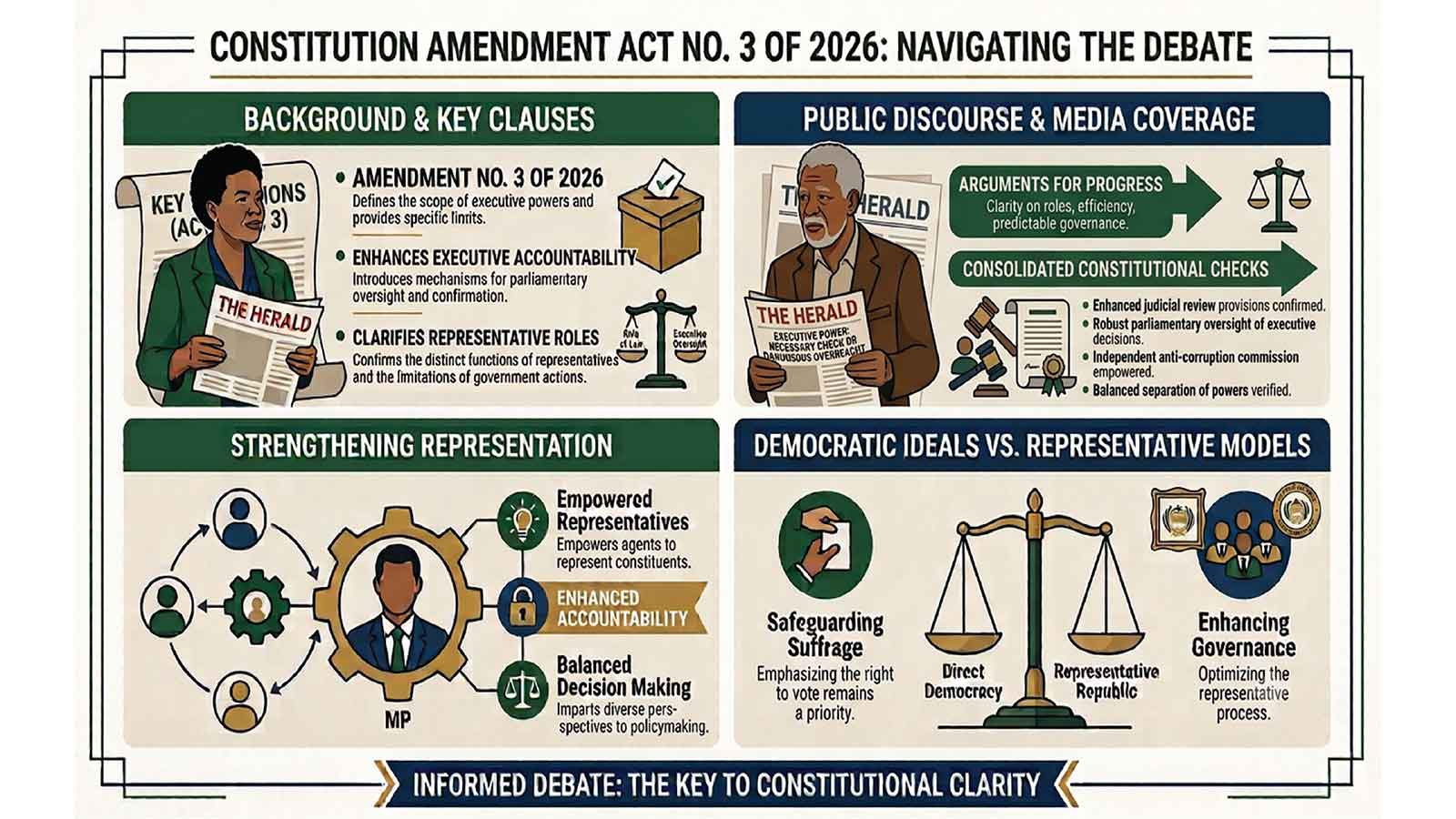
This clause is a progressive instrument in our Constitution. It strengthens institutions. It decentralises power. It ensures that the President is accountable to Parliament which is accountable to the people. It creates a chain of responsibility that binds the executive to the legislature and the legislature to the citizen.
It reduces the risk of violence during presidential campaigns. It curbs the excesses of populism. It fosters stability. It ensures that leadership is the product of consensus rather than confrontation. It aligns our democracy with global best practice.
It is not a repeal of the struggle, but its fulfilment. The struggle was for a democracy that endures. This clause ensures endurance.
Legally universal suffrage remains intact. The Constitution guarantees the right of every citizen to vote. That vote is exercised in parliamentary elections. The electoral college is composed of those representatives. The President is elected by Parliament. The people’s will flows through their representatives. The chain of legitimacy is unbroken.
The false narrative that universal suffrage is nullified is a distortion of law. It confuses the mode of election with the principle of suffrage. Suffrage is the right to vote. That right remains. The mode of electing the President is a matter of constitutional design. It does not diminish the right.
James Madison wrote that representative democracy refines and enlarges the public views by passing them through a chosen body of citizens. That is the essence of this clause.
Mandela declared that democracy is the rule of the majority with respect for the minority. That respect is safeguarded when leadership emerges from parliamentary consensus.
Modern scholars remind us that universal suffrage is not tied to direct presidential elections. It is tied to the right of every citizen to cast a ballot. That right remains inviolate.
CAA3 is not a betrayal. It is a maturation. It is the next step in our democratic journey. It aligns us with global practice. It strengthens institutions. It cures populism. It preserves universal suffrage. It honours the struggle.
The merchants of distortion seek to sow confusion. We must answer with clarity. Universal suffrage endures. The people’s voice remains sovereign. The clause is a progressive instrument that ensures stability and maturity.
As we begin this series of explanations let us start with the most contentious clause and lay bare its truth. Let us refute the false narrative. Let us proclaim that our democracy is not diminished but deepened.
The flame of universal suffrage still burns. The struggle is honoured. The Constitution is strengthened. The nation marches forward.