Theseus Mauruki Shambare
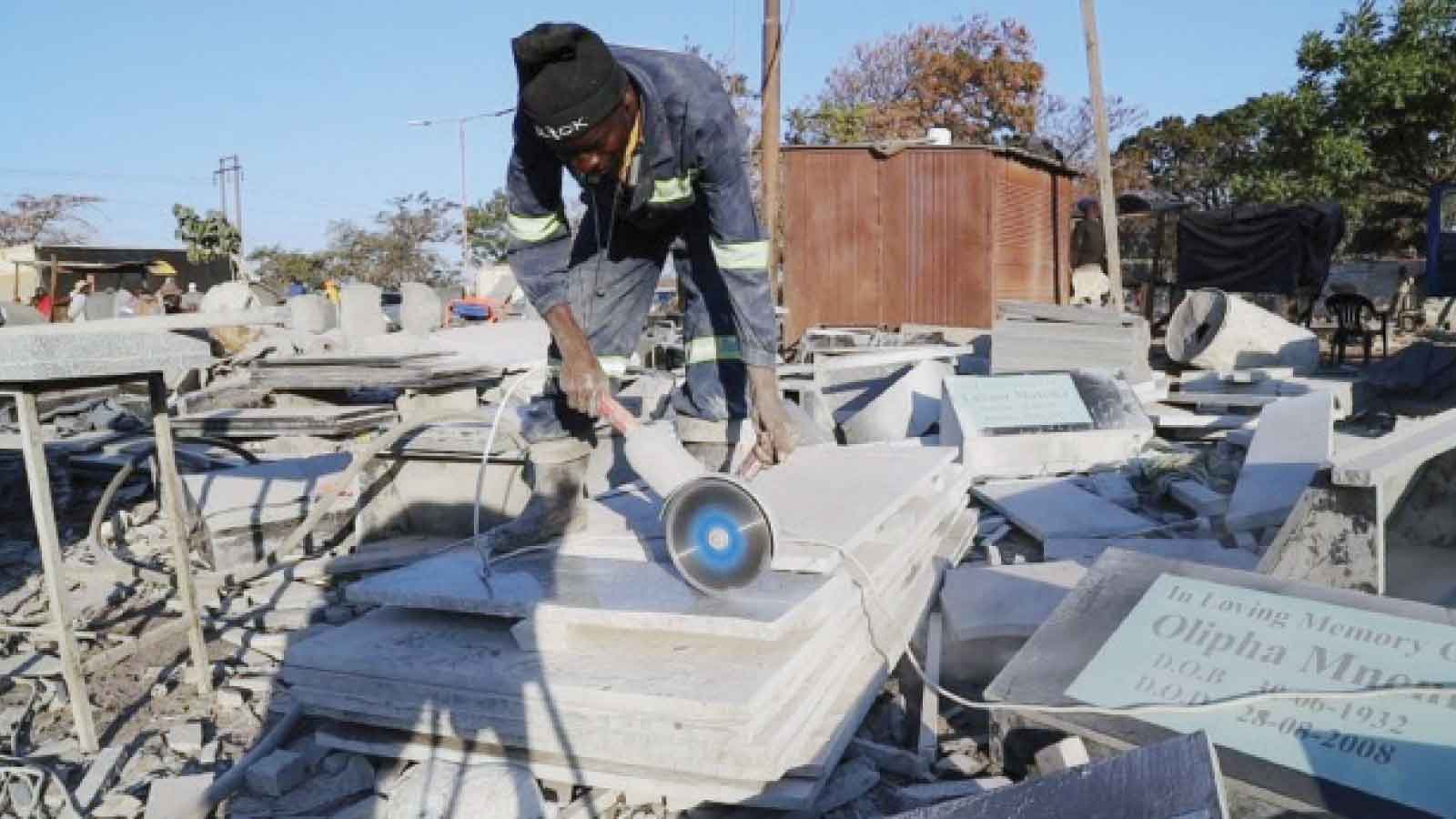
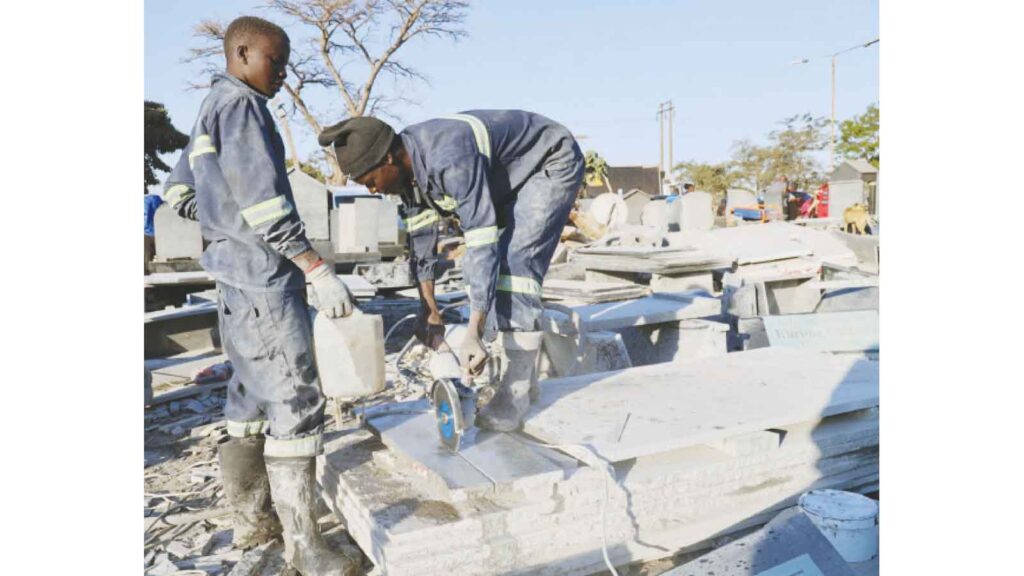
THE grinder screams against granite at Rugare, a suburb in Harare, sending a cloud of fine dust into the air as another slab slowly takes shape.
Nearby, an artisan works on a photograph while a name, date of birth, date of death and epitaph are etched into polished stone.
Soon, the finished monument will leave the workshop for a family grave, where it could stand for generations as a permanent reminder of a lost loved one.
However, the story of granite at Rugare does not end at the cemetery.
The same type of stone is cut into kitchen countertops, shaped into windowsills and, in some luxury homes, laid as flooring, turning a resource extracted from Zimbabwe into products that find their way into both residential and commercial spaces.
For veteran tombstone artist Tafadzwa Goba, August remains one of the busiest periods of the year.
“I do artwork on tombstones. I have been doing this work for a long time. My business usually peaks during the August period. Tombstones are key in ensuring that the living can celebrate their departed relatives,” he said.
Across Zimbabwe, the August holiday has traditionally become a period when families travel home and conduct tombstone-unveiling ceremonies, creating a seasonal market for granite processors, artists, transporters and installers operating at Rugare.

Yet, beneath the August rush is a much bigger story — one of an industry that has grown from a handful of operators in 2010 into a cluster of small enterprises supporting hundreds of workers and families, while now facing uncertainty over whether it will have a permanent place to operate from.
According to Rugare Granite Association secretary Caleb Mariga Chiringa, representing chairperson Barnbas Mhuru, operations began in 2010 with only two people.
The association now has 91 small and medium-sized enterprises, he noted, although figures previously supplied by the association put the number at 94 companies employing about 1 200 workers.
These differing figures reflect estimates at different stages, but both point to remarkable growth from the two-person operation of 2010.
Mariga Chiringa said the businesses collectively contribute about US$4 500 a month to the Harare City Council through rates and other charges. At roughly that level every month, the businesses generate more than US$50 000 annually for the local authority, making Rugare much more than a roadside collection of tombstone sellers. It is an emerging small business ecosystem built around granite.
From Mutoko to the graveyard
The journey of the granite used for tombstones begins far from Harare.
Operators at Rugare source their granite mainly from Mutoko before bringing it to the capital for processing.
At the workshops, the stone is cut, shaped and polished before being transformed to customer needs. For a grieving family, it becomes a tombstone; for a homeowner, a kitchen countertop or windowsill; and for owners of luxury properties, it can become elegant flooring.
The value chain, therefore, extends far beyond the funeral industry, connecting quarrying and transportation with cutting, polishing, construction, artistic engraving and retail.
What begins as a block of stone is progressively converted into a higher-value product, a principle of value addition that is increasingly central to Zimbabwe’s mineral policy.
The Government banned the export of unprocessed granite through Statutory Instrument 127 of 2022, formally titled the Mines and Minerals (Prohibition Order of Exportations of Unprocessed Granite) Notice, 2022.
This policy direction aims to retain more value from the country’s mineral resources through local processing rather than simply exporting raw materials.
The Ministry of Mines and Mining Development stated that its vision includes promoting mining, value addition and beneficiation for the ultimate benefit of Zimbabweans.
Furthermore, the wider policy environment increasingly recognises granite mining and quarrying as reserved sectors for Zimbabweans, with the Ministry of Industry and Commerce listing them among additional reserved sectors under Statutory Instrument 215 of 2025.
Internationally, that is where the real economic opportunity lies.
The scale of this opportunity becomes clearer when Rugare is viewed against the global granite trade. India is one of the world’s leading granite exporters, with the Observatory of Economic Complexity (OEC) recording about US$772 million in granite exports in 2023, while China was the world’s largest importer, bringing in about US$822 million worth of granite that year.
These figures illustrate the immense value created when countries develop the capacity to cut, polish and process stone at scale rather than simply trade in raw materials.
Brazil and Italy have also built a booming industry around its distinctive stones.
South Africa and Zimbabwe are both known globally for their black and dark granite resources, meaning the difference is not simply what lies beneath the ground, but what happens to the stone after it is extracted.
Rugare offers a glimpse into that possibility, albeit through small-scale operations that remain far removed from the highly automated factories.
When remembrance becomes a livelihood
In the tombstone market, the final price depends on the quality of the granite, size, design and level of custom engraving.
In Harare, basic upright headstones or flat grave covers generally cost US$100 to US$200, while standard three-step granite designs range from US$500 to US$1 000. Large executive or double-grave memorials can cost US$1 400 to US$1 700 or more. These figures illustrate the economic value created between the quarry and the final customer — a market that becomes particularly vital in August.
For Edia Chikate, the granite business is not an abstract value chain, but rather the source of school fees and household support.
Recruited into the industry by her elder brothers who started operating years earlier, she now runs the family business from their homestead.
“I operate from this family homestead . . . we are happy that we are now able to send our children to school and look after our widowed mother,” she said.
“The granite business booms in the month of August because of our longstanding tradition.”
The economic cycle is straightforward.
Families travel, orders increase, granite is processed, artists add the final details, transporters deliver the monuments, workers earn wages and families receive a permanent marker of their loved one’s life. For Goba, this artistic work has evolved into a true profession.
“I was born as a natural artist. I now have six years doing art on tombstones,” he said.
He firmly believes the industry is also keeping young people occupied through meaningful employment and skills development.
“This industry has now contributed to the reduction of crime rates. Now young people are focusing on work rather than doing drugs or crimes like theft.”
More than a stone
Mariga Chiringa sees another dimension.
The modern tombstone, he argues, has become a form of family archive.
Photographs, names, dates and inscriptions allow descendants to preserve details about relatives who died long before they were born.
The stone, therefore, undergoes two transformations at Rugare. First, it is physically transformed from a raw mineral into a polished product. Then, it is transformed into memory. But the people responsible for that transformation now face uncertainty over their own future.
The Harare City Council has maintained that the occupation of land along Kambuzuma Road is illegal and poses safety concerns.
The planned removal of the operators has been linked to the city’s infrastructure development, including the expansion of Kambuzuma Road.
However, documents supplied by the association show that the traders had already begun looking for an alternative operating site before the current dispute intensified.
In a letter dated November 21, 2025, and stamped as received by the City of Harare’s records section on the same day, the Rugare Granite Association formally applied to the council’s Housing Department for land between Kambuzuma Road and Douglas Road to accommodate its members for granite manufacturing.
The association said it was prepared to continue paying monthly dues to the council while using the proposed site, which it linked to land designated for road expansion.
The letter was signed by association officials, including chairperson Barnbas Mhuru, secretary Caleb Mariga Chiringa and vice chairperson Ali Matewere.
Mariga Chiringa revealed the association had also approached the National Railways of Zimbabwe for land, arguing that the current area falls under its jurisdiction.
Southerton Ward 13 Councillor Chipo Suka recently told a business meeting with the operators that demolitions were necessary, but declined to comment further, saying the matter was before the courts.
The proposed eviction has also attracted interest from politicians.
In July, the ZANU PF District Coordinating Committee (DCC) 6 challenged the planned removal, warning that nearly 900 families could lose their livelihoods.
The committee questioned why operators who make payments to the council should be regarded as illegal occupants.
Receipts supplied by the operators include payments of US$3 330, US$1 319,92 and US$1 732,25 in rentals and service charges.
DCC 6 secretary for business development and economic development Andrew Makahamadze has questioned the basis of the proposed eviction.
The eviction question
The Harare City Council has maintained that the occupation of the land in question is illegal and poses safety and environmental concerns.
Acting Director of Urban Planning Services for the City of Harare Samuel Nyabezi said the operators were illegally occupying the area and also contributing to pollution in surrounding residential neighbourhoods.
“Before we speak about anything else, these guys are illegally occupying that area. Additionally, they are polluting the residential areas,” he said.
Nyabezi said the dispute was also linked to the wider road reserve set aside by the council for future road expansion.
Although the granite businesses may appear some distance from the existing tarred lanes, the area they occupy falls within a wider corridor reserved for future road extension and upgrading.
The local authority argues that the operators are occupying land required for future infrastructure development and may not have the necessary approvals to operate there.
An industry looking for a home
The traders, however, acknowledge the current location presents environmental challenges.
The association noted it was orally advised that an open space close to the current site could potentially accommodate the businesses.
The operators have also been advised by the Ministry of Women Affairs, Community, Small and Medium Enterprises Development to register as a cooperative, potentially opening access to financial assistance through Government programmes and financial institutions.
That could turn the relocation dispute into an opportunity for formalisation.
A designated granite-processing area could separate industrial activity from residential neighbourhoods, improve dust and waste management, enhance working conditions and provide businesses with greater security.
It could also help the authorities to properly quantify an industry that has largely grown organically.
The bigger question
Rugare’s story is, therefore, not simply about tombstones.
It is about what happens when small businesses grow faster than the urban planning systems around them.
It is about how cities can accommodate enterprises that provide employment and generate revenue while protecting residents from dust, safety risks and unplanned development.
It is also about how Zimbabwe can extract greater value from its granite resources before the finished product reaches the consumer.
The Government’s ban on exports of unprocessed granite was designed around precisely that principle — keeping more processing and value creation within Zimbabwe.
However, value addition requires more than a law prohibiting raw exports.
It requires infrastructure, machinery, skilled workers, access to land and support for small processors to grow into properly organised enterprises.
Rugare operators may not have the automated cutting lines or massive industrial factories found in China’s processing hubs or India’s granite clusters, but they are already doing what national policy seeks to encourage, which is taking stone extracted from Zimbabwe and transforming it into finished products for the domestic market.
From Mutoko to Rugare, granite moves through a chain of workers and businesses.
In the case of a tombstone, it becomes something even more difficult to price — it becomes memory.
For the worker polishing the stone, a single transaction may mean school fees or food on the table, while for the artist, it is a livelihood built from pure talent.
For the local authority, it is an economic activity that generates revenue but also presents planning and environmental challenges.
For the State, it is another test of whether mineral wealth can be converted into jobs, enterprise and greater local value.
But the irony is difficult to miss.
The people of Rugare make monuments designed to remain for generations, yet their own future remains unsettled.