Chronicle Editor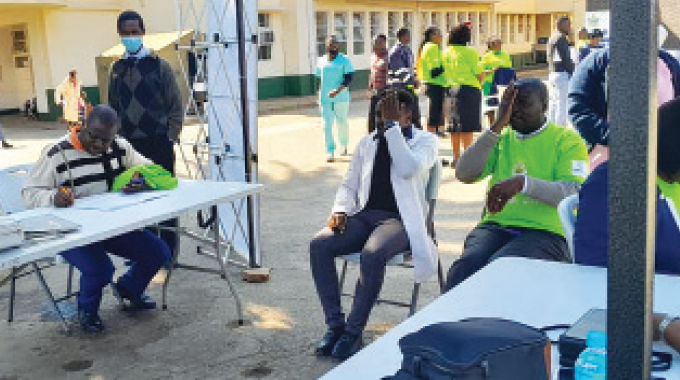
Amos Mpofu and Trish Mukwazo.
THE cataract screening programme launched last week by the Zimbabwe Council for the Blind, in partnership with Richard Morris Hospital, a division of the United Bulawayo Hospitals, specialising in eye treatment, has received an overwhelming response.
In an interview, the Zimbabwe Council for the Blind’s eye care coordinator, Mr Alick Phiri said the eye screening exercise has yielded remarkable results
“We are making significant progress and there is a growing number of individuals attending the screening since its inception. While we haven’t yet compiled the statistics on cataract cases, many people have been identified with this condition during the ongoing screenings,” he said.
Mr Phiri said people with conditions other than cataracts are not being turned away, but are given advice on necessary steps to take to treat their conditions.
“We advise those experiencing other conditions on how they can manage them. We also refer our clients to Mpilo and UBH for the treatments they need,” he said.
Mr Phiri said some of the causes of eye cataracts include reading at a closer range for a long period without resting one’s eyes.
“We recommend that when reading from a closer range, one must take a rest for at least ten seconds by looking away. People must also seek healthy lessons on the diet which is expected for the health of eyes among other reasons,” he said.
Mr Phiri said people should undergo at least one eye test every year.
“This is crucial because many eye diseases can go unnoticed without proper screening. Nowadays, technology has introduced us to a software called Portable Eye Examination Kit (PEEK), which is easy to learn and use,” he said.
“Therefore, we advise those who can access screenings to consult medical experts or utilise this software to test for potential eye diseases.”
Mr Xolani Khumalo, a resident from Magwegwe suburb said the programme has come as a huge relief to him given his financial struggles.
“Accessing cataract screenings can be challenging due to financial constraints. I am certain that this programme has helped many people, especially elderly people like myself who have financial challenges,” he said.
“Without this programme, many of us would have remained at home, ignoring potential eye complications that require screening and prescriptions for medical assistance, simply because we lack the funds to do so.”


 Online Reporter