Online Reporter
Cardinals from across the globe have gathered in Rome, Italy, for the highly anticipated conclave to elect the next Pope.
The ritual kicked off with a mass in St. Peter’s Basilica on Wednesday morning.
Later, in the afternoon, the 133 cardinal electors will make their way to the Sistine Chapel, chanting the litany of the saints. Once inside, they will take a vow of secrecy before Michelangelo’s iconic frescoes, committing to the solemn task of selecting the new leader of the Catholic Church.
This conclave follows the recent funeral of Pope Francis, marking a significant moment in the church’s history.
Stay tuned for live updates as the cardinals begin their deliberations and voting process.
Hope for a Pope that will foster unity within the church
Cardinal Giovanni Battista Re, the dean of the College of Cardinals, has urged the cardinal who will elect the new Pope to put personal interests aside and choose someone who prizes unity in diversity.
Re reminded cardinals that the conclave is the highest church responsibility, and they must set aside “every personal consideration”.
In his sermon, he said the new pope should foster unity within the church.
Re said the cardinals should elect someone “whom the church and humanity need at this difficult, complex, and turbulent turning point in history”.
“Let us pray that God grants the church a Pope who will be able to awaken the consciences of all, as well as the moral and spiritual energies in today’s society, characterised by great technological progress, but which tends to forget God.”
Front-runners emerge
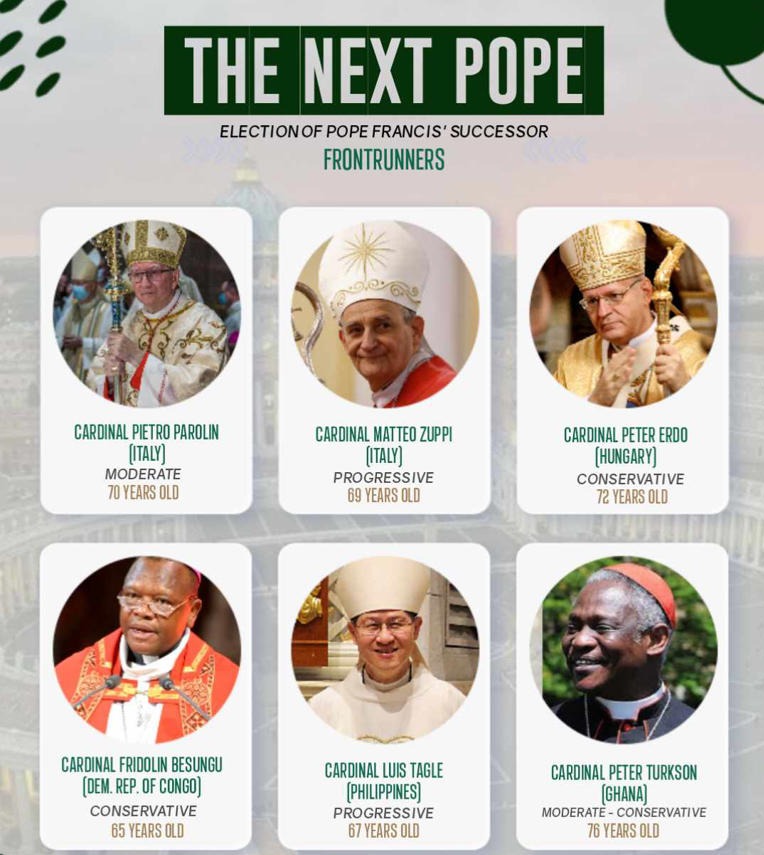
Among the frontrunners are Italian Cardinal Pietro Parolin and Filipino Cardinal Luis Antonio Tagle.
Born on January 17, 1955, in Schiavon, Italy, Parolin has been a significant figure in the Catholic Church, particularly as the Secretary of State under Pope Francis since 2013.
Parolin’s journey began in a devout Catholic family, where he experienced a profound loss at the age of ten when his father died in a car accident. This tragedy shaped his early life and led him to pursue a vocation in the priesthood.
He was ordained in 1980 and began his diplomatic career for the Vatican in 1986, eventually rising to the role of Undersecretary for Relations with States from 2002 to 2009.
According to various observers and betting agencies, Parolin is favoured to secure between 40 to 60 votes in the initial round.
His supporters include influential figures such as Angelo De Donatis and Marcello Semeraro, who believe his experience and diplomatic skills are crucial for the church’s future.
Other notable candidates include Cardinal Luis Antonio Tagle, often referred to as the ‘Asian Bergoglio,’ and Cardinal Jean Marc Aveline, the archbishop of Marseille.
Both are seen as potential successors who resonate with the populace’s needs.
Tagle, in particular, is viewed as a candidate who understands the challenges faced by the church’s followers worldwide.
In a potential negotiation that could unfold during the Conclave, there are discussions about an agreement between Parolin and Tagle, where Tagle might step aside in exchange for a significant position within the Vatican, possibly as Secretary of State.
This kind of strategic alliance could streamline the voting and help solidify Parolin’s position as the leading candidate. The memory of the 2005 Conclave, where two leading candidates withdrew to allow for a compromise, looms large over the proceedings.
In addition to Parolin and Tagle, other candidates like Cardinal Matteo Zuppi and Cardinal Fridolin Ambongo are also in the mix, each bringing their unique perspectives and support bases.
With the first white smoke anticipated later in the evening, the world watches closely as the cardinals embark on this sacred duty.
What is a cardinal?
A cardinal is a member of the Sacred College of Cardinals, whose duties include electing the Pope, acting as his principal counselors, and aiding in the government of the Roman Catholic Church throughout the world.
Cardinals serve as chief officials of the Roman Curia (the papal bureaucracy), as bishops of major dioceses, and often as papal envoys.
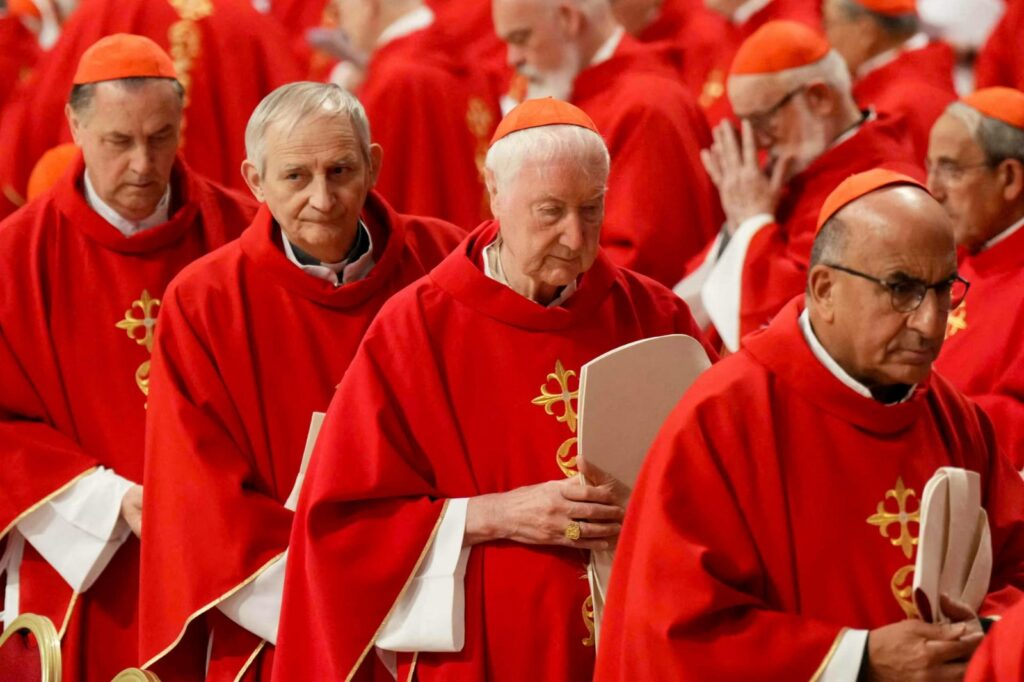
They wear distinctive red attire, are addressed as “Eminence,” and are known as princes of the church.
Who are the cardinals electing the new Pope, where does Africa stand?
133 cardinals from 70 countries will be sequestered from the outside world, their mobile phones surrendered and cell connection around the Vatican jammed to prevent them from all communications until they choose a new leader for the 1.4 billion-strong Catholic Church.
Pope Francis named 108 of them, choosing many pastors in his image from countries like Mongolia, Sweden and Tonga, that had never had a cardinal before.
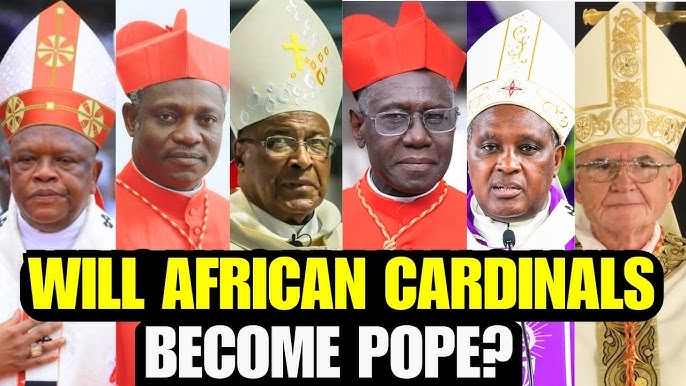
The late Pope’s decision to surpass the usual limit of 120 cardinal electors and include younger ones from the global south — often marginalised countries with lower economic clout — has injected an unusual degree of uncertainty into a process that is always full of mystery and suspense.
Africa accounts for 18 of the 133 cardinals eligible to vote for Pope Francis’ successor at this week’s conclave, according to the Vatican, although one of them, John Njue of Kenya, will sit out the session due to illness.
The electors come from Algeria, Burkina Faso, Cape Verde, Central African Republic, Congo, Ethiopia, Ghana, Guinea, Ivory Coast, Kenya, Madagascar, Morocco, Nigeria, Rwanda, South Africa, South Sudan, and Tanzania.
Many of the cardinals hadn’t met one another until last week and lamented they needed more time to get to know one another, raising questions about how long it might take for one man to secure the two-thirds majority, or 89 ballots, necessary to become the 267th Pope.
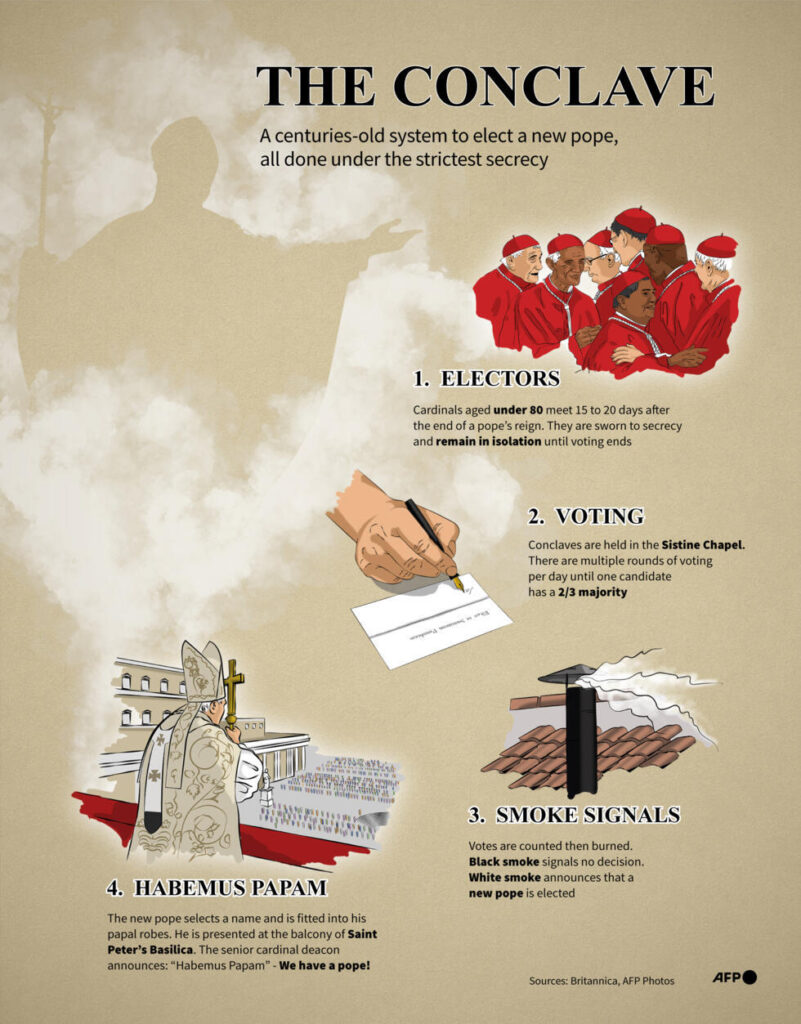
The voting process explained
Each cardinal, in order of precedence, writes the name of their chosen candidate on the ballot, folds it, holds it aloft so it is visible, and carries it to the altar. There, a chalice is placed with a plate covering it.
Each elector says aloud, “I call as my witness Christ the Lord, who will be my judge, that my vote is given to the one whom I believe should be elected according to God”.
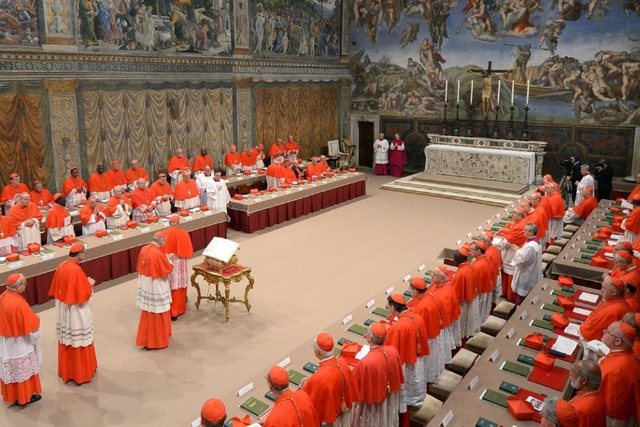
The cardinal then places the ballot on the plate and uses it to drop the vote into the chalice, bows to the altar, and returns to his seat.
Cardinals who are present but unable to walk to the altar due to illness give their folded ballot to one of the scrutineers, who brings it to the altar and deposits it in the same manner, without reciting the oath again. – Vatican News
Unwell cardinals to vote from their rooms
If any cardinals are too ill to be in the chapel, the three infirmarii visit them with a tray of ballots and a sealed box (previously shown to be empty, then locked with the key placed on the altar).
The top of the box has a slit where the folded ballots can be inserted. Once the votes are cast, the infirmarii bring the box back to the chapel, where it is opened in front of the electors. The votes are counted and added to those already in the main chalice.
The count
After all votes have been cast, the first scrutineer shakes the chalice to mix the ballots. The last scrutineer then counts them one by one, transferring them into a second, empty container.
If the number of ballots doesn’t match the number of voters, all ballots are burned and a new vote is held immediately. If the count is correct, the ballots are opened and read.
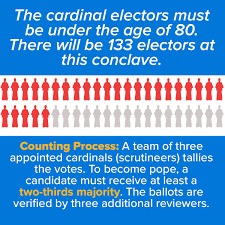
The three scrutineers sit at a table before the altar. The first reads the name written on a ballot and passes it to the second, who confirms the name and hands it to the third, who reads it aloud for everyone to hear and records the vote.
Once all ballots have been read and the votes tallied, the final scrutineer pierces each ballot with a needle through the word Eligo and threads them together with string. The ends of the string are tied in a knot, and the ballots are stored for safekeeping.
The required majority
To elect a new Pope, a two-thirds majority is required. For this current conclave on 7 May, that means at least 89 votes are needed out of 133 electors.
Regardless of whether a Pope is elected, the revisers carefully verify the count and check the notes made by the scrutineers to ensure everything was carried out correctly.
After this, before the electors leave the Sistine Chapel, all the ballots are burned in a cast-iron stove first used in the 1939 conclave. The scrutineers handle this with help from the College secretary and the ceremonial officers, who are summoned by the senior deacon.
A second stove, installed in 2005, is connected to a chimney visible from St Peter’s Square. This is where the chemicals are added to colour the smoke: black if no Pope has been elected, white if one has been selected.
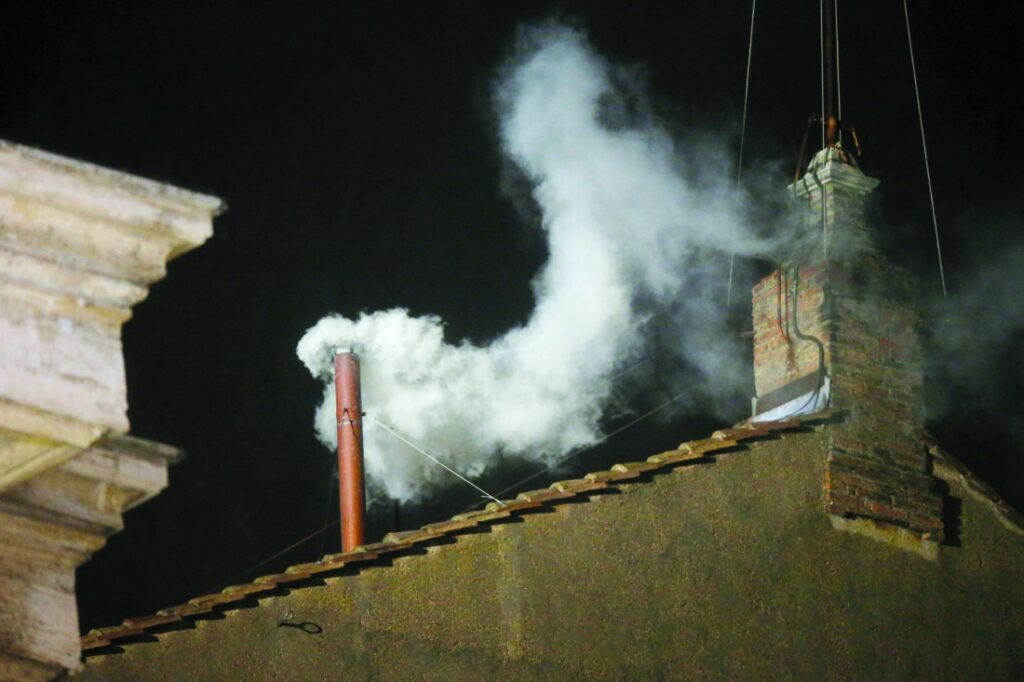
Voting to resume today
The wait for a new Pope goes on after black smoke rose from the Sistine Chapel on Wednesday evening.
Voting will resume today, and up to four rounds of voting can take place each day, two in the morning and two in the afternoon.
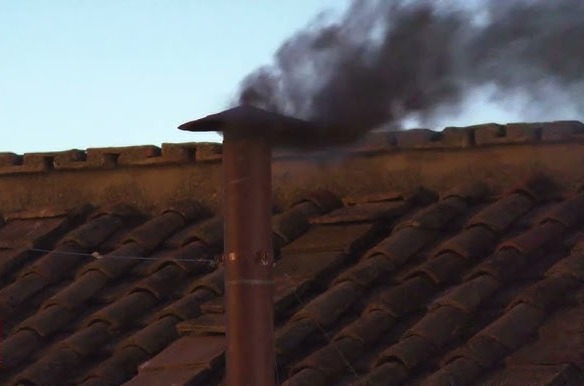
Some cardinals said this week that they hoped to wrap things up by Thursday or Friday.
When a Pope is chosen, white smoke will emerge,
Black smoke for the second time
Black smoke has poured from the Sistine Chapel chimney, signalling that no new Pope has been elected.
It is the second smoke signal from the secret conclave after the 133 cardinal electors sent up a black smoke signal on Wednesday evening as they work to come to a two-thirds majority to elect a successor to Pope Francis.

The smoke is the only public sign of what is happening during the Papal Conclave, after the cardinals handed in their phones and took oaths of secrecy while the Vatican shut down mobile phone towers to protect the deliberations.
The assembled cardinals vote up to four times a day, while crowds gather in St Peter’s Square to wait for the white smoke that signals the Conclave has selected a successor to Pope Francis, who died last month aged 88.
How long has it previously taken to elect a new Pope?
No Pope in modern times has been elected on the first attempt, so Wednesday’s black smoke was widely expected.
But given recent history, a successful outcome is possible from the second day.
On average, new Popes are elected on the third day of the Conclave, after eight ballots, according to Vatican News.
Pope Francis was elected on the second day of the 2013 conclave, after five ballots, and his predecessor Benedict XVI was also elected on the evening of the second day in 2005.
For much of the past century, the conclave has needed between three and 14 ballots to find a Pope.
John Paul I – the pope who reigned for 33 days in 1978 – was elected on the fourth ballot. His successor, John Paul II, needed eight.
New pope selected
White smoke has risen above the Sistine Chapel in Rome, Italy, which is the signal that cardinals have chosen a new Pope on the second day of the conclave.
His identity, and the name he will take as pontiff, will be revealed soon.
What happens next?
The identity of the new pontiff is not yet known.
Vatican officials are expected to announce his name in Latin from the balcony of St Peter’s Basilica shortly.
Cardinal Dominique Mamberti, a 73-year-old Frenchman born in Morocco, is expected to make the announcement — unless he himself is elected Pope.
Then the new Pope himself will appear and address the crowd.
Rome is brimming with excitement, as thousands gather near the Via della Conciliazione to be present for the historic moment when the new Pope is announced and presented to the world.
While the world’s 1.4 billion Catholics await the emergence of the new leader of their church, a series of rituals are taking place.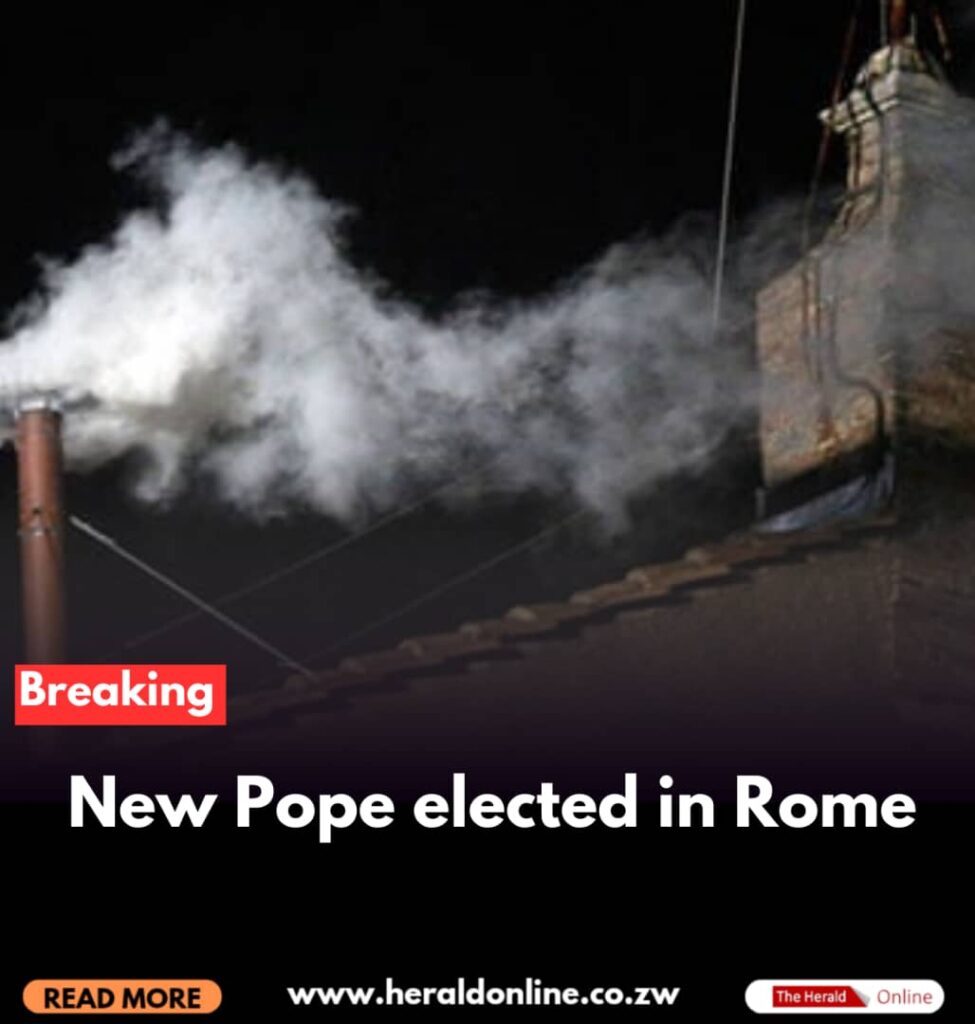
Once a successful vote is complete, the most senior cardinal asks the newly elected pope, “Do you accept your canonical election as supreme pontiff?”
After he accepts, he is then asked, “What name do you wish to be called?”
The cardinal electors then pay homage and pledge obedience to the new head of the church, and thanks are given to God while the new Pope is taken into a sacristy and fitted with papal attire.
Finally, the pronouncement is made in Latin — “I bring you tidings of great joy: We have a Pope!”) — and the new Pope gives an apostolic blessing to throngs of faithful.
The new pontiff was chosen by 133 cardinal electors by a two-thirds majority. – npr.com
Robert Prevost elected new Pope
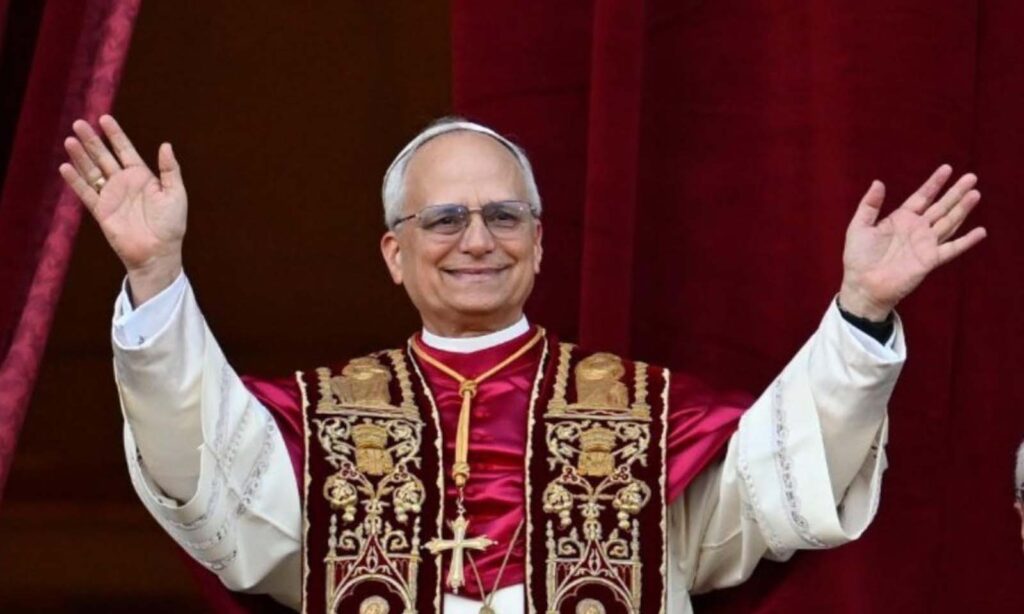
Cardinal Robert Prevost, an American missionary who spent his career ministering in Peru and leads the Vatican’s powerful office of bishops, has been elected the first American Pope in the 2 000-year history of the Catholic Church.
Cardinal Protodeacon Dominique Mamberti announces that the Cardinals have elected Cardinal Robert Francis Prevost, who took the name Pope Leo XIV.
Pope Leo XIV greets the world for the first time