


 peter
peter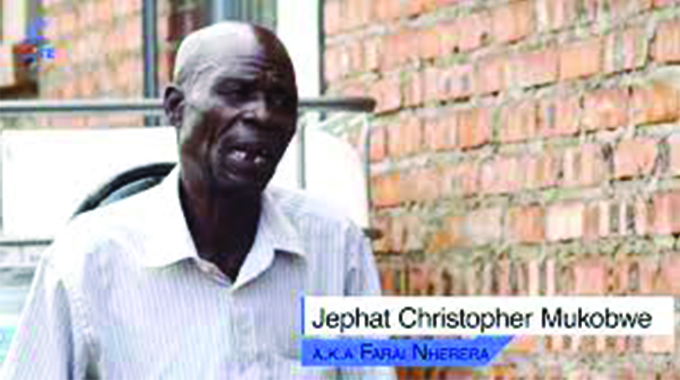
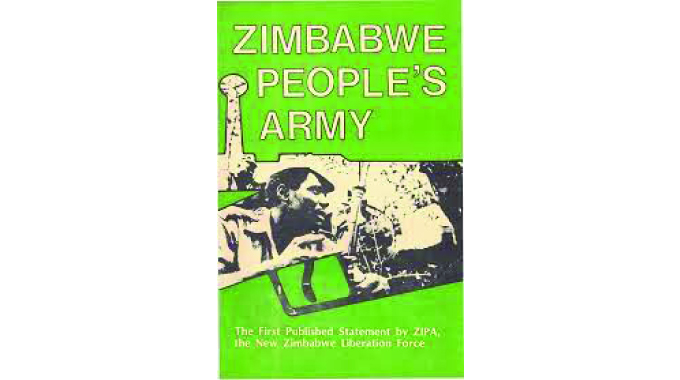
CDE Jephat Christopher Mukombwe pseudo name Cde Farai Nherera at some point had to go under cover and work as a herdboy in Namande area of Mwenezi District in Masvingo Province to fool the Rhodesian forces during the armed struggle. Now the only survivor of a ZPRA section of seven that came out of Mozambique when the Zimbabwe People’s Army (Zipa) collapsed and based in Mwenezi, Cde Mukombwe is still carrying the scars of the armed struggle and at one point he says he had to be operated on to remove a bullet that was lodged in his body. Our Assistant Editor Mkhululi Sibanda (MS) on Thursday spoke to Cde Mukombwe, a native of Hwange District in Matabeleland North Province and he took the opportunity to appeal to the authorities to assist him with equipment especially agricultural implements like a tractor so that he can start an income generating project in his rural home of Sidinda in Hwange.

Cde Mukombwe says he is economically depressed and is appealing for any form of assistance. Cde Mukombwe also spoke about the “not so recognised role” the Tonga speaking people of Binga and Hwange districts played during the armed struggle. He feels their role is not played up despite the fact they also took part in the armed struggle and gave an example of his family which he says of the four sons his father had, three of them took part in the armed struggle. He says as for the villagers they were the first port of call for guerillas deployed from Zambia and like all Zimbabweans they provided intelligence and logistical support for the freedom fighters, a development that invited the ire of the Rhodesian forces. Below are excerpts of the interview. Read on . . .
MS: May we begin our interview by you telling us about yourself. Who is Jephat Christopher Mukombwe?
Cde Mukombwe: I was born on 7 January 1955 at St Mary’s in Hwange District, Matabeleland North Province. I grew up at our rural home in Sidinda and unlike other people, I never went to school. That was because there were no schools in my area. People in my area who went to school were those whose fathers were working for Wankie (Hwange) Colliery Company. My father was one of the locals who eked out a living from fishing in the Zambezi River, a trade which I also adopted. This was the trade that was to contribute to me leaving the country to join the armed struggle. My father had four sons and three of us crossed into Zambia to join the armed struggle. I joined the armed struggle in 1973 while my brothers David and Sipho crossed together the following year. However, our elder brother Phineas did not take part in the armed struggle, he worked for the Colliery.
MS: What were the circumstances that led you to join the armed struggle?
Cde Mukombwe: It had to do with the presence of the freedom fighters, ZPRA guerillas in our area. I started getting into contact with the freedom fighters as from 1971. The first comrades I came across were David Thodlana (late Tshaka Moyo), who went on to become a senior ZPRA intelligence officer, Max and Mthimkhulu. They would cross the Zambezi River from the Zambian side where they had their forward bases and come on our side. They would visit our fishing camps as at that time I had also become a fisherman just like my father. They would give us tasks such as monitoring the movement of Rhodesian soldiers.
The guerillas would also explain to us the objectives of the armed struggle. Then in 1973 although I am no longer sure of the exact month the Rhodesian soldiers came and camped at the District Commissioner’s house. Those soldiers came to us to ask about the whereabouts of the freedom fighters. I think the guerillas were also monitoring the Rhodesian soldiers’ movements from across the Zambezi River using binoculars because after two days they emerged on our side and asked us where the white soldiers were. They came to our fishing camp between 8 and 9pm. I was with my uncle, umalumami. They asked us to go and show them where the Rhodesian soldiers were spending the night. We complied and showed them the direction to the Rhodesian camp.
The guerillas then took over and carried out some reconnaissance on the Rhodesian base. It was Thodlana who went there first and came back to report to his colleagues that there were 14 Rhodesian soldiers. However, I had told the guerillas that there were 16 soldiers. Cde Mthimkhulu went there to reconnoitre as well. Cde Max remained with others, on that day the guerillas were six. They then decided to attack the camp and before the attack they had planted a landmine at a road which led to the Rhodesians’ camp. The attack was guerilla style as the comrades quickly retreated after opening fire at the camp and came to where I and my uncle, Mixon Mugoda were. There was also my cousin, Joe Ngwenya. They then told us to leave the fishing camp and go back to our home. However, my uncle told them that we would be targeted by the Rhodesians, so our lives were in danger.
The guerillas then resolved to take us to Zambia to join the armed struggle. That is how I joined the liberation war.
MS: Then take us through your journey to join the armed struggle.
Cde Mukombwe: We crossed the Zambezi River at around 2am and a few hours later the Rhodesian forces were in hot pursuit. We then got to Ngwemanzi where there was a big ZPRA base and it was when we were there that we heard gun shots. The Rhodesians had encountered a ZPRA unit that we had left behind. The guerillas then decided to evacuate us from Ngwemanzi and took us to Nemaduba, another base where we stayed with four guerillas. Then after a week Cde Gordon Munyanyi, who then was the ZPRA Chief of Intelligence arrived at the camp. He took us to an area called Mutendere in Lusaka.

From there we were moved to a place near Blue Mountain. From Blue Mountain we were moved to Chakwenga where there was a camp which was later on called Mwembeshi. We stayed there for some time before being sent for full military training.
MS: As for your training when did you start and where were you trained?
Cde Mukombwe: It was at the beginning of 1974 that we were taken to Morogoro in Tanzania for our training. The command structure at Morogoro when we got there was like this, the camp commander was Cde Sam Mfakazi with Gedi (late Colonel Richard Dube) being the political commissar.
The chief of staff was Dubhu, now Brigadier-General (Retired) Tjile Nleya. Other instructors were Cde Jack Mpofu who was responsible for combat and tactics, the tough Eddie Sigoge who took us for engineering and Rodwell Nyika (late Brigadier-General Collin Moyo) among others. In my group I trained together with Cde John Nyamupingidza (Colonel Tshipa) who lives in Hwange and our group is the one that succeeded eyabo Ananias, the current commander of the Zimbabwe Defence Forces, General P V Sibanda. That group had comrades who later on went to distinguish themselves in the military such as Richard Mataure, Carlos Mudzingwa, Assaf Ndida who unfortunately died in combat in Zambia while on his way to deploy troops to the front. Also among that group is the former deputy commander of One Brigade, Colonel Brave Matavire and Cde Mbeya (former Midlands Provincial Medical Director, Dr Milton Chemhuru).
n To be continued next week with Cde Mukombwe talking about his deployment to Mozambique under Zipa.



 Bongani Ndlovu
 Online Reporter