Chronicle Editor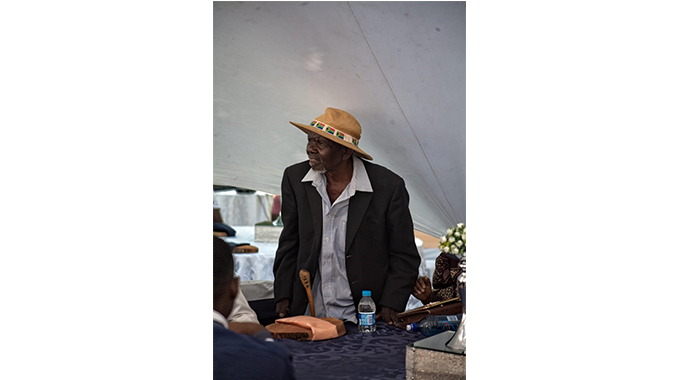
Leonard Ncube
TO many, a migrant worker is a mere foreigner who crossed into a country for employment especially in mines, railways, farms and plantations during the colonial period.
But for Andison Wanandopo Shishola, his life in Zimbabwe was more than just of a migrant worker as he contributed to the liberation struggle as a war collaborator.
While he did not directly join politics, Shishola, a Zambian by origin who was employed by the Rhodesia Railways (now National Railways of Zimbabwe), suffered at the hands of the Rhodesian authorities for supporting the liberation struggle and was sentenced to 14 years in prison in 1979.
He was detained at Hwange Prison but was lucky to be set free after only serving three months when cease fire was declared to mark the end of the liberation war.
His family is celebrating a life well lived following his death because of old age on November 28, 2020 at the age of 102 years.
Shishola was buried at his rural home in BH 3 Nyikanyolo, Jambezi under Chief Shana outside Victoria Falls.
He was born during the First World War on June 2, 1918 in Kaoma, village in Northern Rhodesia, now Zambia before migrating to Southern Rhodesia (now Zimbabwe) at the age of 19.
He had just completed Standard 2 at Luampa Mission in Zambia and was in the company of his brother who is now late when they crossed into Zimbabwe through Victoria Falls in 1937.
He briefly settled at Esikhwahleni single quarters in Victoria Falls where migrant workers were temporarily accommodated before being deployed to different areas such as South Africa where they worked in gold and diamond mines.
Some were sent to work in sugar plantations in the Lowveld, Hwange Colliery Mine and to construct the Victoria Falls Bridge and railway line locally.
Oral historians state that locals were reluctant to work in mines and farms hence the great trek of migrant workers from countries such as Zambia (then Northern Rhodesia), Malawi (then Nyasaland), Angola and Mozambique.
While some returned to their countries after Zimbabwe attained its independence in 1980, many remained in the country where they had established families.
As for Shishola, he got a job as a spanner boy at the railway company and was deployed to Gwayi Siding.
He met the late Anny Fufana Malaba Ncube who was from Vundlana in Tsholotsho while working at Gwayi Siding and the two got married in 1946.
The couple had three children namely Mbawula Ndlovu (73) who lives in Zambia, Simanyula Ndlovu-Mwanza (68) and Mathewu Ndlovu (65). Simanyula and Mathewu live in Jambezi.
Wanandopo Shishola is the same as Ndlovu in Zimbabwe which is why his children use the surname, the late old man’s granddaughter Ms Karen Mwanza (41) said as she narrates his life history.
She said her grandmother passed on in 1995.
The ‘huge’ family comprises 26 grandchildren, 84 great grandchildren and 12 great-great grandchildren.
“He moved from one railway siding to the other with his family until 1959 when he decided to build a homestead in Sheleni line, Sipepa. However, in September 1979 he was arrested by Rhodesian police for accommodating and helping freedom fighters. The police found footprints of suspected freedom fighters outside his compound at the NRZ quarters.
“He was at work at that time and his roommate informed police that the freedom fighters always visited my grandfather. They arrested and detained him at Hwange Prison where he was sentenced to 14 years for working with freedom fighters. Fortunately enough, there was ceasefire and he was set free after serving only three months,” said Ms Mwanza.
She said he continued working at NRZ after independence.
Ms Mwanza said her grandfather relocated from Tsholotsho in 1984 at the height of Gukurahundi as his family was tortured for being aliens.
“In 1984 he relocated with all his children from Tsholotsho and built a home in Jambezi. We were told that he feared for his life since he was an alien which is why he left Tsholotsho and settled in Jambezi where it was safe,” she said.
She described her grandfather as a God fearing man. He went to United Apostolic Faith Church.
There was something interesting about him, she says.
“He usually sat under a mulberries tree during the day reading the Bible. In his old age he would ask one of the grandchildren to read for him. In the evenings he enjoyed telling folktales to his grandchildren.
“He loved his livestock. He had a herd of donkeys that he loved so much and would shout at the herd boys if some went missing. He would mix IsiNdebele and Nkoya languages and I remember his famous statement: “Antii angaphi amathonki namuhla awusingwebi (Andy, where are the donkeys? Today you won’t eat) referring to one of his grandsons Andison who was named after him,” said Ms Mwanza.
His original language was Zambian Nkoya and he also spoke IsiNdebele and Nambya.
“His death robbed us of our pillar. We loved him and he always made us happy. He loved eating traditional foods such as cassava with tea, inkobe and peanut butter. He loved fishing. We will always remember one story about him when one day he went fishing and brought a tortoise which he asked his wife to cook for him. Grandmother made everyone laugh when she said that none of her pots would be used for cooking a tortoise. He didn’t get angry. He was full of love and kindness which is why he found favour in God. He loved helping the needy and orphans and we wish him eternal peace in his resting place,” said Ms Mwanza.
She said her grandfather last visited Zambia in 2000 when his passport expired.
The family celebrated his centenary birthday two years ago.
At the time of his death he wanted to visit his kinsmen in Zambia, Ms Mwanza said.
“Two weeks before his death he always spoke about wanting to visit Zambia. As I was leaving home he told me not to forget to bring him lollipops and tomato sauce. Those were his last words to me.
“He loved sweets and would always say don’t buy me clothes because I am no longer into fashion but I want sweets and tomato sauce. Whenever we visited home we would make sure we had those things. He had a portable radio that was always by his side because he loved to listen to news on radio and follow current affairs. — @ncubeleon


 Online Reporter