admin
admin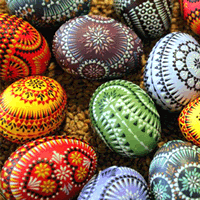
Jesus rose from the dead on the third day after his crucifixion.
His resurrection is celebrated on Easter Day or Easter Sunday (also Resurrection Day or Resurrection Sunday). The chronology of his death and resurrection is variously interpreted to be between AD26 and 36, traditionally 33.
Easter marks the end of Lent, a 40-day period of fasting, prayer, and penance.
The last week of the Lent is called Holy Week, and it contains Good Friday, commemorating the crucifixion and death of Jesus. Easter is followed by a 50-day period called Eastertide or the Easter Season, ending with Pentecost Sunday.
Easter is a moveable feast, meaning it is not fixed in relation to the civil calendar. It occurs during the spring, in March or April; the method for determining the date of Easter Sunday is complex, based on lunisolar calendar.
Easter is linked to the Jewish Passover by much of its symbolism, as well as by its position in the calendar.
In most European languages the feast called Easter in English is termed by the words for passover in those languages and in the older English versions of the Bible the term Easter was the term used to translate passover.
Easter customs vary across the Christian world, but decorating Easter eggs is a common motif. In the Western world, customs such as egg hunting and Easter Bunny extend from the domain of church, and often have a secular character.
Theological significance
The New Testament teaches that the resurrection of Jesus, which Easter celebrates, is a foundation of the Christian faith (1 Corinthians 15:12-20).
The resurrection established Jesus as the powerful Son of God Romans 1:4 and is cited as proof that God will judge the world in righteousness. Acts 17:31 God has given Christians “a new birth into a living hope through the resurrection of Jesus Christ from the dead” (1 Peter 1:3).
Christians, through faith in the working of God (Colossians 2:12) are spiritually resurrected with Jesus so that they may walk in a new way of life (Romans 6:4).
Easter is linked to the Passover and Exodus from Egypt recorded in the Old Testament through the Last Supper and crucifixion that preceded the resurrection. According to the New Testament, Jesus gave the Passover meal a new meaning, as he prepared himself and his disciples for his death in the upper room during the Last Supper.
He identified the loaf of bread and cup of wine as symbolising his body soon to be sacrificed and his blood soon to be shed. 1 Corinthians 5:7 states: “Get rid of the old yeast that you may be a new batch without yeast – as you really are. For Christ, our Passover lamb, has been sacrificed”; this refers to the Passover requirement to have no yeast in the house and to the allegory of Jesus as the Paschal lamb.
One interpretation of the Gospel of John is that Jesus, as the Passover lamb, was crucified at roughly the same time as the Passover lambs were being slain in the temple, on the afternoon of Nisan (14. Exodus 12:6).
Christian denominations and organisations that do not observe Easter
Along with Christmas celebrations, Easter traditions were among the first casualties of some areas of the Protestant Reformation, being deemed “pagan” by some Reformation leaders.
Other Reformation Churches, such as the Lutheran, Methodist, and Anglican, retained a very full observance of the Church Year. In Lutheran Churches, not only were the days of Holy Week observed, but also Christmas, Easter and Pentecost were observed with three day festivals, including the day itself and the two following.
Some Christians (usually, but not always fundamentalists), however, continue to reject the celebration of Easter (and, often, of Christmas), because they believe them to be irrevocably tainted with paganism and idolatry.
Their rejection of these traditions is based partly on their interpretation of 2 Corinthians 6:14-16. Additionally, some Christians who do celebrate the event prefer to call it “Resurrection Sunday” or “Resurrection Day” due to the pagan associations of the word “Easter”, as well as to distinguish the religious celebration from more secular or commercial aspects of the holiday such as the Easter Bunny.
Does Easter have roots more pagan than Christian? And if so, is this a problem?
Most of our holidays have “pagan origins”. This was quite intentional as the leaders of the Church at various times wanted to transform pre-Christian holidays to a Christian purpose.
Rather than trying to outlaw a “pagan” festival, why not simply change the meaning of the celebration? Seems sensible to me.
Easter is, of course, the celebration of Christ’s resurrection. As is the case with most Christian holidays, it commemorates an event in the life of Christ – this is its biblical foundation. Why are Easter and Christmas for that matter not mentioned in the Bible?
Simply because when the New Testament books were written these holidays were in a formative stage, just as was Christian worship and prayer life itself.
Why are customs that seem to have little to do with the central idea of Easter still so widely practised, such as decorating Easter eggs, or consuming tonnes of chocolate candy?
Simply because these are popular activities that people would continue to engage in even if the Church made a major effort to “purify” the holiday. (Also, many businesses thrive through the manufacture and sale of holiday related products.)
When you think about it, almost everything we do in church or as part of our Christian life has “pagan” origins. Prayer, public worship, the reading of scripture, the building of churches, the election of church officers, taking up an offering, the appointing or ordination of clergy, preaching, missionary activity among the poor. You name it; it has pagan roots. If we were to abandon everything that has pagan roots, there would be nothing left.
Easter eggs are traditionally connected with rebirth, rejuvenation and immortality. This is why they are often associated with Easter.
In the early Christian calendar eggs were forbidden during Lent. This made them bountiful and exciting 40 days later. Easter eggs are sometimes decorated with bright colours to honour this celebration. Russian pysanki is one of the most elaborate forms. Conversely, the abstinence of eggs is associated with Lent.
Eggs were coloured, blessed, exchanged and eaten as part of the rites of spring long before Christian times. Even the earliest civilisations held springtime festivals to welcome the sun’s rising from its long winter sleep. They thought of the sun’s return from darkness as an annual miracle and regarded the egg as a natural wonder and a proof of the renewal of life.
As Christianity spread, the egg was adopted as a symbol of Christ’s Resurrection from the tomb. For centuries, eggs were among the foods forbidden by the church during Lent, so it was a special treat to have them again at Easter.
Where did the Easter Bunney come from?
Among the most familiar Easter symbols is the rabbit. The Easter bunny or rabbit is . . . most likely of pre-Christian origin.
The rabbit was known as an extraordinarily fertile creature, and hence it symbolised the coming of spring. Although adopted in a number of Christian cultures, the Easter bunny has never received any specific Christian interpretation.
This delightful custom, like the Christmas tree, was introduced to America by people of German descent. The Pennsylvania Dutch imported the Oschter Haws, or Easter Hare, who delivered coloured eggs to good children.
By the early 19th century, entire Pennsylvania Dutch villages would turn out with gaily decorated Easter eggs to play games, including egg-eating contests. – wikipedia/godweb.org/food time line.org



 Online Reporter