Kudzanai Sharara in Cape Town, South Africa
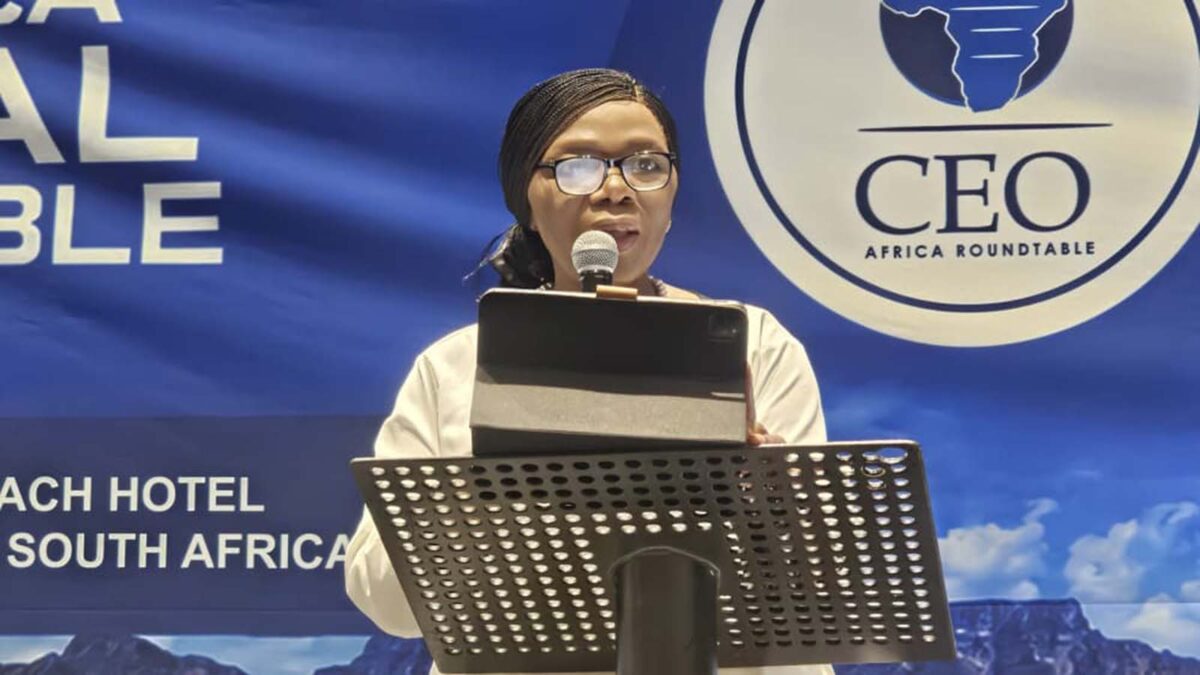
Prof Thuli Madonsela, Director of the Centre for Social Justice at Stellenbosch University, has said Africa’s habit of looking outward for trade and technological solutions is a trap, arguing that the continent has the skills, institutions and confidence to solve its own problems — and warning that operating on someone else’s terrain amounts to a new form of feudalism.
Speaking at the CEO Africa Annual Roundtable in Cape Town, Prof Madonsela traced the problem to how the continent understands itself, beginning with the way its history is taught.
“One of the mistakes we do in this continent is we teach history starting from colonialism. In South Africa, we tend to start in 1652,” she said. “It’s as if we have no history.”
She said the consequence is a distorted self-image passed to children. “What are we instilling unintentionally in our children? Is the moving from the base of deprivation,” she said. “From the neuroscience point of view, it does not activate those genes of excellence.”
Prof Madonsela said she only learned a decade ago that Africans invented mathematics. “It took a Jewish South African professor at Cambridge to convince me that we Africans invented mathematics. And I only learned that 10 years ago,” she said.
She said this explains why African pupils perform well in mathematics competitions, and noted that the world’s first university was on the continent — a fact, she said, that most Africans do not know. She cited binary numeration systems and astronomy methodologies found across Africa as further evidence.
“I’m not talking about this for nostalgia. I’m mentioning this to show we were able to do these things,” she said. “But more importantly, we were trading inside the continent.”
She argued that ignorance of this heritage constrains ambition. “We don’t know what we can do, and therefore we submit to what we’re told we can do,” she said.
Turning to trade, Prof Madonsela said Africa’s instinct to look abroad is the trap. She said the continent was conquered starting with Egypt because it was “the bread basket”, and drew a lesson from that history.
“Maybe instead of buying from these guys, why don’t we just take the whole chicken? You don’t have to buy the eggs,” she said.
She contrasted Africa’s outward gaze with the internal confidence other regions place in one another. “Because of their whole trust in each other — that’s called confidence in what each other can do — we look outside,” she said, describing this as “the trap of our outward eye when we’re looking at trade”.
Prof Madonsela singled out colleagues from across the Limpopo River as an example of African-led technological problem-solving.
“Many of the colleagues coming from across the Limpopo River just show you what you are doing with technological developments as solutions to current problems,” she said.
She said institutions in the region are not seeking technology solutions from outside. Instead, they have deployed young people trained under AIMS, the African Institute for Mathematical Sciences, “to power their banks, to power their government departments”.
Prof Madonsela said the significance extends beyond skills transfer. “This is not just a matter of training those colleagues. It’s also a matter of sovereignty,” she said.
She then invoked the concept of techno-feudalism, describing it as operating on someone else’s terrain.
She said the critical ingredient is self-belief. “It takes the confidence of knowing you have the capacity to translate difficult things. It takes the ability to know that difficult does not mean impossible,” she said. She pointed to the Pyramids as enduring evidence of what the continent has been capable of, saying “those genes are still running in us”.
Prof Madonsela’s address formed part of the session “Africa’s Global Positioning in Shifting Trade & Geopolitics” at the roundtable, which runs from 6 to 10 October under the theme “The Future of Africa: Innovate, Trade and Grow”.