Kudzanai Sharara in Cape Town, South Africa
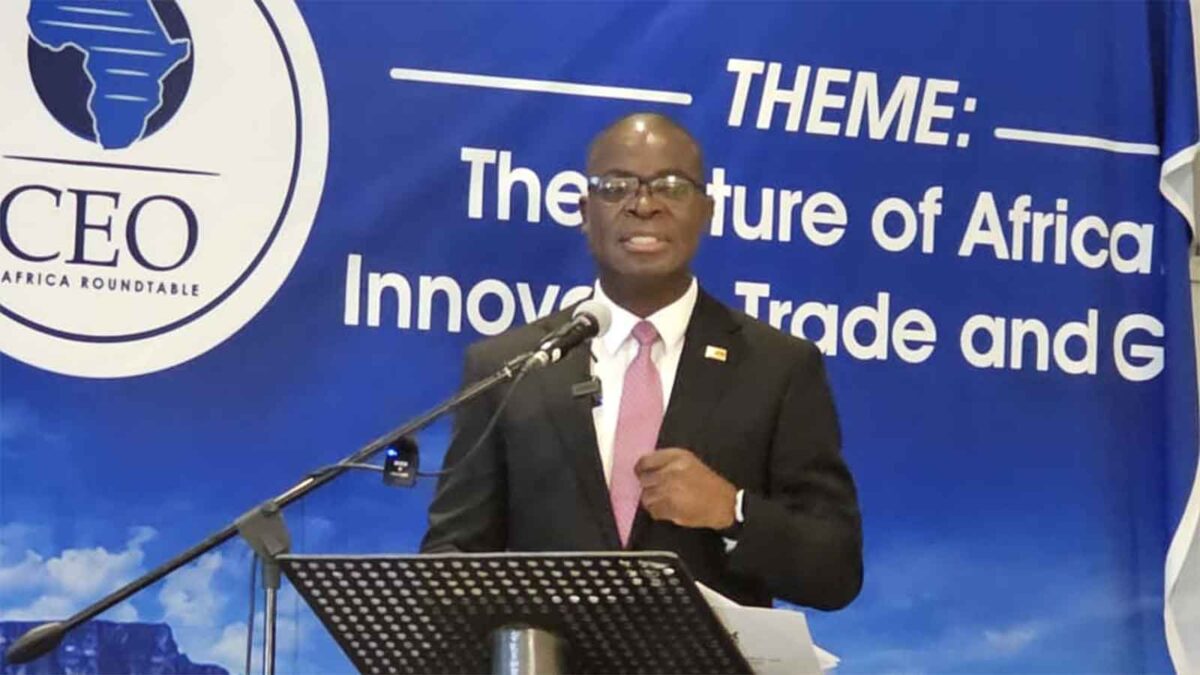
Peace is the first objective of Zimbabwe’s foreign policy, and trade is the lifeline through which prosperity is achieved, the Minister of Foreign Affairs and International Trade, Prof Amon Murwira has told delegates at the CEO Africa Annual Roundtable in Cape Town.
Speaking on the theme “Digital Infrastructure: The Backbone of African Trade”, Prof Murwira cited section 12 of Zimbabwe’s constitution, which sets out the country’s foreign policy objectives. “Our foreign policy is basically to safeguard Zimbabwe’s national interests and pursue those national interests in peace,” he said. “Because peace is the foundation of everything else that follows.”
He described peace as Zimbabwe’s “goal number one”, and said the constitution makes clear that the country’s foreign policy must be, first and foremost, non-adversarial. He said this position is reflected in the pronouncements of His Excellency, President Emmerson Mnangagwa and is stated in section 12, subsection one of the Constitution.
Prof Murwira urged all nations to resolve differences through dialogue. “Wars are caused by wrong talk, and they are solved again by right talk. So why not just adopt right talk all the time?” he said. He said Zimbabwe fought its liberation struggle under section 3 of the constitution, which he described as “the only time that we chose to be rightfully violent”. The country now pursues peace through engagement, not arms. “Our peace is through talk, not through the strength of arms, ” he said.
He said Zimbabwe must offer its partners an environment in which conflict, where it occurs, is treated as an isolated incident rather than a behavioural norm. “Let it be an incident, not a behaviour. The incident — it’s not the trend. It’s not a policy,” he said.
From that foundation, he argued, prosperity follows through trade. “Prosperity takes root through trade. Trade is the lifeline of peace,” he said. Globally, he said, Zimbabwe pursues the doctrine of “friend to all and enemy to none”, positioning itself as a peace builder, with the country “open for business as the enabler of that trend”.
Earlier, Prof Murwira challenged the way prosperity is often discussed, insisting it is neither abstract nor theoretical. “Sometimes prosperity is taken as an esoteric term. It’s not a theory at all. It’s very real. People can be prosperous and people can be poor,” he said. He defined development as “movement from poverty to prosperity”, adding that the methods and strategies employed determine whether a country succeeds or fails.
On regional relations, Prof. Murwira outlined what he called a “neighbour first” policy rooted in pan-Africanism. “By pan-Africanism, we say neighbour first policy — which means Southern Africa first, Africa and beyond,” he said. He stressed that this posture should not be mistaken for weakness, describing it as deliberate and principled.
He said it was important for Zimbabwe to open its economy to the Southern African economy and the wider African economy, in a sequence relevant to its integration agenda within COMESA and other regional frameworks. “We will open ours first, so that the rest can also” follow, he said. He used the metaphor of rain and an umbrella: “We are going to open, and be prepared to provide an umbrella. It is going to rain. But that rain is going to make the grass grow.”
Prof Murwira said African integration can only be achieved through trade, and that digital trade is the critical enabler. He attributed current friction to the historical design of African economies, which he said were oriented outwards rather than towards each other.