Remember Deketeke
Municipal Correspondent
FOR years, the Glen View Area 8 complex has been a hive of activity and enterprise, with furniture makers turning timber, paint, thinners and other materials into livelihoods for thousands of families.
But behind the bustling workshops lies a less appealing reality.
Makeshift wooden structures stand tightly packed together, narrow passageways leave little room for emergency vehicles and highly combustible materials are often kept alongside finished furniture.
Now, just a few kilometres away, a very different picture is beginning to emerge.
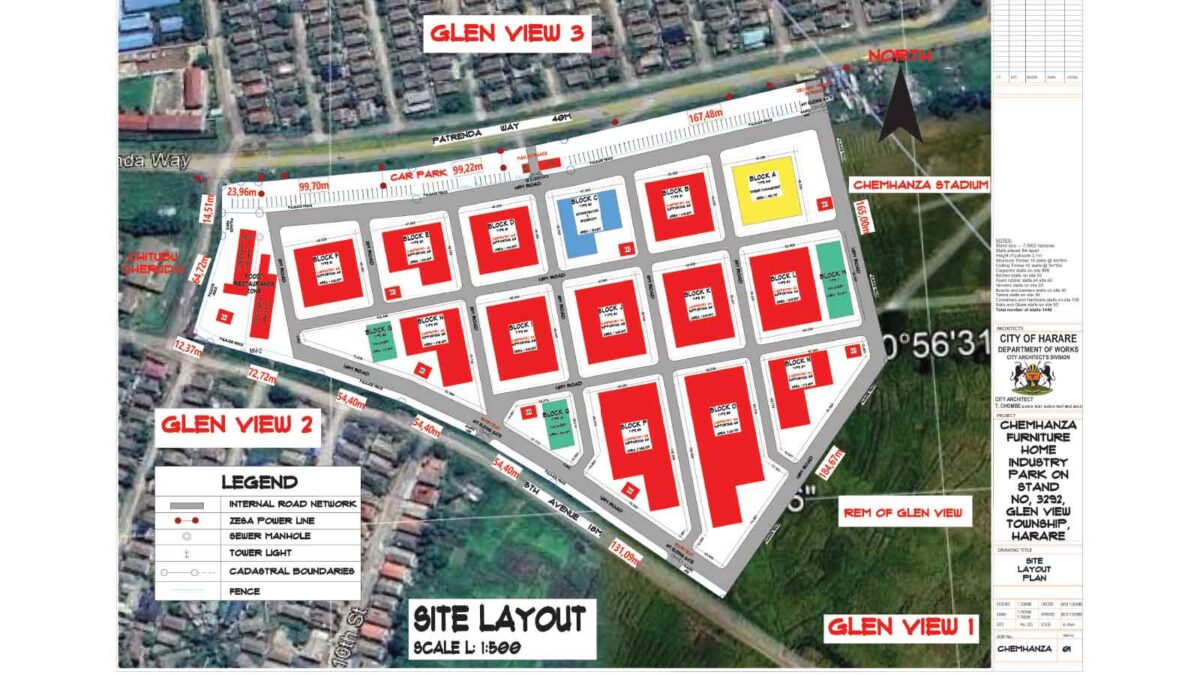
Construction is underway at the Chemhanza Grounds in Glen View 3 to establish a five-hectare furniture home industry park.
Designed to accommodate approximately 3 500 entrepreneurs, this new facility will more than double the capacity of the Glen View Area 8 complex.
Moving away from a sprawling maze of improvised workshops, the new facility is designed as an orderly industrial hub. The development integrates proper roads, water and sewer infrastructure, modern ablution facilities and robust safety measures from the ground up.
The project is part of the Government’s broader push to modernise urban infrastructure while creating safer and more suitable spaces for the country’s growing informal and small-scale business sector.
During a tour of infrastructure projects in Harare Metropolitan province last week, Acting Information, Publicity and Broadcasting Services Minister Professor Paul Mavima said Chemhanza represented a collaborative effort involving the Government, the City of Harare and civil society.
The objective, he said, was to give entrepreneurs operating in dangerous conditions a safer and more organised place to work.
“Our purpose today is to review the projects that are running within the metropolitan province. The Second Republic is on steroids as far as the development of basic infrastructure and urban social amenities is concerned,” Prof Mavima said.
He said the project was particularly important for furniture manufacturers at the Glen View Area 8 complex, where the existing environment had become increasingly difficult to manage.
“We want Harare to know what is happening, and here we have a project that is a collaboration between the City of Harare, Central Government, as well as civil society, where we want to provide working spaces for our entrepreneurs who have been operating in the fire-prone area of Glen View Area 8,” he said.
At Chemhanza, the emphasis is not simply on putting up new buildings.
The development is being planned around the needs of traders who will eventually occupy the site.
Ablution facilities and potable water infrastructure are being put in place. At the same time, construction of roads is going on.
The supporting infrastructure is intended to make the site functional and accessible before the trading structures themselves are completed.
According to Prof Mavima, the structures will incorporate fire-resistant features, while the surrounding environment will include fire guards and other measures aimed at containing outbreaks before they become disasters.
“The designs that are coming out here are very much fire-resistant, in terms of the structures that are going to be put up, but also in terms of the environs. Fire guards are going to be there,” he said.
That represents a major departure from the current situation at the Glen View Area 8 complex.
What began almost two decades ago as a cluster of informal workshops gradually expanded into a vast furniture-manufacturing centre, with traders adding structures and extending their operations as demand for working space grew.
Over time, the site became increasingly congested.
Wooden stalls were built side by side, with limited firebreaks and escape routes.
Narrow passages became even more restricted as traders sought to maximise every available space. For furniture manufacturers, the danger is particularly acute.
Paint, thinners, fuel, sawdust, timber and finished furniture can all become fuel for a rapidly spreading fire.
When water supplies are unreliable and emergency access is restricted, a small blaze can quickly turn into a major disaster.
Fire hydrants at the old site have also been vandalised or blocked, often leaving firefighters dependent on water bowsers that can take valuable time to reach the affected area.
Chemhanza is intended to address many of those weaknesses by making safety part of the planning process rather than trying to retrofit it onto an already congested settlement.
The intervention follows the declaration of a State of Disaster by President Mnangagwa in July last year following an inferno that razed the complex, bringing together Government agencies, including the Department of Civil Protection, in efforts to find a long-term solution.
With land already secured and infrastructure taking shape, Chemhanza offers a glimpse into what informal enterprise could look like when it is supported by deliberate urban planning. But there is still work to be done.
Prof Mavima acknowledged that financing challenges had slowed progress and said the Government would explore ways of mobilising additional resources to accelerate construction.
“We have been told that there are some hiccups here and there with financing, and we will sit down as Government to find financial engineering models that can quicken the process of construction because we want this to be completed as quickly as possible,” he
said.
Once completed, the five-hectare site is expected to accommodate about 3 500 entrepreneurs. For a sector accustomed to making do with whatever space is available, Chemhanza promises something different: a purpose-built home where roads, water, sanitation, trading spaces and fire safety are planned together.