admin
admin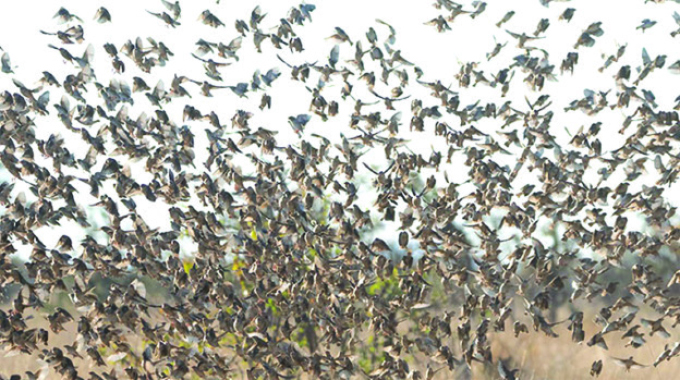
Precious Manomano
Herald Reporter
With a record wheat crop now growing, a major effort to ensure that the quelea birds, “feathered locust” are tracked and controlled with surveillance teams in place and the necessary chemicals for control acquired.
Currently, quelea birds have been reported in Karoi and Magunje areas of Mashonaland West and Mutare area of Manicaland. But flocks can breed fast so continual surveillance and prompt effective action is needed.
In its weekly update, Agricultural and Rural Development Advisory Services (ARDAS) indicated that the Government has acquired chemicals to control the pests and surveillance teams are in place countrywide.
“Quelea bird sightings have been reported in Karoi and Magunje and Mutare. The team is currently on the ground for assessments. All main problem bird units in West Nicholson, Darwendale, Bindura and Birchenough Bridge have a minimum of 150 litres of Fenthion 640 ULV available for controls. Surveillance is ongoing for scouting new roosting sites in all provinces across the country. Fenthion 640ULV delivery is expected anytime soon from both the local and international suppliers,” said the department.
Each tiny bird can feed on four grams of wheat per day and experts say a flock of a million birds, and flocks can get that large, can cause losses exceeding 40 000 tonnes when the quelea birds invade fields in large flocks.
The red-billed quelea is a small weaver bird native to sub-Saharan Africa and renowned for its attacks on small-grain crops within Africa. It is the most numerous bird species in the world, with a peak post-breeding population estimated at 1,8 billion.
Nomadic super-colonies can grow to millions of birds, making quelea not only the most abundant bird in the world but also the most destructive to cereal grains, especially sorghum and millets as well as wheat, rice and barley.
The birds are too small to attack maize, but smaller grains are vulnerable. They are naturally eaters of grass seeds, but farmers planting the smaller grains provide a vast reservoir of potential food allowing flocks to expand to far beyond their original natural size.
Government has also procured drones to control infestation of quelea birds so as to secure wheat production as it moves on to step up ways to digitalise the economy.
The drones can deliver the anti-quelea chemicals to roosting flocks far more cheaply and quickly than the light aircraft once commonly used. The drones will be distributed in provinces for the crop specialists to use. Authorities are making efforts to make sure that all farming and settled areas across the country are free from these pests, hence farmers should embrace new technologies to boost agricultural operations.



 Online Reporter